|
|
5LO38I CRT Tube 5 |
x 1 | |
|
|
12V to 300 V boost converter module |
x 1 | |
|
|
Linear Regulator with Adjustable Output |
x 1 | |
|
|
Resistors and capacitors |
x 1 | |
|
|
Small neon lamp |
x 1 |

|
Soldering Iron Kit |
DIY simplest small CRT Oscilloscope
An oscilloscope is a measuring instrument used to visualize and analyze electronic signals. It is commonly used in various fields, including electronics, telecommunications, engineering, and physics. Overall, oscilloscopes are essential tools for engineers, technicians, and scientists involved in electronics and signal analysis, enabling them to visualize, measure, and diagnose electrical waveforms accurately.

Nowadays, analog (CRT) oscilloscopes are no longer produced, but only digital ones, due to their huge advantages. One of the advantages of analog oscilloscopes is real-time, high-resolution imaging of the signal, and also easier to use than digital oscilloscopes.
In this video I will present to you the simplest possible way to make a retro-style analog oscilloscope with a cathode ray tube (CRT).
A cathode-ray tube (CRT) is a vacuum tube containing one or more electron guns, which emit electron beams that are manipulated to display images on a phosphorescent screen. A CRT tube can be obtained on the Internet for a relatively low price, and depending on the dimensions, it ranges from $20 and up.

And at the beginning, let me say that this is not a serious instrument, but only a demonstration model to describe the way these instruments work.
In previous years, this device has been described in several magazines and portals, but I could not find any pictures or a video presentation of its operation anywhere. So I decided to make it and present the results to you. As the title suggests, the device is extremely simple and consists of several components:
- The main part is the cathode ray tube, and in my case it is a miniature CRT marked 5LO38I with a diameter of only 5cm.
- An electronic part that is extremely simple, and consists only of a few resistors and capacitors.

- LM317 adjustable voltage regulator and two resistors to get the 6.3V needed for the tube heater.
- and power supply - this part is the most common reason why we do not start making devices with electronic tubes. Namely, for their normal operation, high voltages are needed, usually more than 200V, and such power supplies with a classic transformer are bulky and expensive. Specifically for this purpose I used this small compact boost converter which costs only 3 dollars and with 12V at the input gives an output of 45 to 400 Volts, which can be changed continuously with a small potentiometer. The power is quite sufficient for any CRT tube..

And now let's explane how this small oscilloscope works.
The input signal is fed to the Y input via a suitable capacitor to one of the Y deflection plates. For X deflection we use a neon lamp oscillator to generate a timebase, and with a focus regulator circuit we have a complete oscilloscope. Operation of the horizontal deflection oscillator is visible as the gentle flickering of the neon lamp. Whenever the voltage across the parallel-connected capacitor reaches the strike voltage of the lamp, it is discharged with a brief pulse of current. It is hard to imagine a simpler way to generate a sawtooth waveform.
Now, if a signal is applied to the Y input, we should be able to see the waveform on the screen. So, I have shown how little circuitry is required to make a real working oscilloscope.

Let me mention that this device is double isolated from the city voltage network. Once in the external power supply, and the second time in the boost converter.
At first start, it takes a certain amount of time for the cathode to start emitting electrons and an image appears on the screen. Now we will feed the sinusoidal signal generated by this tone generator to the input.

The shape of this signal appears on the screen. We can see that we get a stable image only at certain frequency values because, for the sake of simplicity, the device does not contain a trigger circuit. ( We can also look at the shape of the square wave generated by this small generator. ) If we increase the amplitude of the input sinusoidal signal, the peaks of the sinusoid will be cut off, and thus a trapezoidal signal is obtained.

The device is installed in a suitable box made of PVC board with a thickness of 3 and 5 mm and covered with self-adhesive wallpaper.
Otherwise my intention is to make a simple horizontal and vertical signal amplifier in the future and adapt this small CRT screen for a simple Arduino Oscilloscope clock. Hopefully an oscilloscope clock project will follow soon in one of my next videos.


DIY simplest small CRT Oscilloscope


Raspberry Pi 5 7 Inch Touch Screen IPS 1024x600 HD LCD HDMI-compatible Display for RPI 4B 3B+ OPI 5 AIDA64 PC Secondary Screen(Without Speaker)
BUY NOW


- Comments(0)
- Likes(7)

More by Mirko Pavleski
-
 Arduino 3D Printed self Balancing Cube
Self-balancing devices are electronic devices that use sensors and motors to keep themselves balanc...
Arduino 3D Printed self Balancing Cube
Self-balancing devices are electronic devices that use sensors and motors to keep themselves balanc...
-
 Building a Mini Fostex Horn Speaker with a 2-Inch Full-Range Driver
A back-loaded horn speaker is a loudspeaker design that channels the rear sound wave of a driver th...
Building a Mini Fostex Horn Speaker with a 2-Inch Full-Range Driver
A back-loaded horn speaker is a loudspeaker design that channels the rear sound wave of a driver th...
-
 ESP32 Moon Lamp That Shows the Real Moon Phase on Crowpanel Round Dispaly
Recently on the Hackaday portal I came across a very interesting project called Moon Display by aut...
ESP32 Moon Lamp That Shows the Real Moon Phase on Crowpanel Round Dispaly
Recently on the Hackaday portal I came across a very interesting project called Moon Display by aut...
-
 40-Year-Old DIY Power Amplifiers – Do They Still Work - 500W MOSFET & Transistor Amps
This time I want to describe my two DIY super powerful audio amplifiers that I made about 40 years ...
40-Year-Old DIY Power Amplifiers – Do They Still Work - 500W MOSFET & Transistor Amps
This time I want to describe my two DIY super powerful audio amplifiers that I made about 40 years ...
-
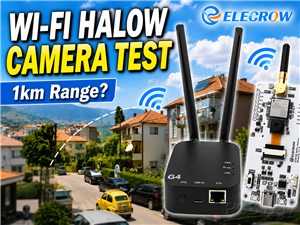 Wi-Fi HaLow Explained! Long-Range Camera Test up to 300m (ESP32 + ThinkNode G4 from ELECROW)
I recently needed to install a security camera at a relatively large distance from my home, more pre...
Wi-Fi HaLow Explained! Long-Range Camera Test up to 300m (ESP32 + ThinkNode G4 from ELECROW)
I recently needed to install a security camera at a relatively large distance from my home, more pre...
-
 Simple Object Recognition with the UNIHIKER K10 – No TensorFlow, No Internet, No Cloud AI
Object recognition has become one of the most popular applications of artificial intelligence and em...
Simple Object Recognition with the UNIHIKER K10 – No TensorFlow, No Internet, No Cloud AI
Object recognition has become one of the most popular applications of artificial intelligence and em...
-
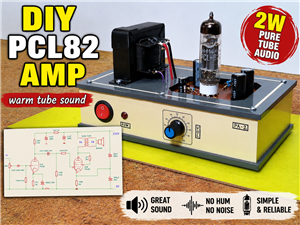 DIY PCL82 Tube Amplifier, Single-Ended Amp with Amazing Sound
The idea for this project came from a local electronics magazine called EMITER, issue 12/13 from 20...
DIY PCL82 Tube Amplifier, Single-Ended Amp with Amazing Sound
The idea for this project came from a local electronics magazine called EMITER, issue 12/13 from 20...
-
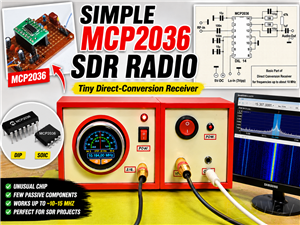 Simple MCP2036 SDR Radio - The Most Unusual Software Defined Radio
SDR (Software Defined Radio) is a radio communication system where many of the key electronic compo...
Simple MCP2036 SDR Radio - The Most Unusual Software Defined Radio
SDR (Software Defined Radio) is a radio communication system where many of the key electronic compo...
-
 Elecrow All-in-One Arduino Starter Kit Review - 20 Projects & 16 Modules
This time I will describe a simple and practical way to enter the world of microcontrollers, specif...
Elecrow All-in-One Arduino Starter Kit Review - 20 Projects & 16 Modules
This time I will describe a simple and practical way to enter the world of microcontrollers, specif...
-
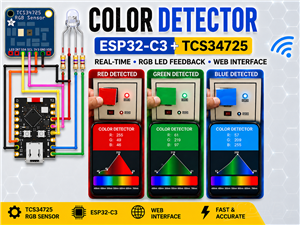 ESP32-C3 Color Detector with TCS34725, Real-Time RGB Detection & Web Interface
Color detection is a fundamental task in many embedded systems – from industrial sorting machines t...
ESP32-C3 Color Detector with TCS34725, Real-Time RGB Detection & Web Interface
Color detection is a fundamental task in many embedded systems – from industrial sorting machines t...
-
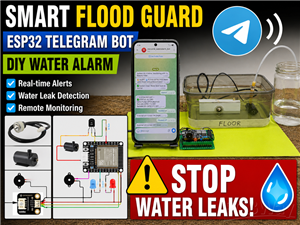 DIY ESP32 Telegram Flood Protection System - Smart Home Automation
Recently I had an unpleasant experience in my home, specifically my ground floor was flooded as a r...
DIY ESP32 Telegram Flood Protection System - Smart Home Automation
Recently I had an unpleasant experience in my home, specifically my ground floor was flooded as a r...
-
 Real-Time Air Traffic Radar using ESP32 + ADS-B Data
ADS-B, which stands for Automatic Dependent Surveillance-Broadcast, is the modern standard for trac...
Real-Time Air Traffic Radar using ESP32 + ADS-B Data
ADS-B, which stands for Automatic Dependent Surveillance-Broadcast, is the modern standard for trac...
-
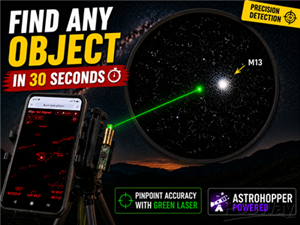 DIY Green Laser Night Sky Object Finder - Find Stars & Galaxies Instantly with great accuracy
As an amateur astronomer, especially at the beginning, the most difficult part of observing the nig...
DIY Green Laser Night Sky Object Finder - Find Stars & Galaxies Instantly with great accuracy
As an amateur astronomer, especially at the beginning, the most difficult part of observing the nig...
-
 DIY Avionics Simulator with ESP32 - Artificial Horizon, Compass & Altimeter
The inspiration for this project comes from classical aircraft cockpit instruments used for navigat...
DIY Avionics Simulator with ESP32 - Artificial Horizon, Compass & Altimeter
The inspiration for this project comes from classical aircraft cockpit instruments used for navigat...
-
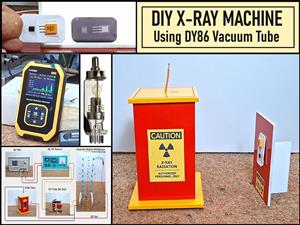 DIY Miniature X-Ray Machine using a TV Vacuum Tube DY86
An X-ray machine (or radiograph) is a quick, painless medical test that produces images of the struc...
DIY Miniature X-Ray Machine using a TV Vacuum Tube DY86
An X-ray machine (or radiograph) is a quick, painless medical test that produces images of the struc...
-
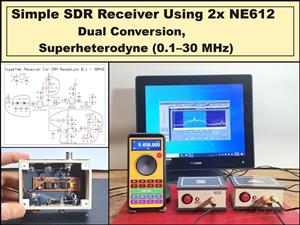 Simple SDR Receiver Using 2x NE612 - Dual Conversion, Superheterodyne (0.1–30 MHz)
SDR (Software Defined Radio) is a radio system in which most of the functions of a classic radio (f...
Simple SDR Receiver Using 2x NE612 - Dual Conversion, Superheterodyne (0.1–30 MHz)
SDR (Software Defined Radio) is a radio system in which most of the functions of a classic radio (f...
-
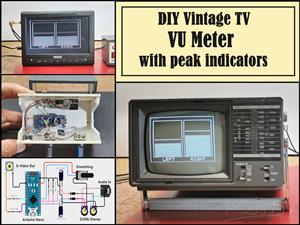 DIY Vintage TV VU Meter with peak indicators
Some time ago in one of my projects I presented you a way to turn a black and white old mini TV int...
DIY Vintage TV VU Meter with peak indicators
Some time ago in one of my projects I presented you a way to turn a black and white old mini TV int...
-
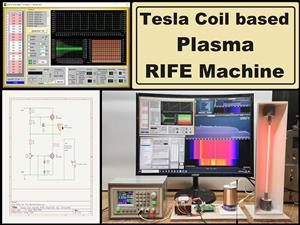 DIY Tesla Coil based Plasma Rife Machine
In several of my previous videos, I presented you with different ways to make a Rife Machine, from ...
DIY Tesla Coil based Plasma Rife Machine
In several of my previous videos, I presented you with different ways to make a Rife Machine, from ...
-
Programmable Mist Maker - XIAO / QT PY Extension
2374 2 2 -
RadioHAT - Raspberry Pi radio development platform
2058 0 4 -
-
-
-
ARPS-2 – Arduino-Compatible Robot Project Shield for Arduino UNO
4210 0 6 -
A Compact Charging Breakout Board For Waveshare ESP32-C3
4985 3 8 -
AI-driven LoRa & LLM-enabled Kiosk & Food Delivery System
5752 2 2 -