|
|
HV Neon sign Trafo |
x 1 | |
|
|
Primary coil |
x 1 | |
|
|
Secondary coil |
x 1 | |
|
|
Spark gap |
x 1 | |
|
|
Topload |
x 1 | |
|
|
HV Capacitor bank |
x 1 |

|
Soldering Iron Kit |
DIY simple Spark Gap Tesla Coil
Tesla coil is a type of resonant transformer circuit invented by Nikola Tesla around 1891. It is a high-frequency air-core transformer that produces high-voltage, low-current, and high-frequency alternating-current electricity. In general, Tesla coils can be divided into two groups, Spark Gap, and Solid State Tesla Coils. In some of my previous videos you can see some Solid State Tesla Coils made with Transistors and Vacuum Tubes. This time I will describe to you how to make a Spark Gap Tesla Coil which is actually the simplest type of Tesla Coil. I recently received as a gift, which was the main reason for starting this project.
"Spark Gap" Tesla coil consists of the following parts
- Primary Coil consisting of several turns of thick copper tube
- Secondary coil containing about 1000 turns of thin lacquered copper wire
- A high voltage source, in this case a Neon Sign Transformer
- Spark Gap
- high voltage capacitor bank
- and Toroidal Top Load Terminal

Let me briefly describe the function of each of these parts:

- The power source is this neon sign transformer with an output voltage of 8000 volts and a current of 30mA. The total power of the device depends on this transformer (the value of the output voltage, actually the length of the spark)

- The primary coil is the first coil in the transformer, typically consisting of a few turns of heavy wire, and it is connected to a power source.

- Capacitor connected in parallel with the primary coil, and it stores electrical energy during the charging phase.

- The spark gap is a switch that rapidly discharges the capacitor into the primary coil. It consists of electrodes separated by a small gap. When the voltage across the spark gap reaches a critical value, a spark jumps across the gap, allowing the capacitor to discharge rapidly.

- The secondary coil is a large number of turns of fine wire wound around the primary coil. It is not electrically connected to the primary coil but is in close proximity. The changing magnetic field induced by the primary coil in the secondary coil causes a voltage to be generated.

- And a top Load which is located at the top of the secondary coil, there is usually a toroid or a metal sphere, and this helps to concentrate the electric field and enhance the efficiency of the coil.
In an ideally tuned Tesla coil, the resonant frequency of the primary LC circuit should be equal to the resonant frequency of the secondary coil.

It is very difficult and almost impossible to achieve this by simply changing the number of windings, or the value of a capacitor bank, as most beginners in this field think. This can be achieved relatively easily using several online calculators of which I think the most used is JavaTC. Also a great source of information and online calculators is the deepfriedneon site.

For the sake of ease of manufacture and visibility, I made the Tesla coil on a flat board, but I soon realized that I could have problems with a spark jump on the HV transformer, which would be fatal for it. So for protection I installed metal mesh around the power transformer which is connected to the ground. Therefore, most often the drive part is placed under the primary and secondary coil.

And now let's see how this device works in real conditions. I should mention that for grounding I use a long metal rod stuck in wet soil.

As can be seen in the video, with a fully tuned Tesla coil I achieved a spark length of about 40+ cm, which is an good result for such a relatively small power neon sign transformer.


And finally a short conclusion. This was my first Spark Gap Tesla coil and it gave me a lot of pleasure both in making and in operation. However, it should be kept in mind that the manufacture and maintenance of such a device is relatively expensive, especially if we have to buy all the components. Fortunately, the most expensive parts, the power transformer and capacitor bank, I already had, and there was no need to buy them. Otherwise, the night view of a functioning Tesla Coil always attracts enormous attention with its audio and visual effect.
SAFETY NOTE: Please do not attempt to recreate the experiments shown on this video unless you are familiar with High Voltage Safety Techniques! Direct Current even above 60V maybe lethal, even when the AC supply voltage has been disconnected due to the stored energy in the capacitors. I have no responsibility on any hazards caused by the circuit. Be very careful. This is a humble request.

DIY simple Spark Gap Tesla Coil


Raspberry Pi 5 7 Inch Touch Screen IPS 1024x600 HD LCD HDMI-compatible Display for RPI 4B 3B+ OPI 5 AIDA64 PC Secondary Screen(Without Speaker)
BUY NOW


- Comments(0)
- Likes(0)
More by Mirko Pavleski
-
 Arduino 3D Printed self Balancing Cube
Self-balancing devices are electronic devices that use sensors and motors to keep themselves balanc...
Arduino 3D Printed self Balancing Cube
Self-balancing devices are electronic devices that use sensors and motors to keep themselves balanc...
-
 Building a Mini Fostex Horn Speaker with a 2-Inch Full-Range Driver
A back-loaded horn speaker is a loudspeaker design that channels the rear sound wave of a driver th...
Building a Mini Fostex Horn Speaker with a 2-Inch Full-Range Driver
A back-loaded horn speaker is a loudspeaker design that channels the rear sound wave of a driver th...
-
 ESP32 Moon Lamp That Shows the Real Moon Phase on Crowpanel Round Dispaly
Recently on the Hackaday portal I came across a very interesting project called Moon Display by aut...
ESP32 Moon Lamp That Shows the Real Moon Phase on Crowpanel Round Dispaly
Recently on the Hackaday portal I came across a very interesting project called Moon Display by aut...
-
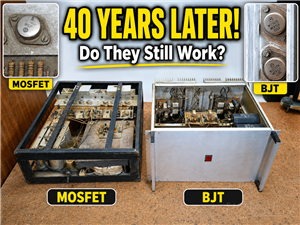 40-Year-Old DIY Power Amplifiers – Do They Still Work - 500W MOSFET & Transistor Amps
This time I want to describe my two DIY super powerful audio amplifiers that I made about 40 years ...
40-Year-Old DIY Power Amplifiers – Do They Still Work - 500W MOSFET & Transistor Amps
This time I want to describe my two DIY super powerful audio amplifiers that I made about 40 years ...
-
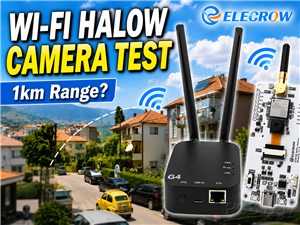 Wi-Fi HaLow Explained! Long-Range Camera Test up to 300m (ESP32 + ThinkNode G4 from ELECROW)
I recently needed to install a security camera at a relatively large distance from my home, more pre...
Wi-Fi HaLow Explained! Long-Range Camera Test up to 300m (ESP32 + ThinkNode G4 from ELECROW)
I recently needed to install a security camera at a relatively large distance from my home, more pre...
-
 Simple Object Recognition with the UNIHIKER K10 – No TensorFlow, No Internet, No Cloud AI
Object recognition has become one of the most popular applications of artificial intelligence and em...
Simple Object Recognition with the UNIHIKER K10 – No TensorFlow, No Internet, No Cloud AI
Object recognition has become one of the most popular applications of artificial intelligence and em...
-
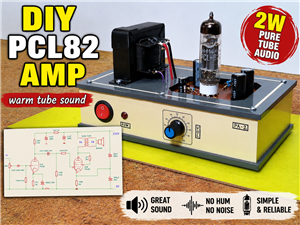 DIY PCL82 Tube Amplifier, Single-Ended Amp with Amazing Sound
The idea for this project came from a local electronics magazine called EMITER, issue 12/13 from 20...
DIY PCL82 Tube Amplifier, Single-Ended Amp with Amazing Sound
The idea for this project came from a local electronics magazine called EMITER, issue 12/13 from 20...
-
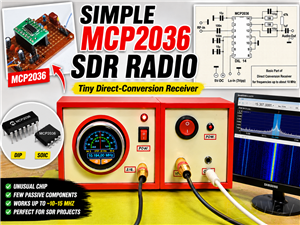 Simple MCP2036 SDR Radio - The Most Unusual Software Defined Radio
SDR (Software Defined Radio) is a radio communication system where many of the key electronic compo...
Simple MCP2036 SDR Radio - The Most Unusual Software Defined Radio
SDR (Software Defined Radio) is a radio communication system where many of the key electronic compo...
-
 Elecrow All-in-One Arduino Starter Kit Review - 20 Projects & 16 Modules
This time I will describe a simple and practical way to enter the world of microcontrollers, specif...
Elecrow All-in-One Arduino Starter Kit Review - 20 Projects & 16 Modules
This time I will describe a simple and practical way to enter the world of microcontrollers, specif...
-
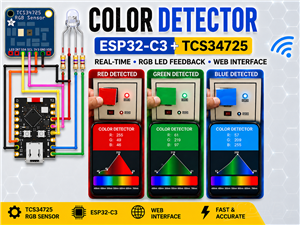 ESP32-C3 Color Detector with TCS34725, Real-Time RGB Detection & Web Interface
Color detection is a fundamental task in many embedded systems – from industrial sorting machines t...
ESP32-C3 Color Detector with TCS34725, Real-Time RGB Detection & Web Interface
Color detection is a fundamental task in many embedded systems – from industrial sorting machines t...
-
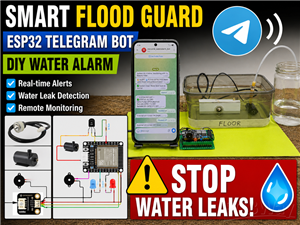 DIY ESP32 Telegram Flood Protection System - Smart Home Automation
Recently I had an unpleasant experience in my home, specifically my ground floor was flooded as a r...
DIY ESP32 Telegram Flood Protection System - Smart Home Automation
Recently I had an unpleasant experience in my home, specifically my ground floor was flooded as a r...
-
 Real-Time Air Traffic Radar using ESP32 + ADS-B Data
ADS-B, which stands for Automatic Dependent Surveillance-Broadcast, is the modern standard for trac...
Real-Time Air Traffic Radar using ESP32 + ADS-B Data
ADS-B, which stands for Automatic Dependent Surveillance-Broadcast, is the modern standard for trac...
-
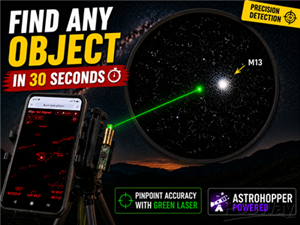 DIY Green Laser Night Sky Object Finder - Find Stars & Galaxies Instantly with great accuracy
As an amateur astronomer, especially at the beginning, the most difficult part of observing the nig...
DIY Green Laser Night Sky Object Finder - Find Stars & Galaxies Instantly with great accuracy
As an amateur astronomer, especially at the beginning, the most difficult part of observing the nig...
-
 DIY Avionics Simulator with ESP32 - Artificial Horizon, Compass & Altimeter
The inspiration for this project comes from classical aircraft cockpit instruments used for navigat...
DIY Avionics Simulator with ESP32 - Artificial Horizon, Compass & Altimeter
The inspiration for this project comes from classical aircraft cockpit instruments used for navigat...
-
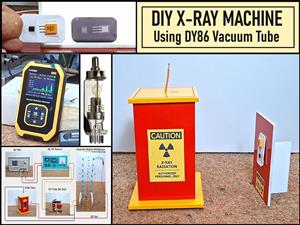 DIY Miniature X-Ray Machine using a TV Vacuum Tube DY86
An X-ray machine (or radiograph) is a quick, painless medical test that produces images of the struc...
DIY Miniature X-Ray Machine using a TV Vacuum Tube DY86
An X-ray machine (or radiograph) is a quick, painless medical test that produces images of the struc...
-
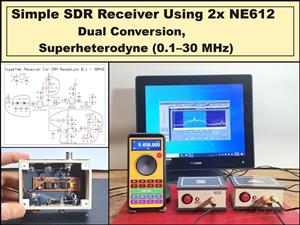 Simple SDR Receiver Using 2x NE612 - Dual Conversion, Superheterodyne (0.1–30 MHz)
SDR (Software Defined Radio) is a radio system in which most of the functions of a classic radio (f...
Simple SDR Receiver Using 2x NE612 - Dual Conversion, Superheterodyne (0.1–30 MHz)
SDR (Software Defined Radio) is a radio system in which most of the functions of a classic radio (f...
-
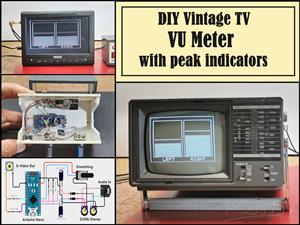 DIY Vintage TV VU Meter with peak indicators
Some time ago in one of my projects I presented you a way to turn a black and white old mini TV int...
DIY Vintage TV VU Meter with peak indicators
Some time ago in one of my projects I presented you a way to turn a black and white old mini TV int...
-
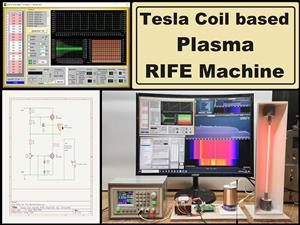 DIY Tesla Coil based Plasma Rife Machine
In several of my previous videos, I presented you with different ways to make a Rife Machine, from ...
DIY Tesla Coil based Plasma Rife Machine
In several of my previous videos, I presented you with different ways to make a Rife Machine, from ...
-
Programmable Mist Maker - XIAO / QT PY Extension
2374 2 2 -
RadioHAT - Raspberry Pi radio development platform
2058 0 4 -
-
-
-
ARPS-2 – Arduino-Compatible Robot Project Shield for Arduino UNO
4210 0 6 -
A Compact Charging Breakout Board For Waveshare ESP32-C3
4985 3 8 -
AI-driven LoRa & LLM-enabled Kiosk & Food Delivery System
5752 2 2 -