|
|
Arduino Nano R3 |
x 1 | |
|
|
8x8 Led Matrix (common anode) |
x 1 | |
|
|
Analog Accelerometer: ADXL335 |
x 1 | |
|
|
ds3231 realtime clock module |
x 1 | |
|
|
74HC595 shift register IC |
x 1 | |
|
|
Resistor 330 ohm |
x 8 | |
|
|
LDR Resistor |
x 1 |

|
Soldering Iron Kit |
|

|
arduino IDEArduino
|
Arduino Buttonless LED Matrix Clock with ADXL335 sensor
This time I will describe to you a way to make an interesting clock on an 8x8 Led matrix, that does not contain any buttons and is adjusted by different movements. This is another one of my collection of unusual clocks, which you can view on my clocks playlist. By the way, I made this clock many years ago on a homemade matrix of 64 yellow 5mm LEDs, and you can watch it at the given link.

Unlike then, this time the clock is made on a ready-made matrix, and I will also describe to you in detail the way of making it, together with the schematic diagrams, and the code.
Otherwise, this beautiful clock is the work of Mark Wilson on whose site you can view the original project.
The device is relatively simple to build and consists of several components:
- Arduino Nano Microcontroller
- 8x8 LED matrix with a common anode
- DS3231 Realtime clock module
- ADXL335 Accelerometer module
- LDR resistor
- i 74HC595 shift register IC

The project is very old and dates back to 2012, so the code needs to be compiled with Arduino IDE version 1.0.6 or older to compile without errors. The Matrix Clock folder contains all the required libraries, so no additional installations are required. Otherwise, in the "PINS" tab, a connecting diagram is presented, which contains a small error in the markings of the cathodes and anodes of the diodes in the matrix. In any case, I recommend that you use the schematic diagrams that I have presented below, and one is if you use a ready-made 8x8 matrix with a common anode, and the other is with a DIY matrix. Just to mention that the common anode and common cathode single color matrices are actually hardware identical, just the rows and columns are swapped. Also, in the original project was used an IMU sensor of the AM3X type , but since this module is no longer produced, I used the ADXL335 sensor module.

Now in order for the device to function normally, it should be in the IMU.cpp tab in the line:
return Voltage/VoltsPerG*100.0; -> to replace the value 100.0 with 150.0
The IMU sensor module should be placed exactly in that position as you see in the pictures. Now let's see how the device works in reality. This clock has several display modes that can be changed by rotating the case for 90 degrees. When switching on, the current time appears and the hour is represented in the middle with a 5×7 font, and the minutes are represented on the edges, with a resolution of 5 minutes (more precisely, the distance between two diodes is 5 minutes).

Now if we rotate it to the left by 90 degrees, it shows the current room temperature in degrees Celsius

One more time to the left by 90 degrees and we enter a mode where the time is written in words.

And with the next rotation, we get the so-called Matrix screen effect.

Finally, by rotating again to the original position, the current time is presented again
Next I will describe the setting of this clock.
- To get the Random Pseudo Words effect, we go in the following order:
Face up -> upside down
- For setting the hours the order is:
Up -> Left -> down -->> right = setted
- For setting minutes:
Repeat Up -> Left -> Down -- >> right = setted
In a similar way, we can change the sensitivity of the LDR resistor, as well as the brightness of the display.

And finally a short conclusion. Although the project is more than 10 years old, the idea of replacing mechanical buttons with an IMU sensor is excellent. Nowadays, it is possible to make such a clock with njs2812 matrix, which would be extremely simple to make, cheap, but also the possibility of many color effects. I'm suggesting this as an idea for a DIYer who is more adept at programming than I am.


Arduino Buttonless LED Matrix Clock with ADXL335 sensor








Raspberry Pi 5 7 Inch Touch Screen IPS 1024x600 HD LCD HDMI-compatible Display for RPI 4B 3B+ OPI 5 AIDA64 PC Secondary Screen(Without Speaker)
BUY NOW


- Comments(0)
- Likes(0)
More by Mirko Pavleski
-
 Arduino 3D Printed self Balancing Cube
Self-balancing devices are electronic devices that use sensors and motors to keep themselves balanc...
Arduino 3D Printed self Balancing Cube
Self-balancing devices are electronic devices that use sensors and motors to keep themselves balanc...
-
 DIY ESP32 Universal Timer with Touchscreen & Rotary Encoder
In several of my previous videos, I presented different projects based on the CrowPanel 2.1-inch HM...
DIY ESP32 Universal Timer with Touchscreen & Rotary Encoder
In several of my previous videos, I presented different projects based on the CrowPanel 2.1-inch HM...
-
 Build a Real 5-Band Parametric EQ with ESP32 + WM8960 - Stereo DSP Audio Processor
Audio equalizer (EQ) is an electronic device that allows control over the strength of different fre...
Build a Real 5-Band Parametric EQ with ESP32 + WM8960 - Stereo DSP Audio Processor
Audio equalizer (EQ) is an electronic device that allows control over the strength of different fre...
-
 Bass Reflex vs Sealed vs Horn – Same 2 inch Speaker Test
In one of the previous videos I presented the making of a miniature Horn type speaker box with a 2 ...
Bass Reflex vs Sealed vs Horn – Same 2 inch Speaker Test
In one of the previous videos I presented the making of a miniature Horn type speaker box with a 2 ...
-
 Building a Mini Fostex Horn Speaker with a 2-Inch Full-Range Driver
A back-loaded horn speaker is a loudspeaker design that channels the rear sound wave of a driver th...
Building a Mini Fostex Horn Speaker with a 2-Inch Full-Range Driver
A back-loaded horn speaker is a loudspeaker design that channels the rear sound wave of a driver th...
-
 ESP32 Moon Lamp That Shows the Real Moon Phase on Crowpanel Round Dispaly
Recently on the Hackaday portal I came across a very interesting project called Moon Display by aut...
ESP32 Moon Lamp That Shows the Real Moon Phase on Crowpanel Round Dispaly
Recently on the Hackaday portal I came across a very interesting project called Moon Display by aut...
-
 40-Year-Old DIY Power Amplifiers – Do They Still Work - 500W MOSFET & Transistor Amps
This time I want to describe my two DIY super powerful audio amplifiers that I made about 40 years ...
40-Year-Old DIY Power Amplifiers – Do They Still Work - 500W MOSFET & Transistor Amps
This time I want to describe my two DIY super powerful audio amplifiers that I made about 40 years ...
-
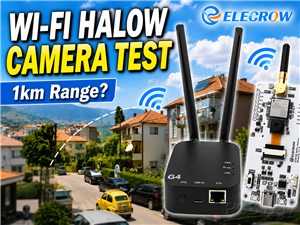 Wi-Fi HaLow Explained! Long-Range Camera Test up to 300m (ESP32 + ThinkNode G4 from ELECROW)
I recently needed to install a security camera at a relatively large distance from my home, more pre...
Wi-Fi HaLow Explained! Long-Range Camera Test up to 300m (ESP32 + ThinkNode G4 from ELECROW)
I recently needed to install a security camera at a relatively large distance from my home, more pre...
-
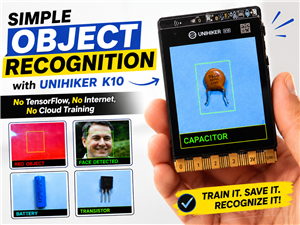 Simple Object Recognition with the UNIHIKER K10 – No TensorFlow, No Internet, No Cloud AI
Object recognition has become one of the most popular applications of artificial intelligence and em...
Simple Object Recognition with the UNIHIKER K10 – No TensorFlow, No Internet, No Cloud AI
Object recognition has become one of the most popular applications of artificial intelligence and em...
-
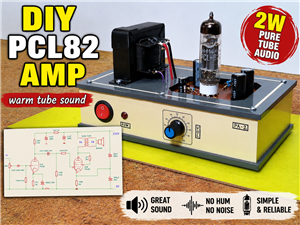 DIY PCL82 Tube Amplifier, Single-Ended Amp with Amazing Sound
The idea for this project came from a local electronics magazine called EMITER, issue 12/13 from 20...
DIY PCL82 Tube Amplifier, Single-Ended Amp with Amazing Sound
The idea for this project came from a local electronics magazine called EMITER, issue 12/13 from 20...
-
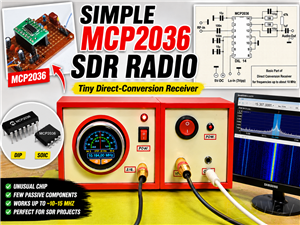 Simple MCP2036 SDR Radio - The Most Unusual Software Defined Radio
SDR (Software Defined Radio) is a radio communication system where many of the key electronic compo...
Simple MCP2036 SDR Radio - The Most Unusual Software Defined Radio
SDR (Software Defined Radio) is a radio communication system where many of the key electronic compo...
-
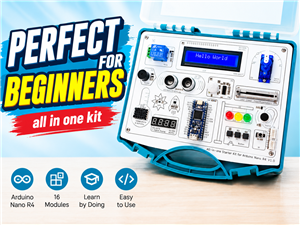 Elecrow All-in-One Arduino Starter Kit Review - 20 Projects & 16 Modules
This time I will describe a simple and practical way to enter the world of microcontrollers, specif...
Elecrow All-in-One Arduino Starter Kit Review - 20 Projects & 16 Modules
This time I will describe a simple and practical way to enter the world of microcontrollers, specif...
-
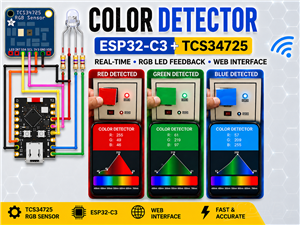 ESP32-C3 Color Detector with TCS34725, Real-Time RGB Detection & Web Interface
Color detection is a fundamental task in many embedded systems – from industrial sorting machines t...
ESP32-C3 Color Detector with TCS34725, Real-Time RGB Detection & Web Interface
Color detection is a fundamental task in many embedded systems – from industrial sorting machines t...
-
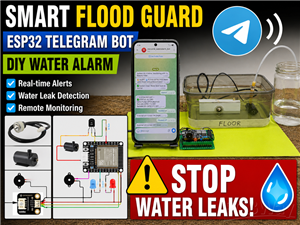 DIY ESP32 Telegram Flood Protection System - Smart Home Automation
Recently I had an unpleasant experience in my home, specifically my ground floor was flooded as a r...
DIY ESP32 Telegram Flood Protection System - Smart Home Automation
Recently I had an unpleasant experience in my home, specifically my ground floor was flooded as a r...
-
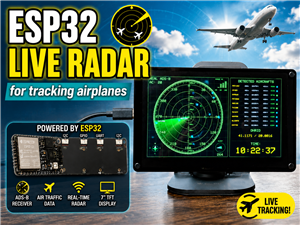 Real-Time Air Traffic Radar using ESP32 + ADS-B Data
ADS-B, which stands for Automatic Dependent Surveillance-Broadcast, is the modern standard for trac...
Real-Time Air Traffic Radar using ESP32 + ADS-B Data
ADS-B, which stands for Automatic Dependent Surveillance-Broadcast, is the modern standard for trac...
-
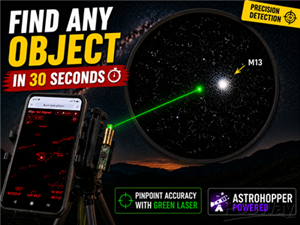 DIY Green Laser Night Sky Object Finder - Find Stars & Galaxies Instantly with great accuracy
As an amateur astronomer, especially at the beginning, the most difficult part of observing the nig...
DIY Green Laser Night Sky Object Finder - Find Stars & Galaxies Instantly with great accuracy
As an amateur astronomer, especially at the beginning, the most difficult part of observing the nig...
-
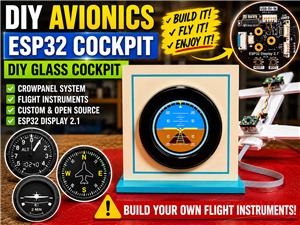 DIY Avionics Simulator with ESP32 - Artificial Horizon, Compass & Altimeter
The inspiration for this project comes from classical aircraft cockpit instruments used for navigat...
DIY Avionics Simulator with ESP32 - Artificial Horizon, Compass & Altimeter
The inspiration for this project comes from classical aircraft cockpit instruments used for navigat...
-
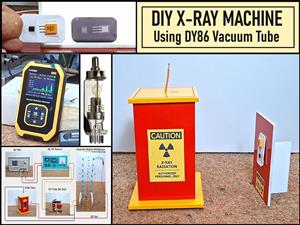 DIY Miniature X-Ray Machine using a TV Vacuum Tube DY86
An X-ray machine (or radiograph) is a quick, painless medical test that produces images of the struc...
DIY Miniature X-Ray Machine using a TV Vacuum Tube DY86
An X-ray machine (or radiograph) is a quick, painless medical test that produces images of the struc...
-
Émetteur Récepteur Optique Expérimental (communication UART ATtiny + fibre optique)
158 0 1 -
SmallOLED - Live PC Stats, Animated Clocks & Audio Visualizer
1012 0 3 -
"Talking Multimeter": Arduino-Based Speech Add-on for Multimeters with SCPI Protocol
580 0 1 -
Programmable Mist Maker - XIAO / QT PY Extension
3048 2 3 -
RadioHAT - Raspberry Pi radio development platform
2597 0 4 -
-
-