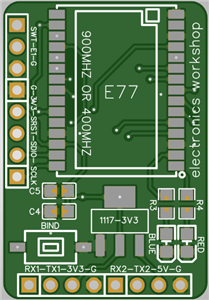
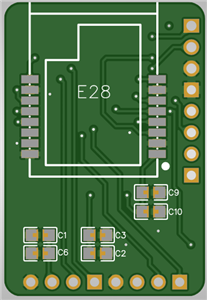
MAV link Long Range System using E77-900M22S
Introduction
The MAVLink Long-Range System (mLRS) is an open-source, bidirectional telemetry link designed for UAVs, drones, and autonomous vehicles. It uses LoRa modulation to achieve robust, long-distance, low-bandwidth communication between a ground station and a vehicle using the MAVLink protocol.
The E77-900M22S module is based on the STM32WLE5CCU6, is an ideal core for this system because it combines:
A Cortex-M4 MCU,
A LoRa transceiver (sub-GHz),
Ultra-low power consumption,
Integrated UART and GPIO interfaces.
Why E77-900M22S for MAV link Long Range?
Feature Benefit Integrated MCU + LoRaAll-in-one chip reduces component count and wiring868–930 MHz ISM bandLong range (up to 5.6 km line-of-sight)AT Command UARTEasy to interface with flight controllers or host MCUsUltra-low power sleep modeIdeal for airborne or solar-powered systemsCompact 14 × 20 mm sizeSuits small drone builds and remote sensors
E77-900M22S Feature
Features
- Under ideal conditions, using transparent transmission protocol , the communication distance can reach 5.6 km;
- Under ideal conditions, using Lo Ra W AN standard firmware, the communication distance can reach 3.5 km;
- The maximum transmit power is 21.5dBm , multi-level software adjustable;
- E77-400M22S supports the global license-free ISM 433/470MHz frequency band;
- E77-900M22S supports the global license – free ISM 868/915 MHz frequency band;
- E77-400M22S supports Lo Ra W AN 1.0.3 EU433/CN470 standard;
- E77-900M22S supports Lo Ra W AN 1.0.4 EU868/US915/AU915/AS923/IN865/KR920/RU864 standard;
- E77-400/900M22S supports two device types: Class A and Class C;
- ~12SF spreading factors launched to support dense networks ;
- 1.8 ~ 3.6 V power supply, and any power supply greater than 3.3 V can ensure the best performance;
- External crystal uses 32.768KHz high precision industrial crystal and 32MHz high precision industrial active temperature compensation crystal;
- 14.0*20.0*2.7mm small size patch package, conducive to system integration development;
- Industrial grade standard design, supports long-term use at -40~+85℃;
- Optional dual antennas (IPEX/stamp hole) facilitate user secondary development and integration;
Recommended connection diagram
 conne
conne
Lora
LoRa (short for Long Range Radio) is a type of Low-Power Wide-Area Network (LPWAN) communication technology. It is designed for long-distance wireless transmission with minimal power consumption and low operational cost. The technology is primarily developed and promoted by the international company Semtech. LoRa operates in unlicensed ISM frequency bands worldwide, including 433 MHz, 470 MHz, 868 MHz, and 915 MHz, making it suitable for a wide range of global applications.
LoRaWAN
The LoRa Alliance is a global, non-profit organization established in March 2015 under the leadership of Semtech. It introduced the LoRaWAN protocol, a low-power wide-area network (LPWAN) standard based on an open-source MAC layer.
Network Architecture:
Topology: Star network
Components:
LoRa nodes/modules
Gateways or base stations
Network server, which includes:
Network control
Application server
Device Classes in LoRaWAN:
LoRaWAN defines three types of end devices based on their receive/transmit behavior:
???? Class A – Basic Bidirectional Devices
Opens two short receive windows after each uplink transmission.
Uses ALOHA-like protocol with randomized time slots.
Most power-efficient, ideal for battery-powered devices.
The server can only send downlink messages immediately after the device’s uplink.
???? Class B – Scheduled Receive Windows
Inherits Class A features but adds scheduled receive slots.
Devices sync with gateway beacons to open receive windows at predefined times.
Allows the server to predictably send downlink messages.
???? Class C – Continuous Reception
Keeps the receive window open nearly all the time, closing it only during transmission.
Consumes more power, but provides minimal downlink latency from server to device.
Note: The E77-400M22S and E77-900M22S modules support Class A and Class C operation modes.
Use Cases
Smart agriculture & irrigation
Environmental monitoring
Industrial automation
Remote metering (gas/water/electric)
Drone telemetry
Smart cities
Schematic Diagram
 Schematic Diagram
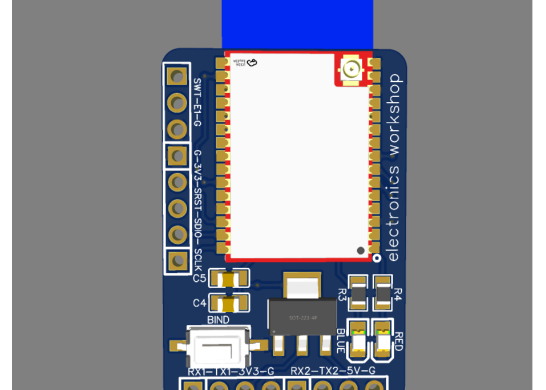
This circuit diagram represents a dual-band long-range wireless communication system based on the Ebyte E77-900M22S (sub-GHz LoRa) and E28-2G4M27S (2.4 GHz) modules. The E77 module is the primary LoRa transceiver, connected to UART2 and SPI interfaces of a host microcontroller, and is powered by a regulated 3.3 V supply from an AMS1117 voltage regulator. It includes support for LEDs to indicate transmission, reception, and network status, along with a reset and bind button for configuration or firmware upgrade. The E28 module is controlled via SPI and provides a secondary communication link, possibly used for higher-speed short-range data. Debugging and programming access are available through SWD pins, and the overall system is designed for low-power, long-range telemetry applications such as MAVLink communication in drones or remote sensing.
PCB Files
 PCB Files
3D Files


Conclusion
In conclusion, this project presents a robust and efficient dual-band telemetry communication system built around the E77-900M22S and E28-2G4M27S LoRa modules. It is specifically designed to support long-range, low-power wireless data transmission, making it highly suitable for applications like MAVLink-based drone telemetry, remote sensing, or IoT deployments. The integration of both sub-GHz and 2.4 GHz bands offers flexibility—balancing range and data rate—while onboard UART, SPI, and SWD interfaces ensure easy development, debugging, and system integration. Overall, the design demonstrates a scalable and adaptable solution for reliable, real-time communication in embedded wireless systems.
For Full Project :
https://electronicsworkshops.com/2025/06/14/mav-link-long-range-system-using-e77-900m22s/
MAV link Long Range System using E77-900M22S
Project images are for reference only. Actual production is based on the manufacturing files on the project page.
Please review the designer's notes (e.g., PCB thickness) and select the appropriate options.
PCBWay is not responsible
for issues caused by unsuitable parameter selections.
For more important ordering information, please refer to
Read More


Raspberry Pi 5 7 Inch Touch Screen IPS 1024x600 HD LCD HDMI-compatible Display for RPI 4B 3B+ OPI 5 AIDA64 PC Secondary Screen(Without Speaker)
BUY NOW

- Comments(3)
- Likes(0)
More by Rabin Poudel
-
 Automatic Water Pump Control System Using ESP-12F
IntroductionWater scarcity and wastage are major challenges in residential, agricultural, and indust...
Automatic Water Pump Control System Using ESP-12F
IntroductionWater scarcity and wastage are major challenges in residential, agricultural, and indust...
-
 Flood Detection and warning system using LORA and Arduino
IntroductionFloods are one of the most devastating natural disasters, causing immense damage to life...
Flood Detection and warning system using LORA and Arduino
IntroductionFloods are one of the most devastating natural disasters, causing immense damage to life...
-
 DIY LED Decoration Tiny Star PCB Project
IntroductionThe Tiny Star PCB is a small and fun DIY electronics project that is perfect for hobbyis...
DIY LED Decoration Tiny Star PCB Project
IntroductionThe Tiny Star PCB is a small and fun DIY electronics project that is perfect for hobbyis...
-
 Simple and Cheap Clap Switch Circuit
IntroductionThe Simple and Cheap Clap Switch Circuit is a practical and fun DIY electronics project ...
Simple and Cheap Clap Switch Circuit
IntroductionThe Simple and Cheap Clap Switch Circuit is a practical and fun DIY electronics project ...
-
 Arduino-based Mist Maker and Hand Dryer
IntroductionIn today’s world, automation and hygiene have become essential, especially in public pla...
Arduino-based Mist Maker and Hand Dryer
IntroductionIn today’s world, automation and hygiene have become essential, especially in public pla...
-
 MPL3115A2 Barometric Pressure, Altitude, and Temperature Sensor
IntroductionThe MPL3115A2 is a highly accurate, low-power digital barometric pressure sensor from NX...
MPL3115A2 Barometric Pressure, Altitude, and Temperature Sensor
IntroductionThe MPL3115A2 is a highly accurate, low-power digital barometric pressure sensor from NX...
-
 E-Speaker Using ESP32
IntroductionThe E-Speaker is a smart, portable, and versatile audio system built using the ESP32 mic...
E-Speaker Using ESP32
IntroductionThe E-Speaker is a smart, portable, and versatile audio system built using the ESP32 mic...
-
 Heart Rate Monitor Circuit Using Photoplethysmography (PPG)
IntroductionHeart rate is a vital physiological parameter that reflects the health and fitness of an...
Heart Rate Monitor Circuit Using Photoplethysmography (PPG)
IntroductionHeart rate is a vital physiological parameter that reflects the health and fitness of an...
-
 Automated Greenhouse Control System using ESP32
IntroductionAn automated greenhouse control system leverages technology to optimize plant growth con...
Automated Greenhouse Control System using ESP32
IntroductionAn automated greenhouse control system leverages technology to optimize plant growth con...
-
 STD CH330N USB to Serial Converter 5V
IntroductionThe CH330N is a versatile USB-to-serial converter chip that simplifies interfacing betwe...
STD CH330N USB to Serial Converter 5V
IntroductionThe CH330N is a versatile USB-to-serial converter chip that simplifies interfacing betwe...
-
 KY-032 Obstacle avoidance sensor module
IntroductionIntroduction to Obstacle Avoidance SensorsObstacle avoidance sensors are essential compo...
KY-032 Obstacle avoidance sensor module
IntroductionIntroduction to Obstacle Avoidance SensorsObstacle avoidance sensors are essential compo...
-
 BC547 BASED WATER LEVEL INDICATOR
IntroductionA water level indicator using a BC547 transistor is a simple and effective electronic pr...
BC547 BASED WATER LEVEL INDICATOR
IntroductionA water level indicator using a BC547 transistor is a simple and effective electronic pr...
-
 How to Design Own Arduino Wifi shield PCB
OverviewArduino wifi shield connects the Arduino with a wifi chip through the serial communication p...
How to Design Own Arduino Wifi shield PCB
OverviewArduino wifi shield connects the Arduino with a wifi chip through the serial communication p...
-
 DIY Air Quality Tester
OverviewIn this project “DIY Air Quality Tester” we use Node MCU microcontroller and air quality sen...
DIY Air Quality Tester
OverviewIn this project “DIY Air Quality Tester” we use Node MCU microcontroller and air quality sen...
-
 Digital Clock Using Arduino
OverviewIn this project, “Digital clock using Arduino” we will make a PCB board for digital clock an...
Digital Clock Using Arduino
OverviewIn this project, “Digital clock using Arduino” we will make a PCB board for digital clock an...
-
 Bluetooth Controlled car using Arduino
OverviewA Bluetooth Controlled Car Using Arduino is a fascinating DIY project that involves building...
Bluetooth Controlled car using Arduino
OverviewA Bluetooth Controlled Car Using Arduino is a fascinating DIY project that involves building...
-
 Design a Magnetic Sensor Using S411A
IntroductionMagnetic sensors are widely used in modern electronic systems for detecting the presence...
Design a Magnetic Sensor Using S411A
IntroductionMagnetic sensors are widely used in modern electronic systems for detecting the presence...
-
 Design Simple Touch Sensor Using LM324
IntroductionTouch sensors have become an essential part of modern electronic devices, replacing trad...
Design Simple Touch Sensor Using LM324
IntroductionTouch sensors have become an essential part of modern electronic devices, replacing trad...
-
Programmable Mist Maker - XIAO / QT PY Extension
2235 2 2 -
RadioHAT - Raspberry Pi radio development platform
1926 0 4 -
-
-
-
ARPS-2 – Arduino-Compatible Robot Project Shield for Arduino UNO
4102 0 6 -
A Compact Charging Breakout Board For Waveshare ESP32-C3
4867 3 8 -
AI-driven LoRa & LLM-enabled Kiosk & Food Delivery System
5655 2 2 -