


Flood Detection and warning system using LORA and Arduino
Introduction
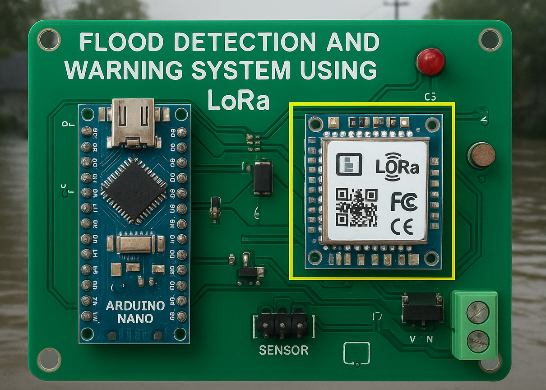
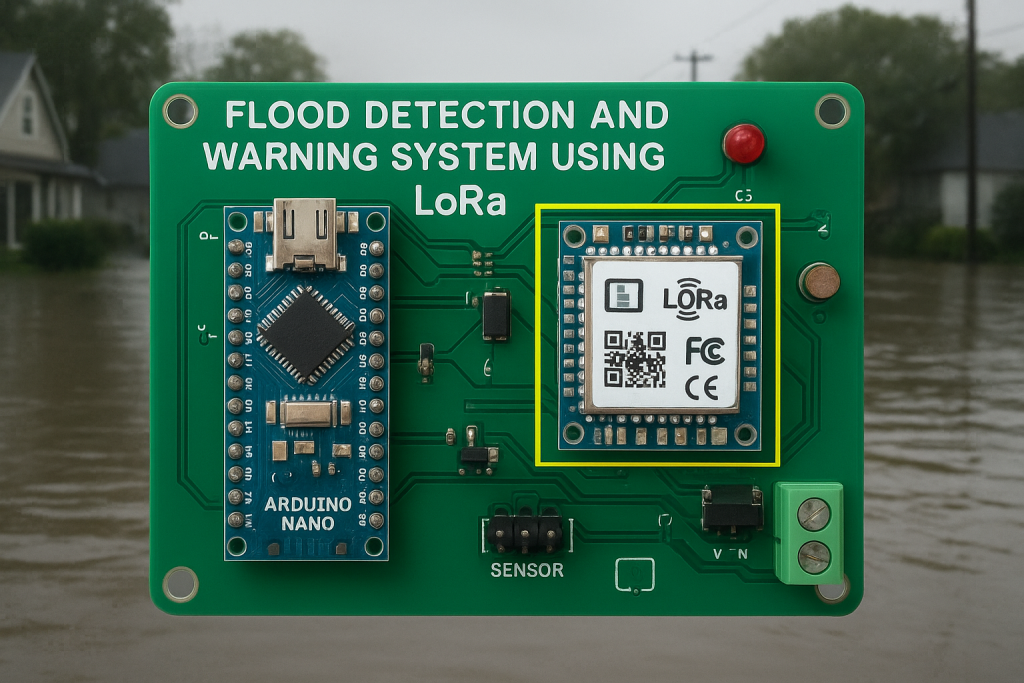
Floods are one of the most devastating natural disasters, causing immense damage to life and property worldwide. Early detection and timely warnings play a crucial role in reducing risks and saving lives. This project, Flood Detection and Warning System using LoRa, leverages IoT technology, Arduino Nano, and LoRa communication to create a low-power, long-range, and reliable flood monitoring solution.
Objectives
- Detect rising water levels in flood-prone areas.
- Transmit real-time alerts to a remote monitoring station using LoRa.
- Provide a cost-effective, scalable, and energy-efficient flood warning system.
System Overview
The system consists of:
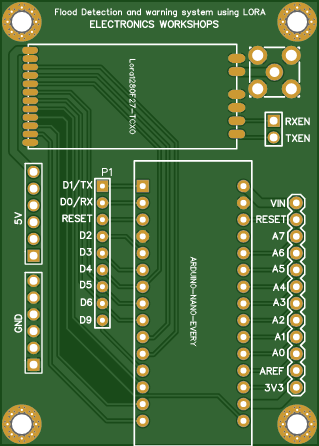
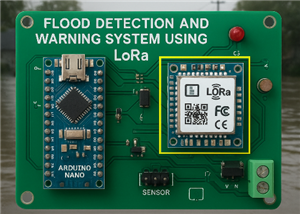
Arduino Nano – Acts as the central microcontroller, reading sensor signals and controlling the LoRa module.
Water Level Sensor – detects water level rise and sends signals to the Arduino.
LoRa1280F27-TCXO Module (U1) – Used for long-range wireless communication.
Connectors/Headers (P1, JP1, etc.) – Allow interfacing with external sensors (like water level sensor) and other components.
Power Supply Lines (+5V, GND) – Supply regulated power to Arduino and LoRa module.
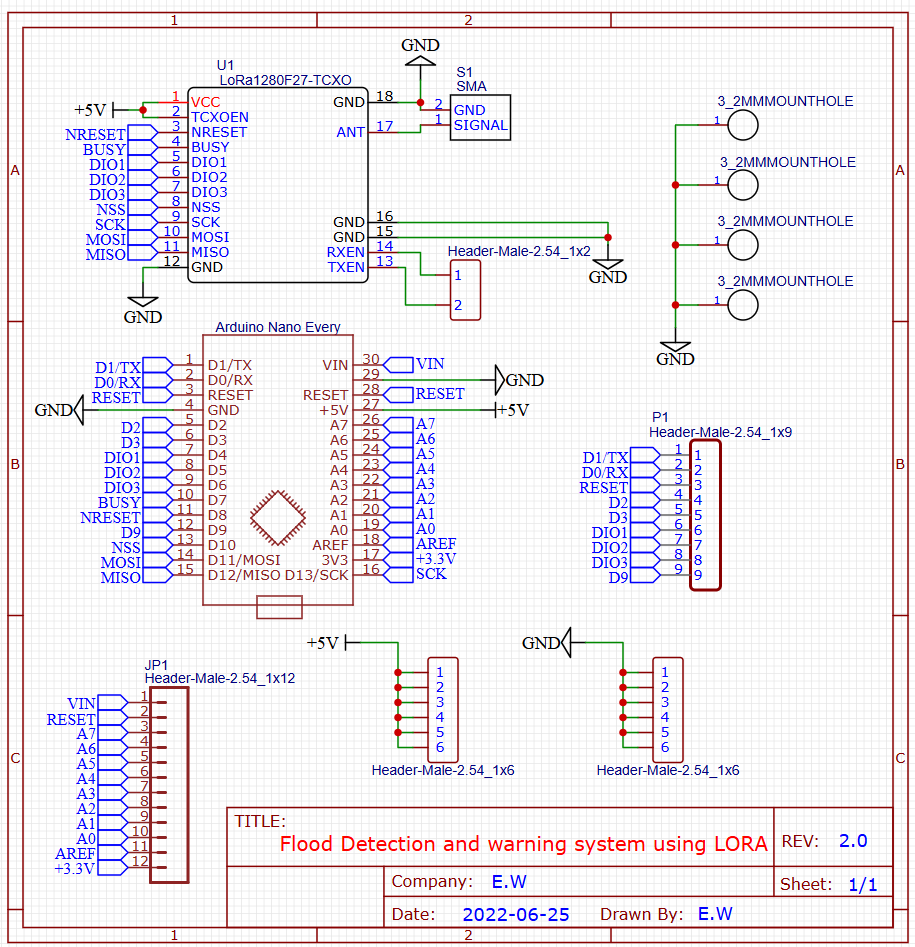
Arduino Nano Section
Pins D10, D11, D12, D13 are connected to the LoRa module SPI interface:
D10 → NSS (Chip Select)
D11 → MOSI
D12 → MISO
D13 → SCK
Reset & Ground lines are provided for system stability.
Other pins (D2–D9, A0–A7) are available via headers (JP1, P1) to connect sensors or alert devices (like buzzers, LEDs).
LoRa Module Section (U1)
Power Supply:
VCC (Pin 2) → +5V supply
GND (Pins 10 & 18) → Ground
SPI Communication with Arduino Nano:
NSS (Pin 9) ↔ Arduino D10
MOSI (Pin 11) ↔ Arduino D11
MISO (Pin 12) ↔ Arduino D12
SCK (Pin 13) ↔ Arduino D13
Additional Control Pins:
RESET, BUSY, DIO0–DIO3 are available for advanced communication and interrupts.
RXEN/TXEN used to switch LoRa module modes (receive/transmit).
Antenna Connection:
SMA connector (S1) provides RF signal to the antenna for wireless communication.
Working Principle
A flood sensor (not explicitly shown in this schematic, but can be connected via JP1 or P1) measures water level.
The Arduino Nano reads this data.
If the water level crosses a set threshold, Arduino sends a warning signal via LoRa module (U1).
The signal is transmitted wirelessly (through SMA antenna) to a receiver station with another LoRa module.
Receiver processes the data and triggers alerts (buzzer, SMS, display, etc.).
Manufacturing Files
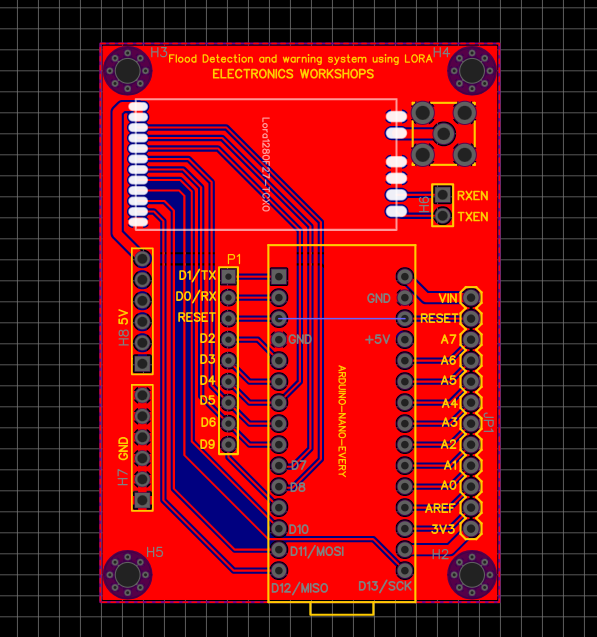
PCB Files
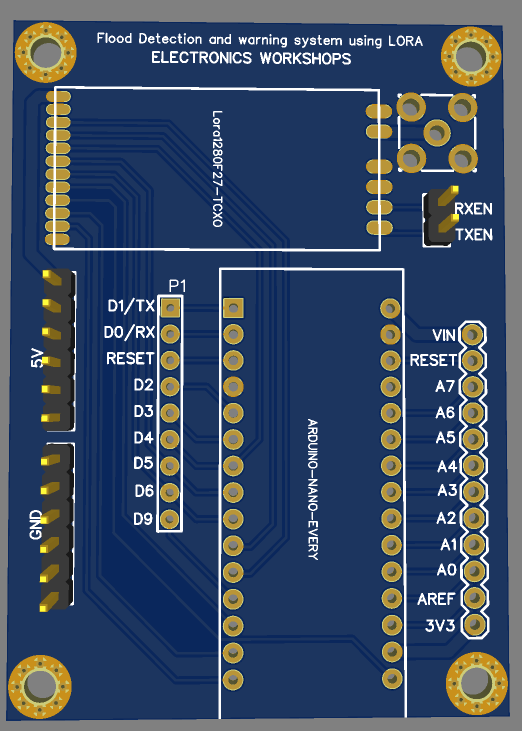
3D Files
Applications
- Flood-prone rural areas and riverbanks.
- Dam or reservoir water monitoring.
- Urban stormwater drainage systems.
- Remote warning system for villages with no GSM network.
Advantages
- Long communication range without the need for internet or GSM.
- Low power consumption for continuous operation.
- Cost-effective and scalable for multiple monitoring stations.
- Early warning reduces casualties and property damage.
Future Enhancements
- Integration with IoT cloud platforms for live dashboards.
- SMS/WhatsApp/email alert system using a GSM backup module.
- Solar-powered nodes for remote and off-grid areas.
- Machine learning models to predict flood risks using historical data.
Conclusion
The Flood Detection and Warning System using LoRa provides a practical, efficient, and affordable solution for early flood detection. By combining Arduino Nano, LoRa communication, and simple water level sensors, this project demonstrates how technology can be harnessed to prevent disasters and save lives.
Flood Detection and warning system using LORA and Arduino
Project images are for reference only. Actual production is based on the manufacturing files on the project page.
Please review the designer's notes (e.g., PCB thickness) and select the appropriate options.
PCBWay is not responsible
for issues caused by unsuitable parameter selections.
For more important ordering information, please refer to
Read More


Raspberry Pi 5 7 Inch Touch Screen IPS 1024x600 HD LCD HDMI-compatible Display for RPI 4B 3B+ OPI 5 AIDA64 PC Secondary Screen(Without Speaker)
BUY NOW

- Comments(0)
- Likes(2)
More by Rabin Poudel
-
 Automatic Water Pump Control System Using ESP-12F
IntroductionWater scarcity and wastage are major challenges in residential, agricultural, and indust...
Automatic Water Pump Control System Using ESP-12F
IntroductionWater scarcity and wastage are major challenges in residential, agricultural, and indust...
-
 Flood Detection and warning system using LORA and Arduino
IntroductionFloods are one of the most devastating natural disasters, causing immense damage to life...
Flood Detection and warning system using LORA and Arduino
IntroductionFloods are one of the most devastating natural disasters, causing immense damage to life...
-
 DIY LED Decoration Tiny Star PCB Project
IntroductionThe Tiny Star PCB is a small and fun DIY electronics project that is perfect for hobbyis...
DIY LED Decoration Tiny Star PCB Project
IntroductionThe Tiny Star PCB is a small and fun DIY electronics project that is perfect for hobbyis...
-
 Simple and Cheap Clap Switch Circuit
IntroductionThe Simple and Cheap Clap Switch Circuit is a practical and fun DIY electronics project ...
Simple and Cheap Clap Switch Circuit
IntroductionThe Simple and Cheap Clap Switch Circuit is a practical and fun DIY electronics project ...
-
 Arduino-based Mist Maker and Hand Dryer
IntroductionIn today’s world, automation and hygiene have become essential, especially in public pla...
Arduino-based Mist Maker and Hand Dryer
IntroductionIn today’s world, automation and hygiene have become essential, especially in public pla...
-
 MPL3115A2 Barometric Pressure, Altitude, and Temperature Sensor
IntroductionThe MPL3115A2 is a highly accurate, low-power digital barometric pressure sensor from NX...
MPL3115A2 Barometric Pressure, Altitude, and Temperature Sensor
IntroductionThe MPL3115A2 is a highly accurate, low-power digital barometric pressure sensor from NX...
-
 E-Speaker Using ESP32
IntroductionThe E-Speaker is a smart, portable, and versatile audio system built using the ESP32 mic...
E-Speaker Using ESP32
IntroductionThe E-Speaker is a smart, portable, and versatile audio system built using the ESP32 mic...
-
 Heart Rate Monitor Circuit Using Photoplethysmography (PPG)
IntroductionHeart rate is a vital physiological parameter that reflects the health and fitness of an...
Heart Rate Monitor Circuit Using Photoplethysmography (PPG)
IntroductionHeart rate is a vital physiological parameter that reflects the health and fitness of an...
-
 Automated Greenhouse Control System using ESP32
IntroductionAn automated greenhouse control system leverages technology to optimize plant growth con...
Automated Greenhouse Control System using ESP32
IntroductionAn automated greenhouse control system leverages technology to optimize plant growth con...
-
 STD CH330N USB to Serial Converter 5V
IntroductionThe CH330N is a versatile USB-to-serial converter chip that simplifies interfacing betwe...
STD CH330N USB to Serial Converter 5V
IntroductionThe CH330N is a versatile USB-to-serial converter chip that simplifies interfacing betwe...
-
 KY-032 Obstacle avoidance sensor module
IntroductionIntroduction to Obstacle Avoidance SensorsObstacle avoidance sensors are essential compo...
KY-032 Obstacle avoidance sensor module
IntroductionIntroduction to Obstacle Avoidance SensorsObstacle avoidance sensors are essential compo...
-
 BC547 BASED WATER LEVEL INDICATOR
IntroductionA water level indicator using a BC547 transistor is a simple and effective electronic pr...
BC547 BASED WATER LEVEL INDICATOR
IntroductionA water level indicator using a BC547 transistor is a simple and effective electronic pr...
-
 How to Design Own Arduino Wifi shield PCB
OverviewArduino wifi shield connects the Arduino with a wifi chip through the serial communication p...
How to Design Own Arduino Wifi shield PCB
OverviewArduino wifi shield connects the Arduino with a wifi chip through the serial communication p...
-
 DIY Air Quality Tester
OverviewIn this project “DIY Air Quality Tester” we use Node MCU microcontroller and air quality sen...
DIY Air Quality Tester
OverviewIn this project “DIY Air Quality Tester” we use Node MCU microcontroller and air quality sen...
-
 Digital Clock Using Arduino
OverviewIn this project, “Digital clock using Arduino” we will make a PCB board for digital clock an...
Digital Clock Using Arduino
OverviewIn this project, “Digital clock using Arduino” we will make a PCB board for digital clock an...
-
 Bluetooth Controlled car using Arduino
OverviewA Bluetooth Controlled Car Using Arduino is a fascinating DIY project that involves building...
Bluetooth Controlled car using Arduino
OverviewA Bluetooth Controlled Car Using Arduino is a fascinating DIY project that involves building...
-
 Design a Magnetic Sensor Using S411A
IntroductionMagnetic sensors are widely used in modern electronic systems for detecting the presence...
Design a Magnetic Sensor Using S411A
IntroductionMagnetic sensors are widely used in modern electronic systems for detecting the presence...
-
 Design Simple Touch Sensor Using LM324
IntroductionTouch sensors have become an essential part of modern electronic devices, replacing trad...
Design Simple Touch Sensor Using LM324
IntroductionTouch sensors have become an essential part of modern electronic devices, replacing trad...
-
Programmable Mist Maker - XIAO / QT PY Extension
2057 2 2 -
RadioHAT - Raspberry Pi radio development platform
1752 0 4 -
-
-
-
ARPS-2 – Arduino-Compatible Robot Project Shield for Arduino UNO
3980 0 6 -
A Compact Charging Breakout Board For Waveshare ESP32-C3
4714 3 8 -
AI-driven LoRa & LLM-enabled Kiosk & Food Delivery System
5520 2 2 -