


Audio Peak Detector using LMV358
Introduction
An Audio Peak Detector is an essential circuit in audio signal processing that identifies the highest amplitude or peak level of an incoming audio signal. This project utilizes the LMV358, a low-voltage, low-power dual operational amplifier, to create a compact and efficient audio peak detection system.
For Full Project:
https://electronicsworkshops.com/2025/04/28/audio-peak-detector-using-lmv358/

PCB Manufacturer
PCBWAY is a highly skilled company specializing in PCB manufacturing. They offer their services at incredibly low prices, such as providing 10 PCBs for only $5. Additionally, new members receive a $5 bonus. The website allows customers to upload their Gerber Files and place orders.
ORDER LINK

PCBWAY is known for producing PCBs of exceptional quality and maintaining high standards, which is why many people trust them for their PCB and PCBA needs.
Below are some of my PCB’S manufactured by PCBWAY and I am fully satisfied by their Quality of service they provide.
Working Principle
Audio Input (from Mic/Line-In):
An electric microphone or audio input signal is fed into the circuit.
The signal is usually AC (alternating current), fluctuating based on sound intensity.
Amplification Stage (Using LMV358):
The LMV358 amplifies the weak audio signal.
One op-amp in the LMV358 IC can be used as a pre-amplifier to boost the audio signal.
Gain can be controlled using external resistors.
Rectifier and Peak Detection:
The second op-amp is configured as a precision rectifier and peak detector.
The output of the op-amp charges a capacitor through a diode.
This capacitor holds the peak voltage for a short duration, representing the highest amplitude of the audio signal.
Indicator (LED or ADC output):
A LED may be connected to indicate peak detection (lights up when sound is loud).
Optionally, the output voltage can be sent to a microcontroller’s ADC to display audio levels on a bar graph, VU meter, etc
Circuit Diagram

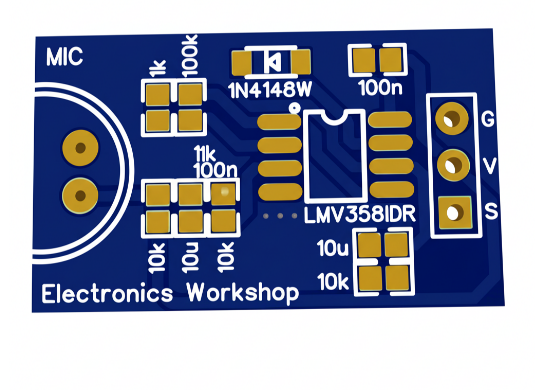
This circuit is an electret microphone preamplifier that amplifies weak audio signals and then processes them into a varying DC voltage. An electret microphone (Q1) converts sound into an electrical signal, which is then capacitively coupled (C1) to an LMV358IDR operational amplifier (U1), configured with feedback (R3) for amplification. The amplified audio signal is then half-wave rectified by a diode (D2), and the resulting pulsating DC is smoothed by capacitors (C2, C3) and a resistor (R5), effectively acting as a peak or envelope detector, with the discharge time of C3 through R5 determining how quickly the output responds to changes in audio amplitude, as indicated by the provided discharge time formula. Finally, the processed output is made available through a 3-pin header (P1) along with the power supply and ground connections.
Applications
Audio level visualization (e.g., VU meters).
Sound-activated circuits (clap switches, volume indicators).
Microcontroller-based audio sensing.
DIY audio and LED projects.
Conclusion
The LMV358 Audio Peak Detector SMD is a simple yet effective circuit to detect audio signal peaks. It uses the LMV358 op-amp to amplify and rectify the signal, storing the peak voltage which can trigger indicators or be read by a microcontroller. It’s ideal for hobbyist audio visualizations or sound-sensing automation systems.
For Full Project:
https://electronicsworkshops.com/2025/04/28/audio-peak-detector-using-lmv358/
Audio Peak Detector using LMV358
Project images are for reference only. Actual production is based on the manufacturing files on the project page.
Please review the designer's notes (e.g., PCB thickness) and select the appropriate options.
PCBWay is not responsible
for issues caused by unsuitable parameter selections.
For more important ordering information, please refer to
Read More


Raspberry Pi 5 7 Inch Touch Screen IPS 1024x600 HD LCD HDMI-compatible Display for RPI 4B 3B+ OPI 5 AIDA64 PC Secondary Screen(Without Speaker)
BUY NOW

- Comments(1)
- Likes(0)
More by Rabin Poudel
-
 Automatic Water Pump Control System Using ESP-12F
IntroductionWater scarcity and wastage are major challenges in residential, agricultural, and indust...
Automatic Water Pump Control System Using ESP-12F
IntroductionWater scarcity and wastage are major challenges in residential, agricultural, and indust...
-
 Flood Detection and warning system using LORA and Arduino
IntroductionFloods are one of the most devastating natural disasters, causing immense damage to life...
Flood Detection and warning system using LORA and Arduino
IntroductionFloods are one of the most devastating natural disasters, causing immense damage to life...
-
 DIY LED Decoration Tiny Star PCB Project
IntroductionThe Tiny Star PCB is a small and fun DIY electronics project that is perfect for hobbyis...
DIY LED Decoration Tiny Star PCB Project
IntroductionThe Tiny Star PCB is a small and fun DIY electronics project that is perfect for hobbyis...
-
 Simple and Cheap Clap Switch Circuit
IntroductionThe Simple and Cheap Clap Switch Circuit is a practical and fun DIY electronics project ...
Simple and Cheap Clap Switch Circuit
IntroductionThe Simple and Cheap Clap Switch Circuit is a practical and fun DIY electronics project ...
-
 Arduino-based Mist Maker and Hand Dryer
IntroductionIn today’s world, automation and hygiene have become essential, especially in public pla...
Arduino-based Mist Maker and Hand Dryer
IntroductionIn today’s world, automation and hygiene have become essential, especially in public pla...
-
 MPL3115A2 Barometric Pressure, Altitude, and Temperature Sensor
IntroductionThe MPL3115A2 is a highly accurate, low-power digital barometric pressure sensor from NX...
MPL3115A2 Barometric Pressure, Altitude, and Temperature Sensor
IntroductionThe MPL3115A2 is a highly accurate, low-power digital barometric pressure sensor from NX...
-
 E-Speaker Using ESP32
IntroductionThe E-Speaker is a smart, portable, and versatile audio system built using the ESP32 mic...
E-Speaker Using ESP32
IntroductionThe E-Speaker is a smart, portable, and versatile audio system built using the ESP32 mic...
-
 Heart Rate Monitor Circuit Using Photoplethysmography (PPG)
IntroductionHeart rate is a vital physiological parameter that reflects the health and fitness of an...
Heart Rate Monitor Circuit Using Photoplethysmography (PPG)
IntroductionHeart rate is a vital physiological parameter that reflects the health and fitness of an...
-
 Automated Greenhouse Control System using ESP32
IntroductionAn automated greenhouse control system leverages technology to optimize plant growth con...
Automated Greenhouse Control System using ESP32
IntroductionAn automated greenhouse control system leverages technology to optimize plant growth con...
-
 STD CH330N USB to Serial Converter 5V
IntroductionThe CH330N is a versatile USB-to-serial converter chip that simplifies interfacing betwe...
STD CH330N USB to Serial Converter 5V
IntroductionThe CH330N is a versatile USB-to-serial converter chip that simplifies interfacing betwe...
-
 KY-032 Obstacle avoidance sensor module
IntroductionIntroduction to Obstacle Avoidance SensorsObstacle avoidance sensors are essential compo...
KY-032 Obstacle avoidance sensor module
IntroductionIntroduction to Obstacle Avoidance SensorsObstacle avoidance sensors are essential compo...
-
 BC547 BASED WATER LEVEL INDICATOR
IntroductionA water level indicator using a BC547 transistor is a simple and effective electronic pr...
BC547 BASED WATER LEVEL INDICATOR
IntroductionA water level indicator using a BC547 transistor is a simple and effective electronic pr...
-
 How to Design Own Arduino Wifi shield PCB
OverviewArduino wifi shield connects the Arduino with a wifi chip through the serial communication p...
How to Design Own Arduino Wifi shield PCB
OverviewArduino wifi shield connects the Arduino with a wifi chip through the serial communication p...
-
 DIY Air Quality Tester
OverviewIn this project “DIY Air Quality Tester” we use Node MCU microcontroller and air quality sen...
DIY Air Quality Tester
OverviewIn this project “DIY Air Quality Tester” we use Node MCU microcontroller and air quality sen...
-
 Digital Clock Using Arduino
OverviewIn this project, “Digital clock using Arduino” we will make a PCB board for digital clock an...
Digital Clock Using Arduino
OverviewIn this project, “Digital clock using Arduino” we will make a PCB board for digital clock an...
-
 Bluetooth Controlled car using Arduino
OverviewA Bluetooth Controlled Car Using Arduino is a fascinating DIY project that involves building...
Bluetooth Controlled car using Arduino
OverviewA Bluetooth Controlled Car Using Arduino is a fascinating DIY project that involves building...
-
 Design a Magnetic Sensor Using S411A
IntroductionMagnetic sensors are widely used in modern electronic systems for detecting the presence...
Design a Magnetic Sensor Using S411A
IntroductionMagnetic sensors are widely used in modern electronic systems for detecting the presence...
-
 Design Simple Touch Sensor Using LM324
IntroductionTouch sensors have become an essential part of modern electronic devices, replacing trad...
Design Simple Touch Sensor Using LM324
IntroductionTouch sensors have become an essential part of modern electronic devices, replacing trad...
-
SmallOLED - Live PC Stats, Animated Clocks & Audio Visualizer
777 0 3 -
"Talking Multimeter": Arduino-Based Speech Add-on for Multimeters with SCPI Protocol
439 0 1 -
Programmable Mist Maker - XIAO / QT PY Extension
2892 2 3 -
RadioHAT - Raspberry Pi radio development platform
2473 0 4 -
-
-
-
ARPS-2 – Arduino-Compatible Robot Project Shield for Arduino UNO
4555 0 6