
Low-Side Switching Circuit for Driving a Water Fuel Cell (WFC) Using Stanley Meyer's "Voltrolysis" Method
Low-Side Switching Circuit for Driving a Water Fuel Cell (WFC) Using Stanley Meyer's "Voltrolysis" Method
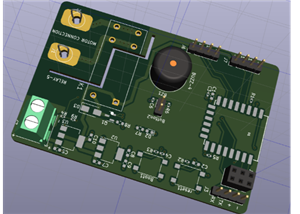
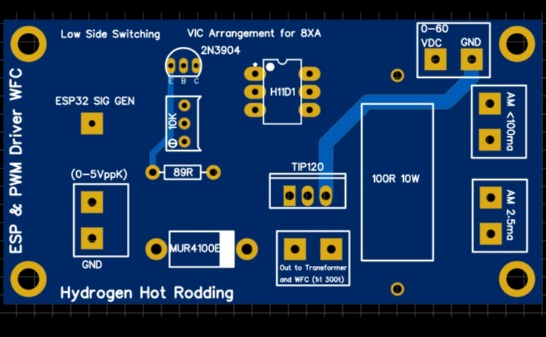
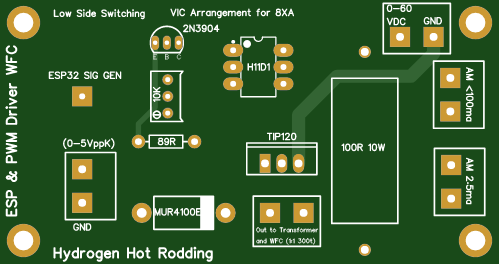
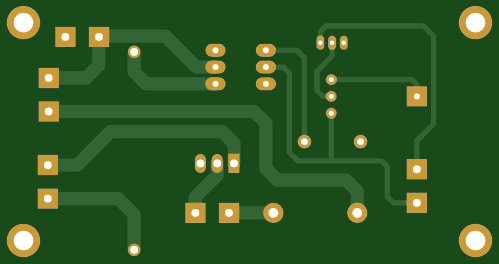
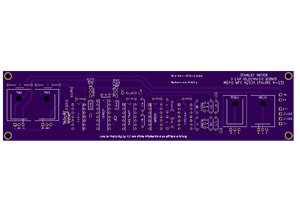
This PCB layout represents a low-side switching circuit designed for driving a Water Fuel Cell (WFC) in alignment with Stanley Meyer’s "voltrolysis" method, aimed at producing nano bubble water fuel.
This approach utilizes pulse width modulation (PWM) amplification, isolated power supplies, and a voltage intensifier circuit (VIC) with a gated transformer, baluns, and chokes to optimize hydrogen production. Below is an explanation of how each component contributes to the voltrolysis process.
Circuit Overview and Functionality
Low-Side Switching Configuration
In this circuit, low-side switching controls the negative (ground) line to the load, which is the WFC or transformer. This approach grounds the switching element, simplifying the design and minimizing component complexity. Low-side switching enables better control of current flow, as the WFC can be connected directly to the positive supply, reducing potential interference issues.
PWM Signal Generation with ESP32
The ESP32 microcontroller generates precise PWM signals to modulate the frequency and duty cycle of the pulses applied to the WFC. These (0–5Vpp) PWM signals are fed to the TIP120 transistor, which amplifies them to drive the VIC circuit, allowing for adjustable control over pulse characteristics, which is crucial for effective hydrogen production.
Pulse Amplification with TIP120
The TIP120, a power Darlington transistor, receives the PWM signal from the ESP32 and amplifies it to handle the higher current requirements of the WFC. By pulsing high current across the VIC circuit, it mimics Meyer’s approach of generating rapid changes in voltage and current for efficient hydrogen gas production.
Voltage Intensifier Circuit (VIC) Arrangement
The VIC setup, a core part of Meyer’s design, produces high-voltage pulses to "split" water molecules without traditional electrolysis methods. In this circuit, the VIC includes transformers, resistors, and high-speed diodes like the MUR4100E, which help create a pulsed high-voltage output suitable for Meyer’s "voltrolysis" method. This configuration eliminates the need for electrolytes, reducing risks of thermal runaway and short circuits.
Isolation and Protection Components
The MUR4100E diode protects the circuit from back-EMF generated by the transformer and high-frequency pulses. Additional components like the 2N3904 transistor and H11D1 optocoupler isolate the control and high-current stages, providing safety and protecting the ESP32 from potential high-voltage feedback.
Monitoring Connections
Voltage and current monitoring points are included in this design, allowing for real-time observation of voltage (0–60V) and current within the ranges of 100 mA and 2.5 mA. These monitoring points are beneficial for analyzing WFC performance, especially for experimentation in nano bubble hydrogen fuel production.
Bill of Materials (BOM)
Primary components in this low-side switching circuit include:
ESP32 Microcontroller: Generates PWM signals for precise control.
TIP120 Power Darlington Transistor: Amplifies PWM signals to drive the VIC.
2N3904 NPN Transistor: Used for switching and amplification.
H11D1 Optocoupler: Provides isolation between control and high-current sections.
MUR4100E Diode: High-speed rectifier for back-EMF protection.
100Ω 10W Resistor: Limits current within the VIC circuit.
89Ω Resistor: Controls base current for the TIP120.
Transformers (1:1 or Step-Up): Key components for producing high-voltage pulses in the VIC.
How It Enables "Voltrolysis" (Stanley Meyer’s Electrolysis Method)
Meyer’s "voltrolysis" approach focuses on using high-frequency, high-voltage pulses to split water molecules without relying on electrolytes, instead using only distilled water. The ESP32 provides precise PWM control, which the TIP120 amplifies and directs through the VIC to the WFC. The VIC’s high-voltage output induces a capacitive effect in the water, aligning water molecules with the electric field and reducing the energy required to break the hydrogen-oxygen bonds. This controlled pulse pattern minimizes power consumption and prevents overheating, leading to efficient nano bubble hydrogen production.
Benefits for Hydrogen "Hot Rodders"
Hydrogen enthusiasts use this low-side switching circuit to replicate Meyer’s WFC process, aiming for efficient hydrogen generation with minimal power draw. By tuning PWM signals and leveraging the VIC, they can maximize hydrogen output and control energy use, making it ideal for those experimenting with Meyer’s clean fuel concepts and nano bubble fuel technology.
This low-side switching circuit, with its PWM control, VIC, and safety isolations, serves as a robust platform for exploring Meyer’s voltrolysis principles and advancing nano bubble water fuel technology.
Daniel's kind-hearted approach and dedication to a cleaner energy future deserve recognition and support.
JOIN SUPPORT LEARN MORE HERE https://www.patreon.com/c/securesupplies
You can contribute to his ongoing efforts by donating through PayPal at https://www.paypal.com/donate/?hosted_button_id=29MNNNGUSBQXW
Additionally, joining his Builder Level on Patreon at https://www.patreon.com/c/securesupplies grants you access to exclusive updates, resources, and a community of like-minded supporters dedicated to advancing hydrogen technology.
By supporting his work, you join in the journey toward a sustainable future. Godspeed, Daniel Donatelli!
Low-Side Switching Circuit for Driving a Water Fuel Cell (WFC) Using Stanley Meyer's "Voltrolysis" Method
*PCBWay community is a sharing platform. We are not responsible for any design issues and parameter issues (board thickness, surface finish, etc.) you choose.


Raspberry Pi 5 7 Inch Touch Screen IPS 1024x600 HD LCD HDMI-compatible Display for RPI 4B 3B+ OPI 5 AIDA64 PC Secondary Screen(Without Speaker)
BUY NOW


- Comments(0)
- Likes(1)
More by Daniel Donatelli
-
 Stanley A Meyer VIC Voltage intensifier circuit transformer board v1.8 updated jan 11 2021
Stanley A Meyer VIC Voltage intensifier transformer board Join Support help change the World https:/...
Stanley A Meyer VIC Voltage intensifier circuit transformer board v1.8 updated jan 11 2021
Stanley A Meyer VIC Voltage intensifier transformer board Join Support help change the World https:/...
-
 STANLEY A MEYER LES BANKI AUTO START AUTO WATER FUEL REFILL
Join Support help change the World https:...
STANLEY A MEYER LES BANKI AUTO START AUTO WATER FUEL REFILL
STANLEY A MEYER LES BANKI AUTO START AUTO WATER FUEL REFILLJoin Support help change the World https:...
-
 Stanley A Meyer Gated Pulse Frequency Generator K3 with DB 37 updated 060622
Stanley A Meyer Gated Pulse Frequency Generator K3 with DB 37 to suit matrix vic main board Join Sup...
Stanley A Meyer Gated Pulse Frequency Generator K3 with DB 37 updated 060622
Stanley A Meyer Gated Pulse Frequency Generator K3 with DB 37 to suit matrix vic main board Join Sup...
-
 Stanley A Meyer K2 Variable Pulse Frequency Generator GMS Vic Matrix PCB Gerber
Stanley A Meyer K2 Variable Pulse Frequency Generator GMS Vic Matrix PCBGerberJoin Support help chan...
Stanley A Meyer K2 Variable Pulse Frequency Generator GMS Vic Matrix PCB Gerber
Stanley A Meyer K2 Variable Pulse Frequency Generator GMS Vic Matrix PCBGerberJoin Support help chan...
-
 Hyduino Stim Stimulator circuit board Ms EMS ECU
Join Support help change the World https://www.patre...
Hyduino Stim Stimulator circuit board Ms EMS ECU
Hyduino Stim Stimulator circuit board Ms EMS ECUJoin Support help change the World https://www.patre...
-
 Stanley A Meyer VIC Daughter Board Driver Transistor Circuit board Version 1
 Updated 28th Sept 2021 ...
Stanley A Meyer VIC Daughter Board Driver Transistor Circuit board Version 1
Stanley A Meyer VIC Daughter Board Driver Transistor Circuit board Version 1 Updated 28th Sept 2021 ...
-
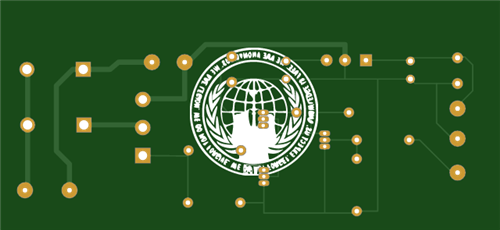 Stanley A Meyer VIC Daughter Board Driver USed with Variac EEC eleectron eextrract & chokes
Stanley A Meyer VIC Daughter Board Driver USed with Variac EEC eleectron extrract & chokes can d...
Stanley A Meyer VIC Daughter Board Driver USed with Variac EEC eleectron eextrract & chokes
Stanley A Meyer VIC Daughter Board Driver USed with Variac EEC eleectron extrract & chokes can d...
-
 Stanley A Meyer Taking Gas Management Warning Board Stans Voice
 Who Wants to Clone Stans Voice and M...
Stanley A Meyer Taking Gas Management Warning Board Stans Voice
Stanley A Meyer Taking Gas Management Warning Board Stans Voice Who Wants to Clone Stans Voice and M...
-
 Stanley A Meyer Stack Resonant Cavity
Dynamysthesis: Force-Dominant Energy Release via Charge-Separated Fuel Collapse1. Definition of Dyna...
Stanley A Meyer Stack Resonant Cavity
Dynamysthesis: Force-Dominant Energy Release via Charge-Separated Fuel Collapse1. Definition of Dyna...
-
 Stanley A Myer nano bubble water fuel 9 TUBE CELL Modern 3d Print
Join Us https://www.patreon.com/c/s...
Stanley A Myer nano bubble water fuel 9 TUBE CELL Modern 3d Print
Stanley A Myer nano bubble water fuel 9 TUBE CELL Modern 3d PrintJoin Us https://www.patreon.com/c/s...
-
 Stanley A Meyer Nano Bubble Water Fuel Tank Steam Defrost Resonator
Stanley A. Meyer Nano-Bubble Water Fuel Tank Steam Defrost ResonatorTechnical DescriptionJoin Us htt...
Stanley A Meyer Nano Bubble Water Fuel Tank Steam Defrost Resonator
Stanley A. Meyer Nano-Bubble Water Fuel Tank Steam Defrost ResonatorTechnical DescriptionJoin Us htt...
-
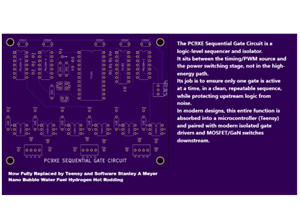 Stanley A Meyer PC9XE Sequential Gate Circuit
Ethan Replication Stanley A Meyer PC9XE Sequential Gate Circuit 1. Where This Board Fits in the Stan...
Stanley A Meyer PC9XE Sequential Gate Circuit
Ethan Replication Stanley A Meyer PC9XE Sequential Gate Circuit 1. Where This Board Fits in the Stan...
-
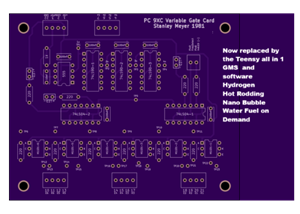 Stanley A Meyer PC9XC Variable Gate Card
Ethan Replication Stanley A Meyer Stanley A Meyer PC9XC Variable Gate CardJoin Us https://www.patreo...
Stanley A Meyer PC9XC Variable Gate Card
Ethan Replication Stanley A Meyer Stanley A Meyer PC9XC Variable Gate CardJoin Us https://www.patreo...
-
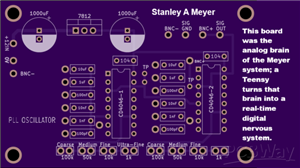 Stanley A Meyer PLL Gated Frequency Generator
Ethan Replication bom notes and advancing it Stanley A Meyer PLL Gated Frequency Generator2. Wher...
Stanley A Meyer PLL Gated Frequency Generator
Ethan Replication bom notes and advancing it Stanley A Meyer PLL Gated Frequency Generator2. Wher...
-
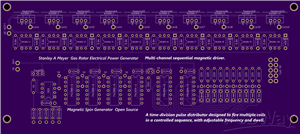 Stanley A Meyer EPG Magnetic Spin Gerbers MUlt i Trigger VIc or Coils
You’re looking at a multi-channel sequential magnetic driver. This is not a simple oscillator board ...
Stanley A Meyer EPG Magnetic Spin Gerbers MUlt i Trigger VIc or Coils
You’re looking at a multi-channel sequential magnetic driver. This is not a simple oscillator board ...
-
 Stanley A Meyer Steam Resonator PCB
1. Bill of Materials (BOM)Based on silkscreen labels visible on the PCB. Values are conservative and...
Stanley A Meyer Steam Resonator PCB
1. Bill of Materials (BOM)Based on silkscreen labels visible on the PCB. Values are conservative and...
-
 U-Core Bobbin for VIC Transformer | 8XA Stanley A. Meyer Style | Ferrite U126x91x20 | High-Voltage Experimental Coil Former
Stanley A. Meyer U-Core Bobbin – 8XA ConfigurationFerrite U-Core Bobbin for VIC / Water Fuel Cell Re...
U-Core Bobbin for VIC Transformer | 8XA Stanley A. Meyer Style | Ferrite U126x91x20 | High-Voltage Experimental Coil Former
Stanley A. Meyer U-Core Bobbin – 8XA ConfigurationFerrite U-Core Bobbin for VIC / Water Fuel Cell Re...
-
 Nano Second Laser Diode Driver STANLEY a MEYER Nano Bubble Water Fuel
 # Avalanche Laser Diode Driver...
Nano Second Laser Diode Driver STANLEY a MEYER Nano Bubble Water Fuel
Nano Second Laser Diode Driver STANLEY a MEYER Nano Bubble Water Fuel # Avalanche Laser Diode Driver...
-
-
ARPS-2 – Arduino-Compatible Robot Project Shield for Arduino UNO
1302 0 4 -
A Compact Charging Breakout Board For Waveshare ESP32-C3
1824 3 7 -
AI-driven LoRa & LLM-enabled Kiosk & Food Delivery System
1810 2 0 -
-
-
-
ESP32-C3 BLE Keyboard - Battery Powered with USB-C Charging
1986 0 1 -