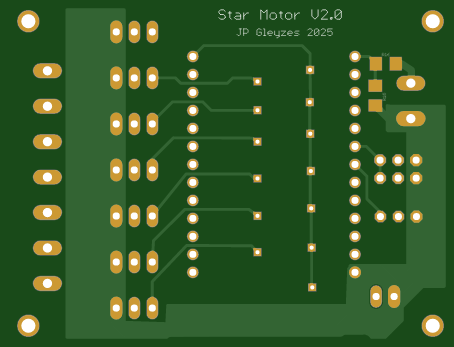
ESP32_StarMotor_glow plugs heater _ V2
Background
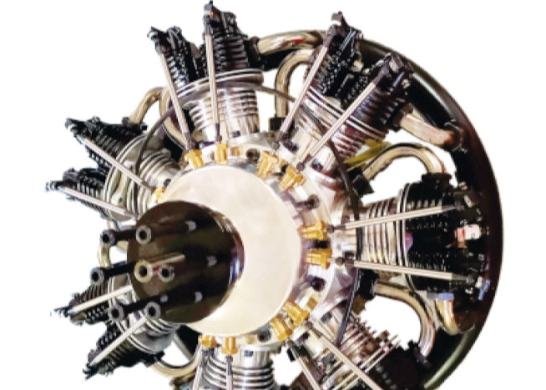
My friend bought this wonderful engine from UMS_technologies
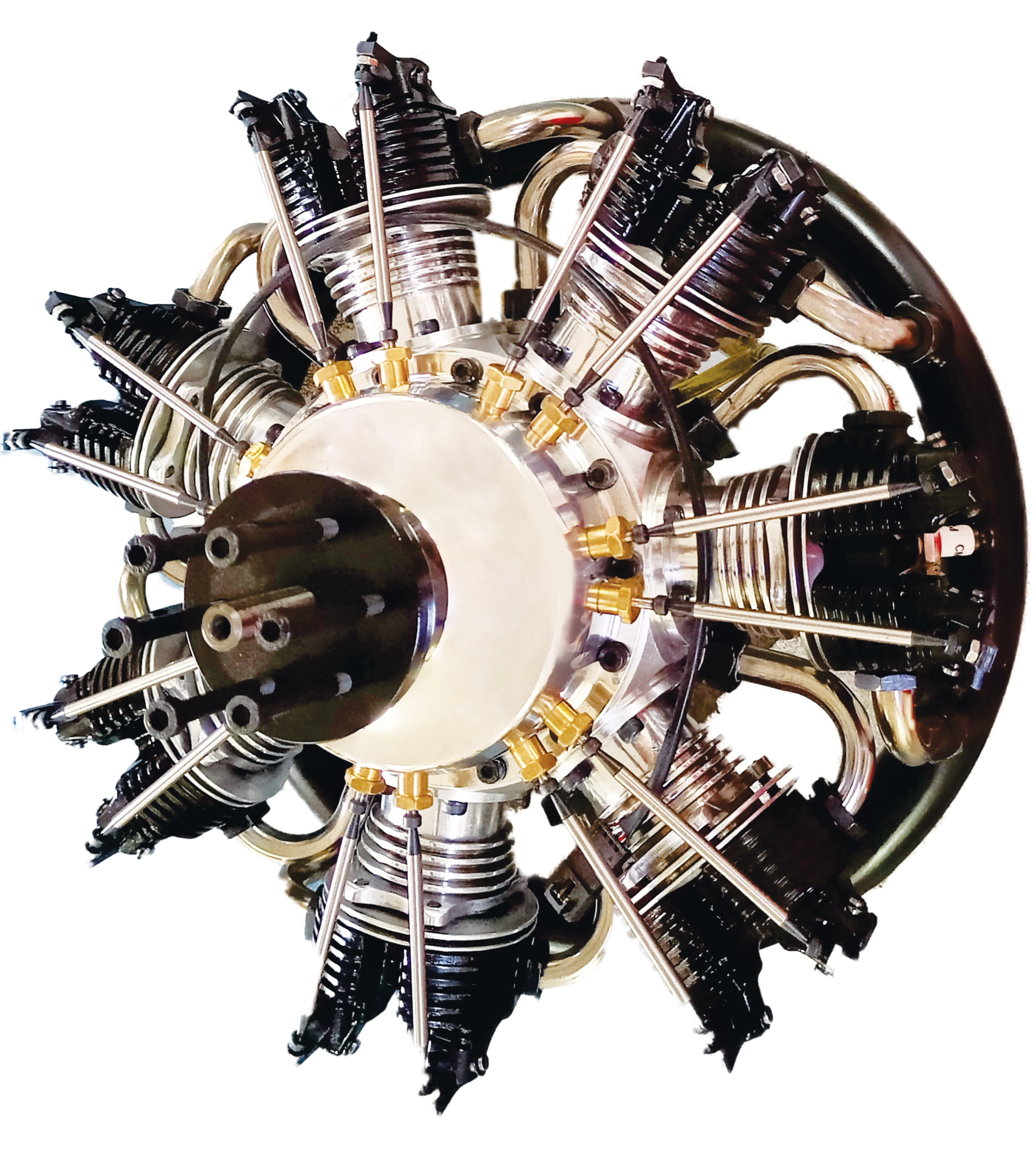
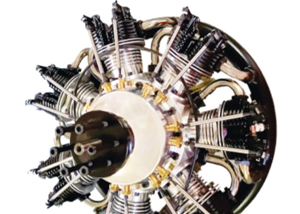
It's a 7 cylinders star engine which uses "glow fuel".
The fuel ignites when it comes in contact with the heating element of the glow plug. Between strokes of the engine, the wire remains hot, continuing to glow partly due to thermal inertia, but largely due to the catalytic combustion reaction of methanol remaining on the platinum filament. This keeps the filament hot, allowing it to ignite the next charge, thus sustaining the power cycle.
A 7 cylinders engine is thus equiped with seven glow plugs (one per cylinder)
To start the engine the glow plugs must be heated, then the motor starts, then the heaters can be removed.
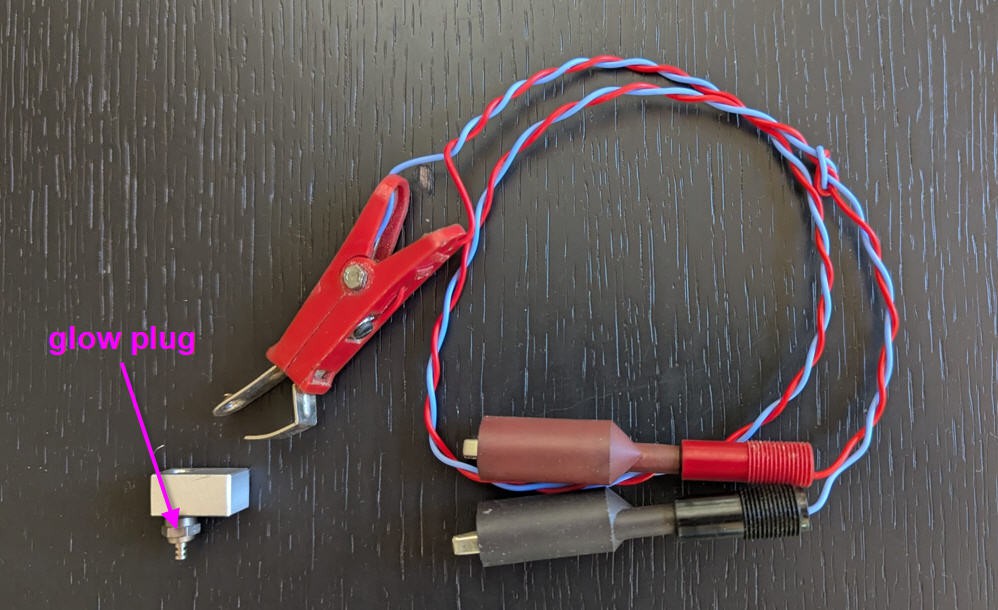
In real life difficulties may occur, the motor starts properly and keeps running at high speed. But when reducing the throttle, temperature at the heating element decreases and may not be sufficient to ignite to next charge... and one cylinder stops... Engine is still running but the rotation is less powerful, noisy and un balanced...
To prevent this behavior an idea would be to keep the heating elements switched on external battery (glowing).
This of course works, but the current into the glow plug is quite high (4A at 1.5V) so that the battery into the plane would be really big (and thus heavy)...
This project is an attempt to power the heating elements (called sparks in the rest od the text) only when the engine is at low speed (low throttle).
Full description is available on my hackaday's project pages
I can't help showing you the result !
Schematics version 2
Compared to V1, several things have changed :
- power is now produced by a Li-Ion battery at 3.7V.
- dual stages N channels mosfets are used for each plug control. They are much easier to solder ! (one small 2N7002 and one big logic Level FQP30N06L)
Please forget V1 of this project, rather use this V2 version !
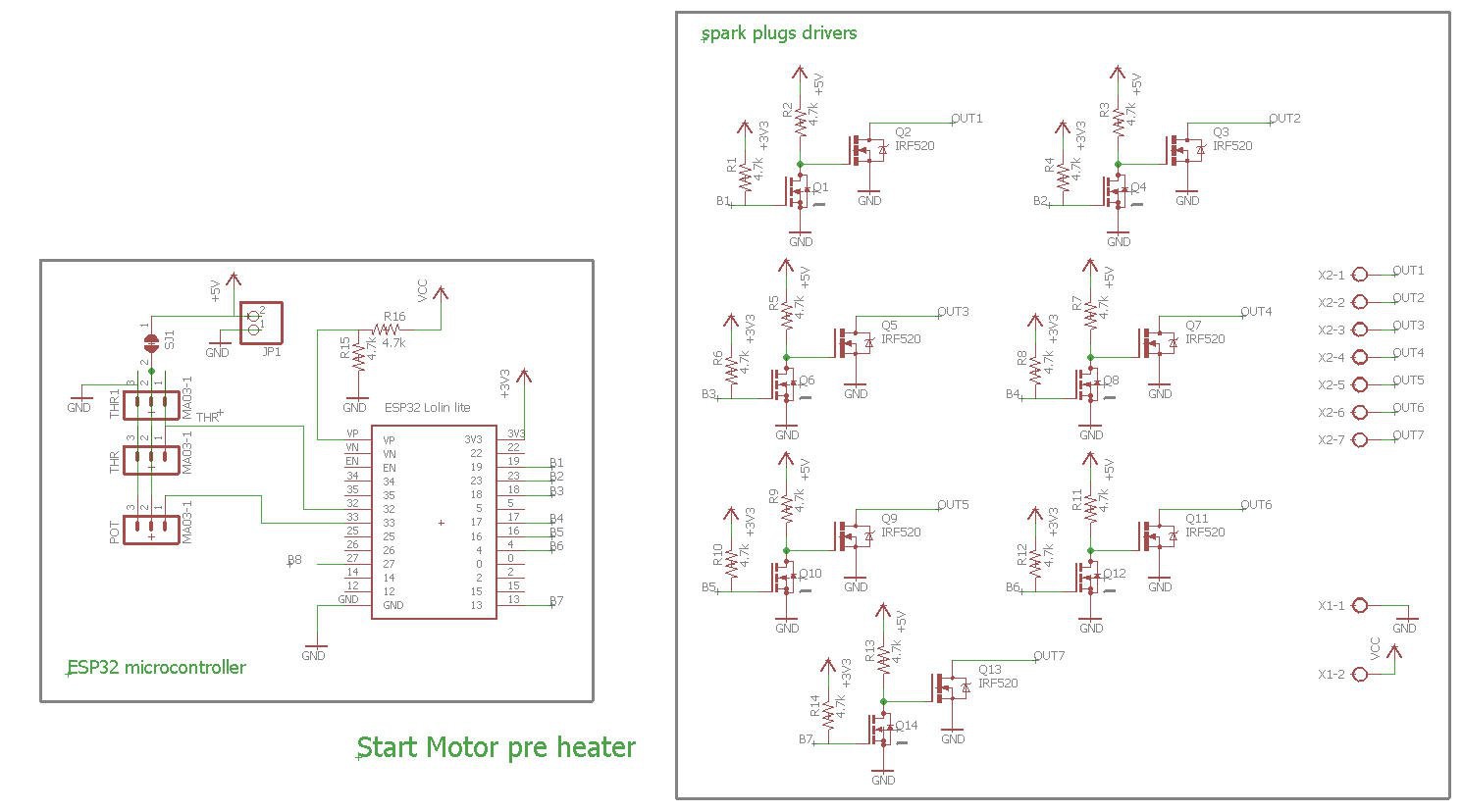
Powering glow plugs at more than 1.2V allows to avoid voltage drop and very big wires to drive the sparks.
However 3.7V is way to high to directly power the glow plugs. They would blow as an incandescent light...
So we need to control the voltage delivered to each glow plug with a PWM signal produced by the ESP2 and driven by the mosfets.
Note that two resistors pull down the gates of the mosfets for each glow plug. So that , when power is applied, the glow plugs are switched off electrically. Then, after boot, the ESP32 can safely take again the control.
Note also that all the glow plugs share the motor body as the high side of the mosfets switches. The central electrod can only be controled by the low side of the switch.
This means that the body of the motor is not at the electrical ground but at the +3.7V.
This works safely if you take care not to connect anything else to the mass of the motor thinking that it is grounded... Take care !
Finally, to avoid to empty the Li-Ion battery (and to definitively kill it) I have added a voltage measurement to automatically (by software) stop the sparks when voltage is too low (let say under 3V).
Using protected 18650 battery would be another solution to avoid over discharge. Both solutions can safely co exist.
PCB version 2
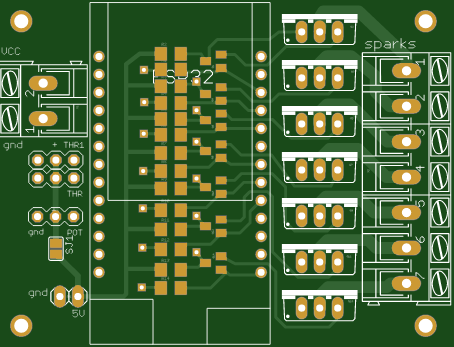
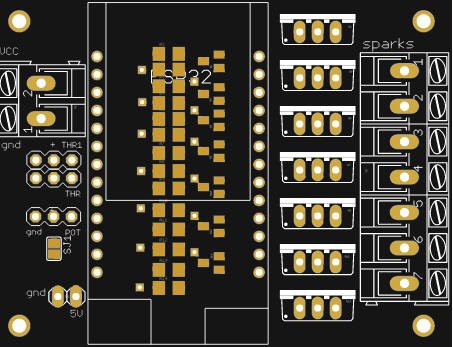
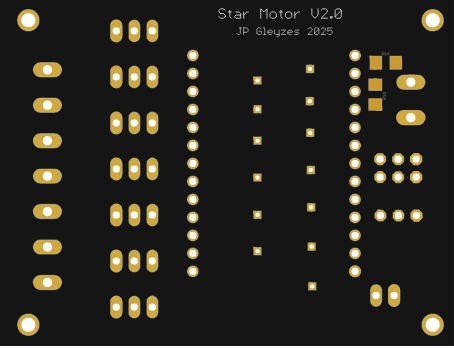
I have designed a nice and compact PCB allowing to fit into an RC plane cockpit.
The PCB was again kindly sponsored by PCBWay and is as usual of excellent quality.

You can order it directly on this project paget. It's cheap, delivered very fast and so professional looking!
The size is almost the same as V1 but with much more components !
You may notice that the ESP32 board is mounted in "mezzanine" allowing to solder all the pull down resistors on the top side of the pcb just under the ESP32.
5V power is coming from the BEC of the ESC via the throttle channel (THR or THR1).
Solder the solder pad SJ1 to allow this behavior. Then connect the 5V to the battery female plug on the ESP32 board.
Software and tests
Here is a first "integration test" of this system, using a single "glow plug" and showing the pre heating function when "throttle" is changing.
software
software is quite simple and source code is available on my github pages
To compile this code you will need version 1.0.6 of Expressif ESP32 boards and select Wemos Lolin32 board.
There is nothing special to say for this simple code. Most of the "clever" part is when applying power to the plugs.
void cycleSparks() {
if (Vbat > 3.5) THR = speedRaw;
else THR = 0; //will stop sparks if battery is low
power = maxPower + 200*Vbat -800 ; //linear fit from 1780 to 1680 when Vbat goes from 4.0V to 3.5V
if (power < 1500) power = 1500;
/// map(value, fromLow, fromHigh, toLow, toHigh)
dutyCycle = map(THR, startThr, 1000, power, MIN_POWER);
if (THR < startThr) dutyCycle = 2047; //will stop sparks is throttle is low
for (int i = 0; i < 7; i++) { //else output PWM on each spark
ledcWrite(channels[i], dutyCycle);
}
if (THR > 0) {
Serial.print("switch on spark (throttle / dutyCycle / maxPower ) ");
Serial.print(THR);
Serial.print(" / ");
Serial.print(dutyCycle);
Serial.print(" / ");
Serial.print(maxPower);
Serial.print(" V bat = ");
Serial.println(Vbat);
}
}
- Battery voltage is read and used to shut down the glowing elements when it is too low (to protect against under discharge).
- Throttle power is mapped between maxPower and MIN_POWER. maxPower is tuned with the battery voltage in order to balance voltage variations of the battery.
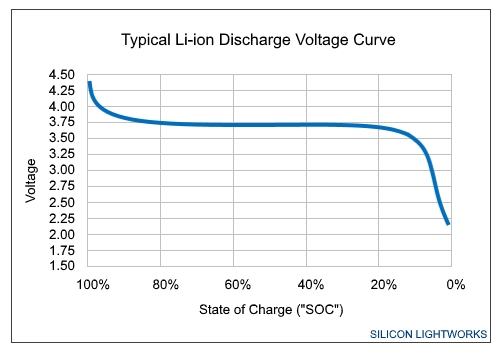
This formula has been tuned on our glowing elements and should be refined for other batches as resistivity of each plug may vary quite a lot...
power = maxPower + 200*Vbat -800 ; //linear fit from 1780 to 1680 when Vbat goes from 4.0V to 3.5V
Here is the result when using a poor 1s3p 18650 battery made with old battery packs...
This is the reason why we only get 7A from this pack which is barely enough to glow the sparks...
However we can clearly see the "throttle effect", plugs only glow when throttle is low and decreases when throttle increases !
We will now solder a more powerful battery pack and next video will show the system running on the motor !
Serious game
Here is the setup for a "serious" test on the bench.
Motor is fixed on a bed, hot plug preheater is connected on a big 10Ah 1s li_Ion pack.
The propeller is an impressive 18x6 wooden one.
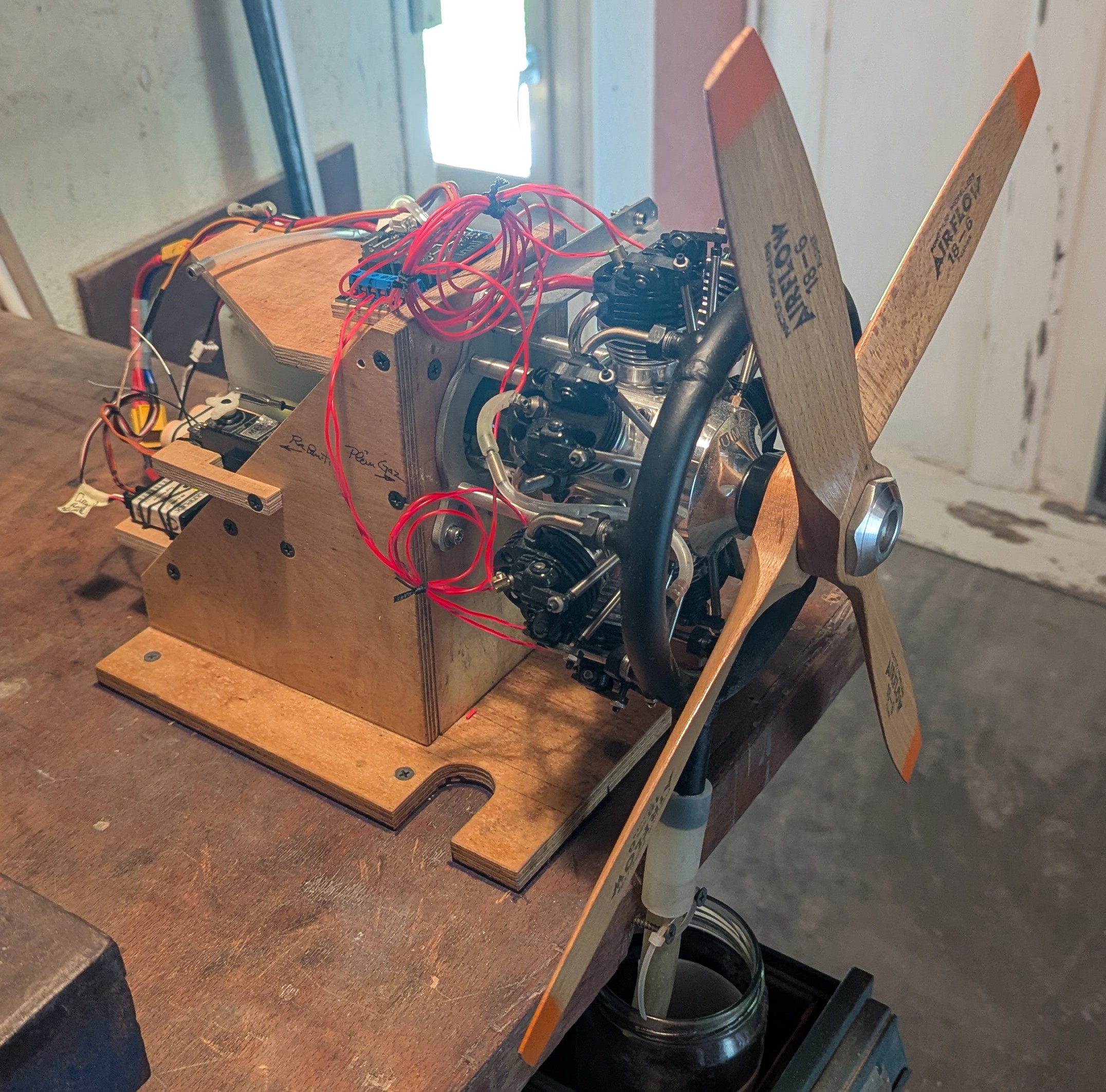
What you will see now is a "cold start". Meaning that the motor is at ambiant temperature 15°C and will start with the pre heater.
Let's enjoy the music of this marvel !
Obviously the preheater is working, but we wanted to see how efficient it was. So here is a test withthe motor already hot, minimum throttle and then disconnecting the pre heater.
So the effficiency of the system has no longer to be proven. The motor can be started at very throttle and keeps a quiet rythm. If we disconenct it then it stalls which was expected !
To finish this project here is a warm start done manually. And , for the sake of art, the video will slow down between 20 and 30s for you to enjoy the motion of the rocker rods !
appreciate the wonder of this precision mechanics !
ESP32_StarMotor_glow plugs heater _ V2
Project images are for reference only. Actual production is based on the manufacturing files on the project page.
Please review the designer's notes (e.g., PCB thickness) and select the appropriate options.
PCBWay is not responsible
for issues caused by unsuitable parameter selections.
For more important ordering information, please refer to
Read More


Raspberry Pi 5 7 Inch Touch Screen IPS 1024x600 HD LCD HDMI-compatible Display for RPI 4B 3B+ OPI 5 AIDA64 PC Secondary Screen(Without Speaker)
BUY NOW


- Comments(0)
- Likes(0)
More by Jean-Pierre Gleyzes
-
 RC radial engine spark plug heater
BackgroundMy friend bought this wonderful engine from UMS_technologiesIt's a 7 cylinders star engine...
RC radial engine spark plug heater
BackgroundMy friend bought this wonderful engine from UMS_technologiesIt's a 7 cylinders star engine...
-
 Convert a DC motor into a stepper one
This project is a way to convert a DC motor into a stepper motor.Of course "conversion" will not be ...
Convert a DC motor into a stepper one
This project is a way to convert a DC motor into a stepper motor.Of course "conversion" will not be ...
-
 OpenxSensor variometer and telemetry for RC planes
Ever wanted a very cheap variometer on your RC glider ?battery voltage monitoring ?extra RC channels...
OpenxSensor variometer and telemetry for RC planes
Ever wanted a very cheap variometer on your RC glider ?battery voltage monitoring ?extra RC channels...
-
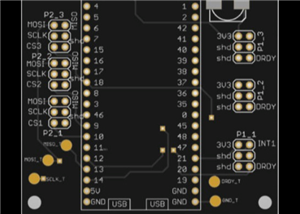 ESP32-S3 3 x ADXL357 acquisition board
SpecificationMy son wanted a high accuracy accelerometer board to characterize a vibrating pot.Here ...
ESP32-S3 3 x ADXL357 acquisition board
SpecificationMy son wanted a high accuracy accelerometer board to characterize a vibrating pot.Here ...
-
 ESP32 Linky Teleinfo (TIC) to MQTT – Real-Time Home Assistant Integration
The teleinfo component allows you to retrieve data from a French electrical counter using Teleinform...
ESP32 Linky Teleinfo (TIC) to MQTT – Real-Time Home Assistant Integration
The teleinfo component allows you to retrieve data from a French electrical counter using Teleinform...
-
 Air Quality station (e-paper and Home Assistant)
OverviewThis DIY air quality monitoring system integrates precision sensors with a connected process...
Air Quality station (e-paper and Home Assistant)
OverviewThis DIY air quality monitoring system integrates precision sensors with a connected process...
-
 2S LiPo High-Current Power Box with two Sbus inputs
Project Overview: 2S LiPo High-Current Power Box with two Sbus inputsThis circuit is a high-performa...
2S LiPo High-Current Power Box with two Sbus inputs
Project Overview: 2S LiPo High-Current Power Box with two Sbus inputsThis circuit is a high-performa...
-
 Power box for big RC plane
Project Overview: 2S LiPo High-Current Power BoxThis circuit is a high-performance power distributio...
Power box for big RC plane
Project Overview: 2S LiPo High-Current Power BoxThis circuit is a high-performance power distributio...
-
 A bluetooth Joystick for TX16s radio (or others)
This project is kind of follow on of this one : Buddy Box for Radiomaster TX16sI decided to write an...
A bluetooth Joystick for TX16s radio (or others)
This project is kind of follow on of this one : Buddy Box for Radiomaster TX16sI decided to write an...
-
 Radiomaster TX16s buddy box (master/trainer and more)
I wanted a wireless buddy box for my Radiomaster TX16sThis buddy box would allow to wireless link tw...
Radiomaster TX16s buddy box (master/trainer and more)
I wanted a wireless buddy box for my Radiomaster TX16sThis buddy box would allow to wireless link tw...
-
 "perpetual" motion ball
Browsing internet and youtube, I found this mind blowing "perpetual motion" device designed by Willi...
"perpetual" motion ball
Browsing internet and youtube, I found this mind blowing "perpetual motion" device designed by Willi...
-
 Freon: Freeze On Neck - 3d printed box top
Freon project is fully describbed on this project page
Freon: Freeze On Neck - 3d printed box top
Freon project is fully describbed on this project page
-
 Freon: Freeze On Neck - 3d printed box bottom
Freon project is fully described on this project page
Freon: Freeze On Neck - 3d printed box bottom
Freon project is fully described on this project page
-
 Freon: Freeze On Neck personal cooler
DescriptionAre you tired of sweltering through hot days, feeling uncomfortable and unproductive?Imag...
Freon: Freeze On Neck personal cooler
DescriptionAre you tired of sweltering through hot days, feeling uncomfortable and unproductive?Imag...
-
 ESP32_StarMotor_glow plugs heater _ V2
BackgroundMy friend bought this wonderful engine from UMS_technologiesIt's a 7 cylinders star engine...
ESP32_StarMotor_glow plugs heater _ V2
BackgroundMy friend bought this wonderful engine from UMS_technologiesIt's a 7 cylinders star engine...
-
 RC plane CoG finder
IntroductionAs an intro here is a video of the system runningand another using the LCD displayA litt...
RC plane CoG finder
IntroductionAs an intro here is a video of the system runningand another using the LCD displayA litt...
-
 JP eCatFeeder
Overview In 2017 I published the first iteration of this project. And since then, the cat feeder had...
JP eCatFeeder
Overview In 2017 I published the first iteration of this project. And since then, the cat feeder had...
-
 ESP32_RC_Motor_tester_V2
FeaturesOn an RC plane, propeller performance depends on pitch, diameter, profile, and material.Test...
ESP32_RC_Motor_tester_V2
FeaturesOn an RC plane, propeller performance depends on pitch, diameter, profile, and material.Test...
-
Programmable Mist Maker - XIAO / QT PY Extension
2226 2 2 -
RadioHAT - Raspberry Pi radio development platform
1916 0 4 -
-
-
-
ARPS-2 – Arduino-Compatible Robot Project Shield for Arduino UNO
4093 0 6 -
A Compact Charging Breakout Board For Waveshare ESP32-C3
4857 3 8 -
AI-driven LoRa & LLM-enabled Kiosk & Food Delivery System
5645 2 2 -