Custom Touch panel using TTP223 Capacitive Touch Sensor
TP223 is a capacitive touch sensor module that can detect the touch of a finger or a conductive object. It is a compact and low-cost module that can be easily integrated into various electronic projects.The module has a single touch pad, which can be connected to a microcontroller or a digital input of a circuit. When a user touches the touch pad, the module detects the change in capacitance and outputs a digital signal to indicate the touch.
The TP223 module has a wide operating voltage range of 2.0V to 5.5V, making it compatible with a variety of electronic devices. It also has a built-in power-on reset circuit, which ensures reliable operation during power-up.The TP223 module is commonly used in various applications such as touch switches, touch lamps, touch sensors, and other human-machine interfaces. It is easy to use, requires minimal external components, and has low power consumption, making it an excellent choice for battery-powered devices.
Overall, the TP223 capacitive touch sensor module is a versatile and reliable touch sensor module that can be used in a wide range of electronic projects.
 TTP223 Capacitive Touch Sensor
Pin Configuration of TTP223 Touch Sensor
The touch sensor as you can see in the picture above consists of only three pins. These are the signal, VCC, and GND pins.
The OUT pin is connected with the digital pin of Arduino board. This will be set up as an input. When pressure will be applied at the sensor’s surface, the signal will be 1 or HIGH. Other wise it will be 0 or LOW.
The VCC pin is connected with the power pin of the Arduino. The touch sensor module supports 2.0-5.5V DC power supply. We will connect this pin with Arduino 5V pin.
The GND pin is connected with the GND of the Arduino board.
 Pin diagram of TTP223 Capacitive Touch Sensor
Features of TTP223 Capacitive Touch Sensor
The response time max 220mS at low power mode @VDD=3V
Sensitivity can adjust by the capacitance(0~50pF) outside
Stable touching detection of the human body for replacing traditional direct switch key
Provides Low Power mode
Provides direct mode、toggle mode by pad option(TOG pin) Q pin is CMOS output
All output modes can be selected active high or active low by pad option(AHLB pin)
Operating voltage 2.0V~5.5V
Operating current @VDD=3V, no load
At low power mode typical 1.5uA, maximum 3.0uA
After power-on have about 0.5sec stable-time, during the time do not touch the keypad, And the function is disabled
Auto calibration for life.
At low power mode, the re-calibration period is about 4.0sec normally,
When key detected touch and released touch, the auto re-calibration will be redoing after about 16sec from releasing key
The sensitivity of TTP223N-BA6 is better than TTP223-BA6’s. But the stability of TTP223N-BA6 is worse than TTP223-BA6’s.
Modes / Configuration of TTP223 Touch Sensor
There are four different configurations for this touch switch, which is explained below in details.
 Modes of TTP223 Capacitive Touch Sensor
Config 1:
To obtain configuration one both A and B terminals should be in open position.
Default output state will be LOW
Changes the state (to HIGH) when a touch is detected and will be back to the default state when touch is released
Config 2:
To obtain configuration one both A should be open and B should be closed position.
Default output state will be LOW
Changes the state when a touch is detected and remains on that state until another touch is detected.
Config 3:
To obtain configuration one both A should be closed and B should be in open position.
Default output state will be HIGH
Changes the state (to LOW) when a touch is detected and will be back to the default state when touch is released
Config 4:
To obtain configuration one both A and B terminals should be closed position.
Default output state will be HIGH
Changes the state when a touch is detected and remains on that state until another touch is detected.
Touch sensitivity Adjustment
The TP223 capacitive touch sensor module's sensitivity can be adjusted by adding a capacitor. The value of the capacitor can range from 0 to 50 pf, with 0 pf providing maximum sensitivity, and 50 pf providing the lowest sensitivity.
For example, if you want to use the touch switch through a glass or acrylic material, you may need to adjust the sensitivity based on the thickness of the material. Adding a capacitor with an appropriate value can increase or decrease the sensitivity of the touch sensor, allowing it to detect touches through the material.
In general, adjusting the sensitivity of the TP223 module can help optimize its performance for different applications and environments. By adding or removing capacitors, you can fine-tune the module's sensitivity to meet specific requirements and improve its reliability and accuracy.
For full Project :
https://electronicsworkshops.com/2023/03/24/interfacing-ttp223-capacitive-touch-sensor-with-arduino/
Custom Touch panel using TTP223 Capacitive Touch Sensor
Project images are for reference only. Actual production is based on the manufacturing files on the project page.
Please review the designer's notes (e.g., PCB thickness) and select the appropriate options.
PCBWay is not responsible
for issues caused by unsuitable parameter selections.
For more important ordering information, please refer to
Read More








Raspberry Pi 5 7 Inch Touch Screen IPS 1024x600 HD LCD HDMI-compatible Display for RPI 4B 3B+ OPI 5 AIDA64 PC Secondary Screen(Without Speaker)
BUY NOW

- Comments(0)
- Likes(1)
More by Rabin Poudel
-
 Automatic Water Pump Control System Using ESP-12F
IntroductionWater scarcity and wastage are major challenges in residential, agricultural, and indust...
Automatic Water Pump Control System Using ESP-12F
IntroductionWater scarcity and wastage are major challenges in residential, agricultural, and indust...
-
 Flood Detection and warning system using LORA and Arduino
IntroductionFloods are one of the most devastating natural disasters, causing immense damage to life...
Flood Detection and warning system using LORA and Arduino
IntroductionFloods are one of the most devastating natural disasters, causing immense damage to life...
-
 DIY LED Decoration Tiny Star PCB Project
IntroductionThe Tiny Star PCB is a small and fun DIY electronics project that is perfect for hobbyis...
DIY LED Decoration Tiny Star PCB Project
IntroductionThe Tiny Star PCB is a small and fun DIY electronics project that is perfect for hobbyis...
-
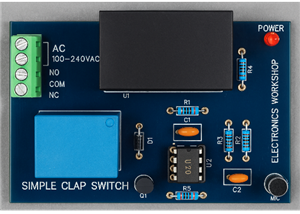 Simple and Cheap Clap Switch Circuit
IntroductionThe Simple and Cheap Clap Switch Circuit is a practical and fun DIY electronics project ...
Simple and Cheap Clap Switch Circuit
IntroductionThe Simple and Cheap Clap Switch Circuit is a practical and fun DIY electronics project ...
-
 Arduino-based Mist Maker and Hand Dryer
IntroductionIn today’s world, automation and hygiene have become essential, especially in public pla...
Arduino-based Mist Maker and Hand Dryer
IntroductionIn today’s world, automation and hygiene have become essential, especially in public pla...
-
 MPL3115A2 Barometric Pressure, Altitude, and Temperature Sensor
IntroductionThe MPL3115A2 is a highly accurate, low-power digital barometric pressure sensor from NX...
MPL3115A2 Barometric Pressure, Altitude, and Temperature Sensor
IntroductionThe MPL3115A2 is a highly accurate, low-power digital barometric pressure sensor from NX...
-
 E-Speaker Using ESP32
IntroductionThe E-Speaker is a smart, portable, and versatile audio system built using the ESP32 mic...
E-Speaker Using ESP32
IntroductionThe E-Speaker is a smart, portable, and versatile audio system built using the ESP32 mic...
-
 Heart Rate Monitor Circuit Using Photoplethysmography (PPG)
IntroductionHeart rate is a vital physiological parameter that reflects the health and fitness of an...
Heart Rate Monitor Circuit Using Photoplethysmography (PPG)
IntroductionHeart rate is a vital physiological parameter that reflects the health and fitness of an...
-
 Automated Greenhouse Control System using ESP32
IntroductionAn automated greenhouse control system leverages technology to optimize plant growth con...
Automated Greenhouse Control System using ESP32
IntroductionAn automated greenhouse control system leverages technology to optimize plant growth con...
-
 STD CH330N USB to Serial Converter 5V
IntroductionThe CH330N is a versatile USB-to-serial converter chip that simplifies interfacing betwe...
STD CH330N USB to Serial Converter 5V
IntroductionThe CH330N is a versatile USB-to-serial converter chip that simplifies interfacing betwe...
-
 KY-032 Obstacle avoidance sensor module
IntroductionIntroduction to Obstacle Avoidance SensorsObstacle avoidance sensors are essential compo...
KY-032 Obstacle avoidance sensor module
IntroductionIntroduction to Obstacle Avoidance SensorsObstacle avoidance sensors are essential compo...
-
 BC547 BASED WATER LEVEL INDICATOR
IntroductionA water level indicator using a BC547 transistor is a simple and effective electronic pr...
BC547 BASED WATER LEVEL INDICATOR
IntroductionA water level indicator using a BC547 transistor is a simple and effective electronic pr...
-
 How to Design Own Arduino Wifi shield PCB
OverviewArduino wifi shield connects the Arduino with a wifi chip through the serial communication p...
How to Design Own Arduino Wifi shield PCB
OverviewArduino wifi shield connects the Arduino with a wifi chip through the serial communication p...
-
 DIY Air Quality Tester
OverviewIn this project “DIY Air Quality Tester” we use Node MCU microcontroller and air quality sen...
DIY Air Quality Tester
OverviewIn this project “DIY Air Quality Tester” we use Node MCU microcontroller and air quality sen...
-
 Digital Clock Using Arduino
OverviewIn this project, “Digital clock using Arduino” we will make a PCB board for digital clock an...
Digital Clock Using Arduino
OverviewIn this project, “Digital clock using Arduino” we will make a PCB board for digital clock an...
-
 Bluetooth Controlled car using Arduino
OverviewA Bluetooth Controlled Car Using Arduino is a fascinating DIY project that involves building...
Bluetooth Controlled car using Arduino
OverviewA Bluetooth Controlled Car Using Arduino is a fascinating DIY project that involves building...
-
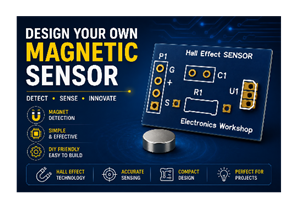 Design a Magnetic Sensor Using S411A
IntroductionMagnetic sensors are widely used in modern electronic systems for detecting the presence...
Design a Magnetic Sensor Using S411A
IntroductionMagnetic sensors are widely used in modern electronic systems for detecting the presence...
-
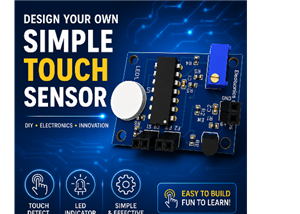 Design Simple Touch Sensor Using LM324
IntroductionTouch sensors have become an essential part of modern electronic devices, replacing trad...
Design Simple Touch Sensor Using LM324
IntroductionTouch sensors have become an essential part of modern electronic devices, replacing trad...
-
SmallOLED - Live PC Stats, Animated Clocks & Audio Visualizer
636 0 3 -
"Talking Multimeter": Arduino-Based Speech Add-on for Multimeters with SCPI Protocol
364 0 1 -
Programmable Mist Maker - XIAO / QT PY Extension
2802 2 3 -
RadioHAT - Raspberry Pi radio development platform
2404 0 4 -
-
-
-
ARPS-2 – Arduino-Compatible Robot Project Shield for Arduino UNO
4496 0 6