

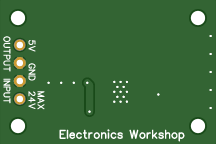
MP2307 5V to 24V Buck Converter
Introduction
If you've ever needed to step down a higher DC voltage say, from a 12V or 24V source down to a clean, stable 5V rail without burning power as heat, a linear regulator just won't cut it efficiently. That's where the MP2307 buck converter comes in. In this project blog, I'll walk through exactly how I designed, built, and tested a 5V output buck converter using the MP2307 switching regulator IC covering the schematic, component selection math, PCB considerations, and bench-tested performance numbers.
For Full Project
https://electronicsworkshops.com/mp2307-5v-buck-converter-a-complete-project-build-guide/
What Is the MP2307?
The MP2307 is a monolithic synchronous buck regulator manufactured by Monolithic Power Systems (MPS). It integrates a pair of low-resistance 100mΩ power MOSFETs on-chip, which is what allows it to deliver up to 3A of continuous load current across a wide input voltage range — without needing an external Schottky diode. That low on-resistance is a big part of why this chip runs cool and efficient even at full load.
Key headline specs that make it a popular choice for hobbyist and professional power supply projects alike:
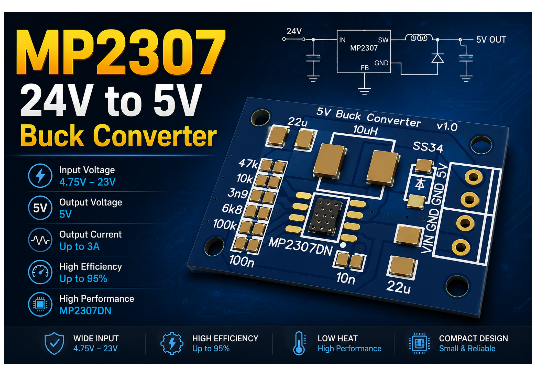
Input voltage range: 4.75V to 23V
Output current: up to 3A continuous
Integrated MOSFETs: 100mΩ on-resistance, synchronous (high-side + low-side) — no external diode needed
Fixed switching frequency: 340kHz
Output voltage: adjustable via a resistor divider (down to 0.925V reference), or fixed-output variants are available
Package: typically available in SO8 / TSOT23-8 style packages, useful for moderately compact builds
Because the MOSFETs are synchronous and low-resistance, conduction losses stay low and efficiency commonly lands in the 90–95% range depending on input/output voltage and load — a massive improvement over a linear regulator, which simply dissipates the voltage difference as heat.
Why Build a Buck Converter Instead of Using a Linear Regulator
This is usually the first question that comes up, so let's settle it with the math. Say you have a 12V input and need 5V at 2A output.
Linear regulator (e.g., LM7805): Power dissipated = (Vin − Vout) × Iout = (12 − 5) × 2 = 14W wasted as heat
MP2307 buck converter at ~92% efficiency: Output power = 5 × 2 = 10W. Input power ≈ 10 / 0.92 ≈ 10.87W. Power lost ≈ 0.87W
That's the difference between needing a large heatsink and fan versus a small IC that barely gets warm. For battery-powered or thermally constrained projects, this isn't optional — it's essential.
Project Goals and Specifications
Circuit Design and Schematic
The MP2307 reference application circuit follows a classic synchronous buck topology. The core building blocks are:
Input bulk capacitor (Cin) — buffers the input rail and supplies the pulsed current the switching MOSFET demands.
MP2307 IC — handles switching, current limiting, soft-start, and thermal shutdown internally.
Inductor (L1) — stores and releases energy each switching cycle, smoothing the pulsed switch-node voltage into a DC current.
Output capacitor (Cout) — filters the inductor ripple current into a clean DC output voltage.
Feedback resistor divider (R1, R2) — sets the output voltage by feeding a scaled-down version of Vout back to the FB pin, compared against the internal 0.925V reference.
Compensation network (Rc, Cc) — stabilizes the control loop, since the MP2307 uses voltage-mode control with external compensation.
Bootstrap capacitor (Cboot) — drives the high-side MOSFET gate above the input rail.
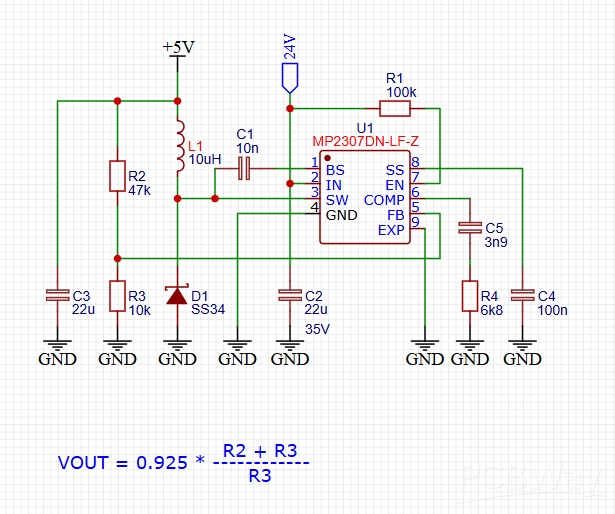
The signal flow is straightforward: input power enters at Cin, gets chopped by the internal high-side/low-side MOSFETs at 340kHz, smoothed by the L1–Cout filter, and the resulting DC output is sampled by the feedback divider to keep the loop regulated at exactly 5V.
The MP2307 reference application circuit follows a classic synchronous buck topology. The core building blocks are:
Input bulk capacitor (Cin) — buffers the input rail and supplies the pulsed current the switching MOSFET demands.
MP2307 IC — handles switching, current limiting, soft-start, and thermal shutdown internally.
Inductor (L1) — stores and releases energy each switching cycle, smoothing the pulsed switch-node voltage into a DC current.
Output capacitor (Cout) — filters the inductor ripple current into a clean DC output voltage.
Feedback resistor divider (R1, R2) — sets the output voltage by feeding a scaled-down version of Vout back to the FB pin, compared against the internal 0.925V reference.
Compensation network (Rc, Cc) — stabilizes the control loop, since the MP2307 uses voltage-mode control with external compensation.
Bootstrap capacitor (Cboot) — drives the high-side MOSFET gate above the input rail.
The signal flow is straightforward: input power enters at Cin, gets chopped by the internal high-side/low-side MOSFETs at 340kHz, smoothed by the L1–Cout filter, and the resulting DC output is sampled by the feedback divider to keep the loop regulated at exactly 5V.
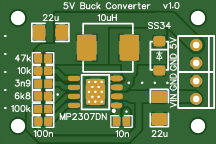
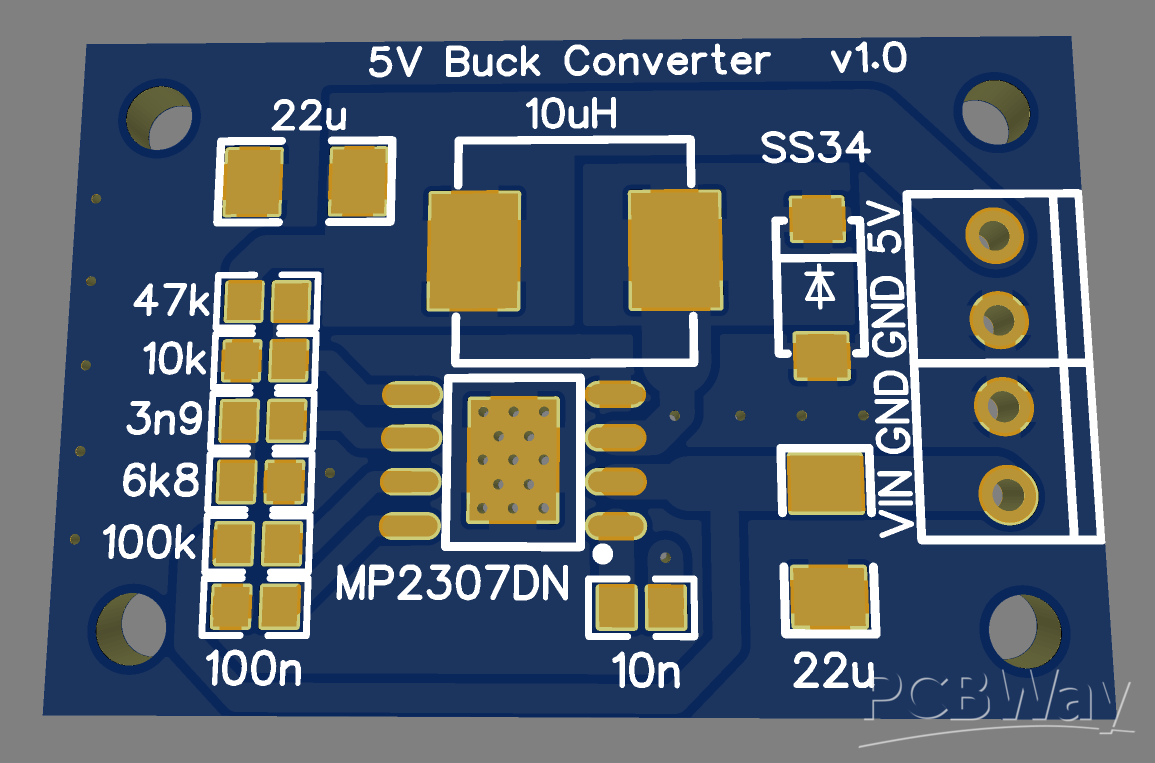
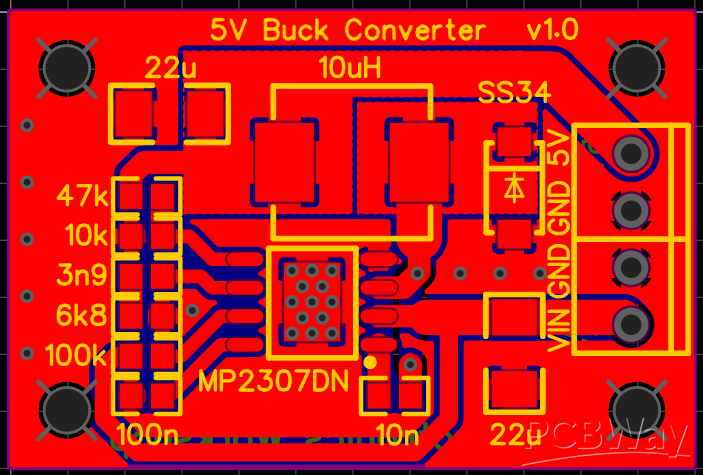
PCB Image
Conclusion
The MP2307 remains one of the most practical chips for a 5V buck converter project thanks to its integrated synchronous MOSFETs, simple external component count, and forgiving design margins. With careful attention to inductor selection, output capacitor ESR, and PCB layout — particularly around the switch node and feedback trace — it's straightforward to hit 90%+ efficiency in a compact footprint.
If you're working on a similar power supply build, the calculations above (feedback divider, inductor sizing, and capacitor selection) apply broadly to most MP2307-based designs, not just this specific 5V/2A target — adjust the divider ratio and component values for your own input/output requirements.
For Full Project
https://electronicsworkshops.com/mp2307-5v-buck-converter-a-complete-project-build-guide/
Best Electronics Calculator
Numerical Calculator offers the best collection of electronics calculators including Ohm's Law, PCB Trace Width, Voltage Drop, LED Resistor, Battery, Power, and Circuit Design tools - all in one place. Numerical Calculator The Ultimate Electronics Calculation Platform for Engineers, Technicians, Students, and PCB Designers. Fast, Accurate, and Free!
https://numericalcalculator.com/
MP2307 5V to 24V Buck Converter
Project images are for reference only. Actual production is based on the manufacturing files on the project page.
Please review the designer's notes (e.g., PCB thickness) and select the appropriate options.
PCBWay is not responsible
for issues caused by unsuitable parameter selections.
For more important ordering information, please refer to
Read More


Raspberry Pi 5 7 Inch Touch Screen IPS 1024x600 HD LCD HDMI-compatible Display for RPI 4B 3B+ OPI 5 AIDA64 PC Secondary Screen(Without Speaker)
BUY NOW

- Comments(0)
- Likes(0)
More by Rabin Poudel
-
 Automatic Water Pump Control System Using ESP-12F
IntroductionWater scarcity and wastage are major challenges in residential, agricultural, and indust...
Automatic Water Pump Control System Using ESP-12F
IntroductionWater scarcity and wastage are major challenges in residential, agricultural, and indust...
-
 Flood Detection and warning system using LORA and Arduino
IntroductionFloods are one of the most devastating natural disasters, causing immense damage to life...
Flood Detection and warning system using LORA and Arduino
IntroductionFloods are one of the most devastating natural disasters, causing immense damage to life...
-
 DIY LED Decoration Tiny Star PCB Project
IntroductionThe Tiny Star PCB is a small and fun DIY electronics project that is perfect for hobbyis...
DIY LED Decoration Tiny Star PCB Project
IntroductionThe Tiny Star PCB is a small and fun DIY electronics project that is perfect for hobbyis...
-
 Simple and Cheap Clap Switch Circuit
IntroductionThe Simple and Cheap Clap Switch Circuit is a practical and fun DIY electronics project ...
Simple and Cheap Clap Switch Circuit
IntroductionThe Simple and Cheap Clap Switch Circuit is a practical and fun DIY electronics project ...
-
 Arduino-based Mist Maker and Hand Dryer
IntroductionIn today’s world, automation and hygiene have become essential, especially in public pla...
Arduino-based Mist Maker and Hand Dryer
IntroductionIn today’s world, automation and hygiene have become essential, especially in public pla...
-
 MPL3115A2 Barometric Pressure, Altitude, and Temperature Sensor
IntroductionThe MPL3115A2 is a highly accurate, low-power digital barometric pressure sensor from NX...
MPL3115A2 Barometric Pressure, Altitude, and Temperature Sensor
IntroductionThe MPL3115A2 is a highly accurate, low-power digital barometric pressure sensor from NX...
-
 E-Speaker Using ESP32
IntroductionThe E-Speaker is a smart, portable, and versatile audio system built using the ESP32 mic...
E-Speaker Using ESP32
IntroductionThe E-Speaker is a smart, portable, and versatile audio system built using the ESP32 mic...
-
 Heart Rate Monitor Circuit Using Photoplethysmography (PPG)
IntroductionHeart rate is a vital physiological parameter that reflects the health and fitness of an...
Heart Rate Monitor Circuit Using Photoplethysmography (PPG)
IntroductionHeart rate is a vital physiological parameter that reflects the health and fitness of an...
-
 Automated Greenhouse Control System using ESP32
IntroductionAn automated greenhouse control system leverages technology to optimize plant growth con...
Automated Greenhouse Control System using ESP32
IntroductionAn automated greenhouse control system leverages technology to optimize plant growth con...
-
 STD CH330N USB to Serial Converter 5V
IntroductionThe CH330N is a versatile USB-to-serial converter chip that simplifies interfacing betwe...
STD CH330N USB to Serial Converter 5V
IntroductionThe CH330N is a versatile USB-to-serial converter chip that simplifies interfacing betwe...
-
 KY-032 Obstacle avoidance sensor module
IntroductionIntroduction to Obstacle Avoidance SensorsObstacle avoidance sensors are essential compo...
KY-032 Obstacle avoidance sensor module
IntroductionIntroduction to Obstacle Avoidance SensorsObstacle avoidance sensors are essential compo...
-
 BC547 BASED WATER LEVEL INDICATOR
IntroductionA water level indicator using a BC547 transistor is a simple and effective electronic pr...
BC547 BASED WATER LEVEL INDICATOR
IntroductionA water level indicator using a BC547 transistor is a simple and effective electronic pr...
-
 How to Design Own Arduino Wifi shield PCB
OverviewArduino wifi shield connects the Arduino with a wifi chip through the serial communication p...
How to Design Own Arduino Wifi shield PCB
OverviewArduino wifi shield connects the Arduino with a wifi chip through the serial communication p...
-
 DIY Air Quality Tester
OverviewIn this project “DIY Air Quality Tester” we use Node MCU microcontroller and air quality sen...
DIY Air Quality Tester
OverviewIn this project “DIY Air Quality Tester” we use Node MCU microcontroller and air quality sen...
-
 Digital Clock Using Arduino
OverviewIn this project, “Digital clock using Arduino” we will make a PCB board for digital clock an...
Digital Clock Using Arduino
OverviewIn this project, “Digital clock using Arduino” we will make a PCB board for digital clock an...
-
 Bluetooth Controlled car using Arduino
OverviewA Bluetooth Controlled Car Using Arduino is a fascinating DIY project that involves building...
Bluetooth Controlled car using Arduino
OverviewA Bluetooth Controlled Car Using Arduino is a fascinating DIY project that involves building...
-
 Design a Magnetic Sensor Using S411A
IntroductionMagnetic sensors are widely used in modern electronic systems for detecting the presence...
Design a Magnetic Sensor Using S411A
IntroductionMagnetic sensors are widely used in modern electronic systems for detecting the presence...
-
 Design Simple Touch Sensor Using LM324
IntroductionTouch sensors have become an essential part of modern electronic devices, replacing trad...
Design Simple Touch Sensor Using LM324
IntroductionTouch sensors have become an essential part of modern electronic devices, replacing trad...
-
Programmable Mist Maker - XIAO / QT PY Extension
1481 2 1 -
RadioHAT - Raspberry Pi radio development platform
1251 0 3 -
-
-
-
ARPS-2 – Arduino-Compatible Robot Project Shield for Arduino UNO
3599 0 6 -
A Compact Charging Breakout Board For Waveshare ESP32-C3
4288 3 8 -
AI-driven LoRa & LLM-enabled Kiosk & Food Delivery System
4670 2 2 -