




|
|
LM386 |
x 1 |

|
KiCADKicad
|
Audio amplifier with LM386 (and BASS boost)
Audio amplifier with LM386 (and BASS boost)
Hello everyone!
Circuit description
The LM386 is quite a versatile chip. Only a few resistors and capacitors are needed to make a working audio amplifier. The chip has options for gain control and bass boost, and can also be turned into an oscillator capable of outputting sine waves or square waves.
There are three variants of the LM386, each with different output powers:
- LM386N-1: 0.325 watts
- LM386N-3: 0.700 watts
- LM386N-4: 1.00 watts
The actual power output you get will depend on the supply voltage and speaker impedance. The datasheet says that these ICs have a wide range of supply voltages: 4V-12V or 5V-18V. Check according to the series of your IC.
The LM386 is a type of operational amplifier (Op-Amp). Op amps have a basic duty. They take an input potential (voltage) and produce an output potential that is tens, hundreds, or thousands of times the magnitude of the input potential. In an amplifier circuit, the LM386 takes an audio input signal and increases its potential anywhere from 20 to 200 times. This amplification is what is called voltage gain.
After building this amp and playing around with the volume and gain controls, you'll notice that both seem to increase or decrease the intensity of the sound coming out of the speaker. So what's the difference then? Gain is the amplification of the input potential and is a characteristic of the amplifier. Volume allows you to adjust the sound level within the amplification range set by the gain. Gain sets the range of possible volume levels. For example, if the gain is set to 20, the volume range is 0 to 20. If the gain is set to 200, the volume range is 0 to 200.
Gain control can be achieved by connecting a 10 μF capacitor between pins 1 and 8. Without a capacitor between pins 1 and 8, the gain will be set to 20. With the 10 μF capacitor, the gain will be set to 200. The gain can be changed to any value between 20 and 200 by placing a resistor (or potentiometer). ) in series with the capacitor.
An interesting feature of the LM386 is the option to add an adjustable bass boost to the amplifier. You will probably find that this is the best sounding circuit. The bass boost is basically just a low pass filter and removes most of the noise that is not removed by the decoupling capacitors. All you need for the bass boost circuit is a 0.033μF capacitor and a 10K Ohm potentiometer in series between pins 1 and 5.
P.S. I am not the original author of this circuit, more details here https://www.circuitbasics.com/build-a-great-sounding-audio-amplifier-with-bass-boost-from-the-lm386/.
Enjoy it!

Audio amplifier with LM386 (and BASS boost)
Project images are for reference only. Actual production is based on the manufacturing files on the project page.
Please review the designer's notes (e.g., PCB thickness) and select the appropriate options.
PCBWay is not responsible
for issues caused by unsuitable parameter selections.
For more important ordering information, please refer to
Read More


Raspberry Pi 5 7 Inch Touch Screen IPS 1024x600 HD LCD HDMI-compatible Display for RPI 4B 3B+ OPI 5 AIDA64 PC Secondary Screen(Without Speaker)
BUY NOW


- Comments(0)
- Likes(3)
 More by cris 🙂
-
 Dynamic decoration with LEDs and more
Hello everyone!As you can see in the title, we have a circuit with LEDs, many LEDs, it's a 4x4 LEDs ...
Dynamic decoration with LEDs and more
Hello everyone!As you can see in the title, we have a circuit with LEDs, many LEDs, it's a 4x4 LEDs ...
-
 LEDs Stars
Hello everyone! I'm signing up for this competition with a small project designed to attract your a...
LEDs Stars
Hello everyone! I'm signing up for this competition with a small project designed to attract your a...
-
 Audio amplifier with LM386 (and BASS boost)
Hello everyone!Circuit descriptionThe LM386 is quite a ve...
Audio amplifier with LM386 (and BASS boost)
Audio amplifier with LM386 (and BASS boost)Hello everyone!Circuit descriptionThe LM386 is quite a ve...
-
 Audio amplifier 25W TDA2030
A fairly well-known and interesting montagePresentationThe presented audi...
Audio amplifier 25W TDA2030
Audio amplifier 25W TDA2030A fairly well-known and interesting montagePresentationThe presented audi...
-
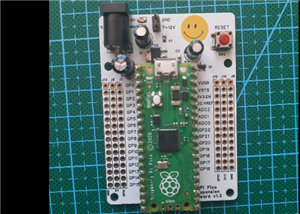 Raspberry Pi Pico Expansion Board
Hello everyone!UPDATE!!!I made some changes, routing in particular, and freed up the board of a few ...
Raspberry Pi Pico Expansion Board
Hello everyone!UPDATE!!!I made some changes, routing in particular, and freed up the board of a few ...
-
 Adjustable voltage power supply
Among the most important electronic devices in the electronics laboratory is the voltage source. Thi...
Adjustable voltage power supply
Among the most important electronic devices in the electronics laboratory is the voltage source. Thi...
-
 Digital Clock with AT89C2051
Circuit OperationShort SW2 presses cycle through displaying the current time in HH:MM and MM:SS form...
Digital Clock with AT89C2051
Circuit OperationShort SW2 presses cycle through displaying the current time in HH:MM and MM:SS form...
-
 Switch based light sensor
Hi!The circuit shown can be used to turn on the light in the garden, or some light panels / advertis...
Switch based light sensor
Hi!The circuit shown can be used to turn on the light in the garden, or some light panels / advertis...
-
 LM3909 flashing indicator
I present to you a circuit which is a little outdated, but quite pleasant for some, I saw that this ...
LM3909 flashing indicator
I present to you a circuit which is a little outdated, but quite pleasant for some, I saw that this ...
-
 LM1084 Regulator
Hello makers! This schematic represents an Adjustable Linear Voltage Regulator (Power Supply) circui...
LM1084 Regulator
Hello makers! This schematic represents an Adjustable Linear Voltage Regulator (Power Supply) circui...
-
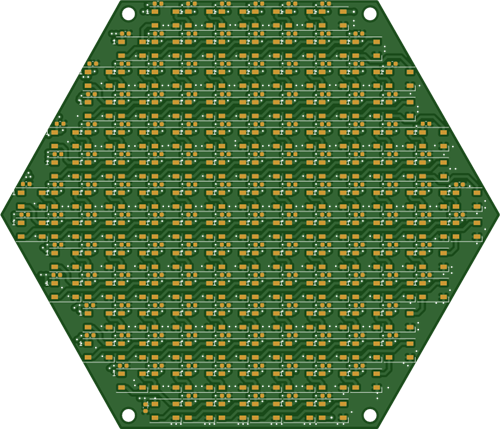 Hexagonal Panel with WS2812B LEDs
Hi makers!I created a hexagonal PCB with many WS2812B LEDs, 144 in total, for which I thought of pla...
Hexagonal Panel with WS2812B LEDs
Hi makers!I created a hexagonal PCB with many WS2812B LEDs, 144 in total, for which I thought of pla...
-
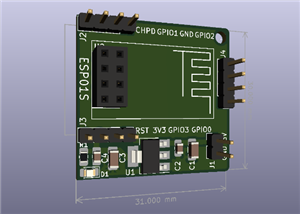 ESP01S Minimal Board
Hi makers!I created this small PCB for ESP01S because before I was using a DIY version and then I bo...
ESP01S Minimal Board
Hi makers!I created this small PCB for ESP01S because before I was using a DIY version and then I bo...
-
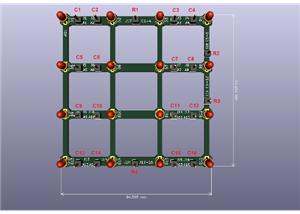 4x4x4 cube with blue LEDs
Hi makers!I know that these days there are many variations of LEDs, for example SMDs are smaller and...
4x4x4 cube with blue LEDs
Hi makers!I know that these days there are many variations of LEDs, for example SMDs are smaller and...
-
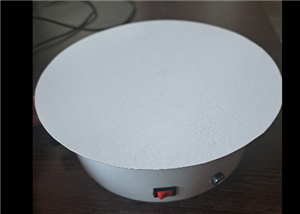 Low cost turntable 😁
Hi makers!I'm entering this competition with a small project that I've wanted to make for some time,...
Low cost turntable 😁
Hi makers!I'm entering this competition with a small project that I've wanted to make for some time,...
-
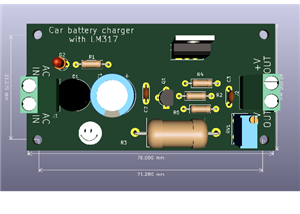 A DIY charger for 12V battery
Hello everyone!I present to you a project that really didn't reach its final state, until recently. ...
A DIY charger for 12V battery
Hello everyone!I present to you a project that really didn't reach its final state, until recently. ...
-
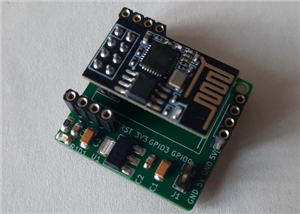 ESP01 board
Hello PCBWayers!You probably know that ESP01S/01 boards can be a little difficult to use in an easie...
ESP01 board
Hello PCBWayers!You probably know that ESP01S/01 boards can be a little difficult to use in an easie...
-
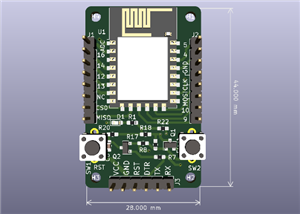 ESP12F Board
Hello makers!Some time ago I had a shopping coupon and I thought about making some simple PCBs with ...
ESP12F Board
Hello makers!Some time ago I had a shopping coupon and I thought about making some simple PCBs with ...
-
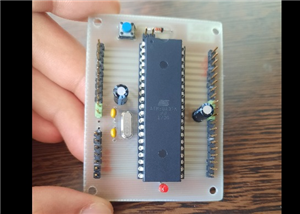 ATMega32 Board
Hi !I remembered this simple project I made for myself, you can use it with an ATMega32 or ATMega16 ...
ATMega32 Board
Hi !I remembered this simple project I made for myself, you can use it with an ATMega32 or ATMega16 ...
-
Programmable Mist Maker - XIAO / QT PY Extension
2142 2 2 -
RadioHAT - Raspberry Pi radio development platform
1822 0 4 -
-
-
-
ARPS-2 – Arduino-Compatible Robot Project Shield for Arduino UNO
4031 0 6 -
A Compact Charging Breakout Board For Waveshare ESP32-C3
4766 3 8 -
AI-driven LoRa & LLM-enabled Kiosk & Food Delivery System
5582 2 2 -