VoltDuo: LM7805-Based 3.3V & 5V Breadboard Power Supply
VoltDuo: LM7805-Based 3.3V & 5V Breadboard Power Supply
OVERVIEW
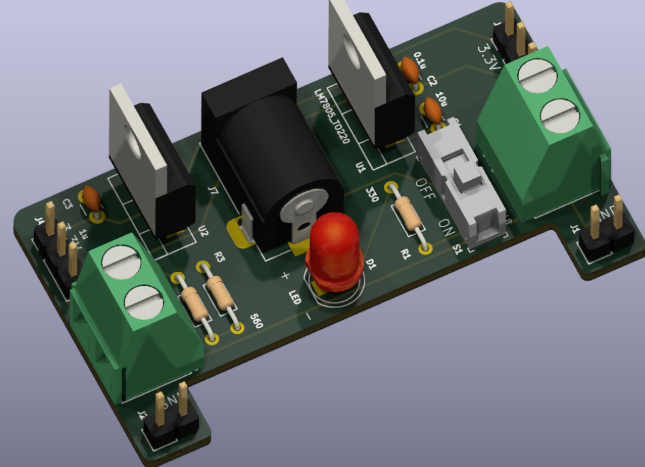
VoltDuo is a compact, through-hole power supply module that delivers a regulated 5V or 3.3V rail directly to a breadboard from a standard DC adapter. It is designed for students, makers and educators who need a clean, dependable power source during prototyping, without improvised jumper wires or unregulated supplies.
THE PROBLEM
Breadboard circuits are commonly powered from unstable USB ports, loose battery clips or unregulated adapters. The result is random resets, noisy sensor readings and, in the worst case, damaged components. The problem is sharper in modern projects, where 5V logic (Arduino, relays, sensors) and 3.3V logic (ESP32 and similar modules) are often used side by side.
THE SOLUTION
VoltDuo takes a single DC input and provides a selectable 5V or 3.3V output through a simple jumper header. A built-in power switch allows the board to be turned on and off without unplugging the adapter, and the outputs are available both as breadboard-ready pins and as a screw terminal for external wiring. The design uses only common, low-cost through-hole parts, so it can be assembled with basic soldering skills.
HOW IT WORKS
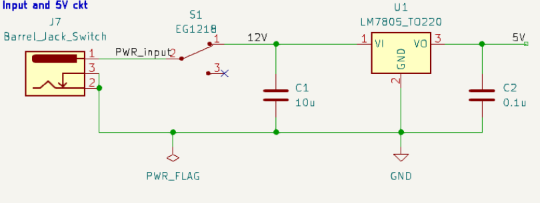
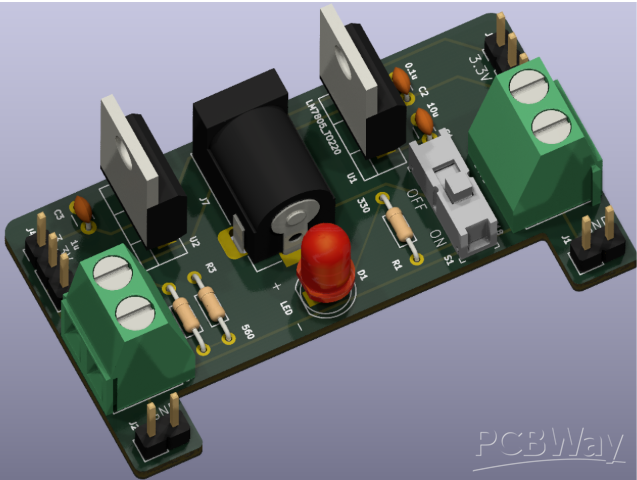
Power enters through a DC barrel jack (J7) and passes through the slide switch (S1), which isolates the entire circuit when off. The input is stabilised by a 10µF capacitor (C1) before reaching the LM7805 linear regulator (U1), which produces a regulated 5V rail. A 0.1µF capacitor (C2) at the output suppresses high-frequency noise and keeps the rail steady under changing load.
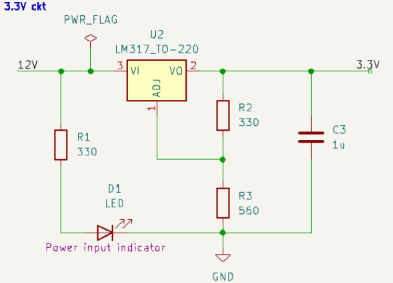
[Describe your 3.3V generation here, e.g. "A second regulator (part number) derives the 3.3V rail from the 5V line."]
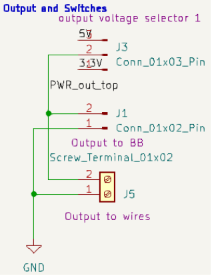
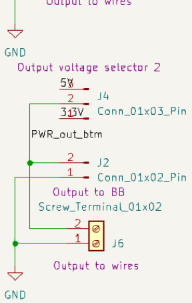
A three-pin header (J3) acts as the voltage selector: placing the jumper chooses between the 5V and 3.3V rail. The chosen voltage is routed to a two-pin header (J1) that mates with the breadboard power rails, and to a two-way screw terminal (J5) for external loads.
PCB DESIGN
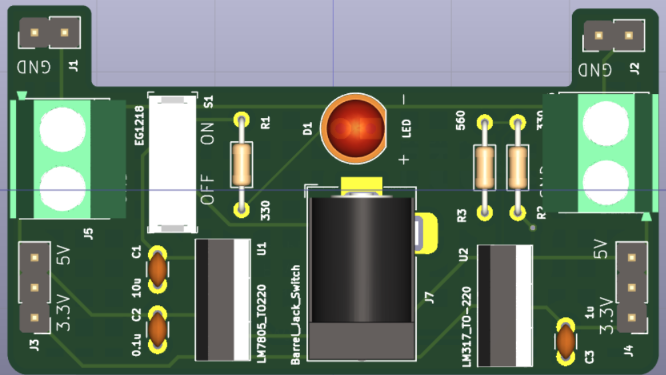
The board is a two-layer design of [82 × 55 mm], laid out to sit neatly on a breadboard. Power traces are kept wide to handle load current with minimal voltage drop, and the ground connection is kept continuous for low noise. All components are through-hole to keep assembly and repair simple. The Gerber files are provided and ready to order directly from PCBWay.
 \
BILL OF MATERIALS
U1 – LM7805 (TO-220), 5V regulator
U2 – [3.3V regulator part number]
C1 – 10µF, input filtering
C2 – 0.1µF, output decoupling
S1 – EG1218 slide switch, power on/off
J7 – DC barrel jack, power input
J3 – 1×3 pin header, voltage selector
J1 – 1×2 pin header, breadboard output
J5 – 2-pin screw terminal, external output
ASSEMBLY AND TESTING
Solder the low-profile parts first (capacitors, headers), followed by the regulators, switch, barrel jack and screw terminal. Before connecting any circuit, apply a [9–12V] DC supply and verify both output voltages with a multimeter. Set the selector jumper to the required rail, confirm the output again, and then connect the board to the breadboard.
PERFORMANCE NOTES
As a linear regulator, the LM7805 dissipates the input-output voltage difference as heat. For best results, use an input close to the lower end of the recommended range, and add a small heatsink for loads approaching [500 mA / your tested value].
APPLICATIONS
Breadboard prototyping, Arduino and ESP32 development, electronics laboratories and classrooms, and student mini-projects.
FUTURE IMPROVEMENTS
Planned revisions include a USB power input option, reverse-polarity protection, status LEDs, a fuse, and an adjustable output stage.
CONCLUSION
VoltDuo turns a common breadboard annoyance into a simple, reliable solution: one adapter, one small board, and clean power at the voltage you need. The complete design files are shared so that anyone caan build, modify and improve it.
Thank you to PCBWay for supporting open hardware and making projects like this possible.
Apply for sponsorship >>- Comments(0)
- Likes(0)
 More by Harsh Parmar
-
 VoltDuo: LM7805-Based 3.3V & 5V Breadboard Power Supply
OVERVIEWVoltDuo is a compact, through-hol...
-
 ESP32 Smart Visitor Counter & Energy Saver
PROJECT TITLECompact Double-Sided ESP32 Smart Visitor Counter & Automatic Room Light Controller ...