HeatSink and Cover for Arduino Uno Q
WHO I AM
I'm Anajana, a freelance firmware engineer and video editor. My work sits at the intersection of embedded systems and edge AI, spanning bare-metal peripheral driver development, general-purpose SBC work, and web development. When I'm not writing firmware, I edit video professionally, which has quietly made me a better engineer — both disciplines reward the same thing: cutting the noise and keeping only what earns its place.
Outside client work, I've been going down a beekeeping-technology rabbit hole — thinking through how low-power sensing and edge inference could monitor hive health without disturbing the colony. It's the kind of side-quest that keeps me restless in a good way.
I'm an electronics enthusiast who's always chasing the next thing I don't fully understand yet — thermal design for compact SBCs being the latest one. This project sits right at that edge: not glamorous, but genuinely useful, and exactly the kind of "boring but necessary" hardware problem I like solving properly instead of half-heartedly.
PROJECT DESCRIPTION
Overview
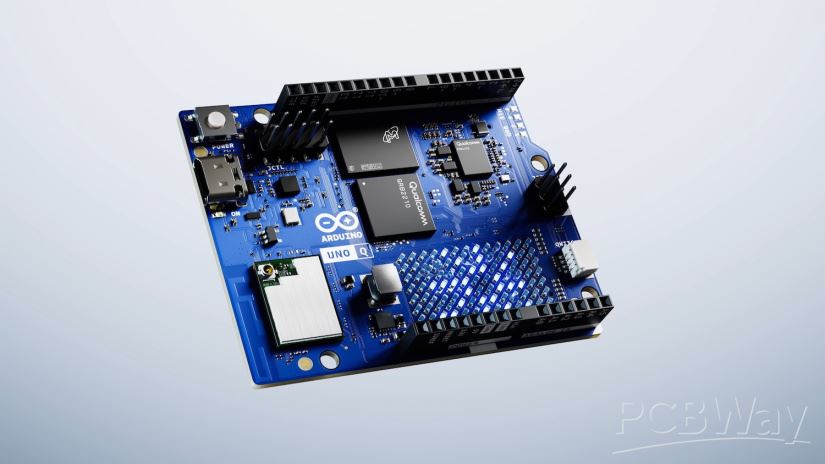
The Arduino UNO Q represents Arduino's first "dual-brain" board developed in partnership with Qualcomm: a quad-core Dragonwing QRB2210 microprocessor (up to 2 GHz, with an integrated GPU, VPU, DSP, and dual ISP) running a full Debian Linux environment, paired with an STM32U585 microcontroller running Zephyr for deterministic real-time control — all fused into the familiar UNO form factor, and notably, designed to run entirely fanless.
This is a significant amount of compute packed into a very small, passively-cooled footprint. It puts edge AI, computer vision, and wireless connectivity within reach of a board the size of a standard Uno — but it also means the board inherits a problem that its predecessors never had to deal with: sustained silicon-level heat generation with no active thermal management built in. This project set out to characterize that problem properly and engineer a solution around it, rather than treating "runs a bit warm" as an acceptable trade-off for the performance on offer.
The Problem, Examined Properly
Rather than assuming the UNO Q needs cooling, I approached this as a question to be answered with evidence. Three structural issues stood out on inspection of the board and its documented architecture:
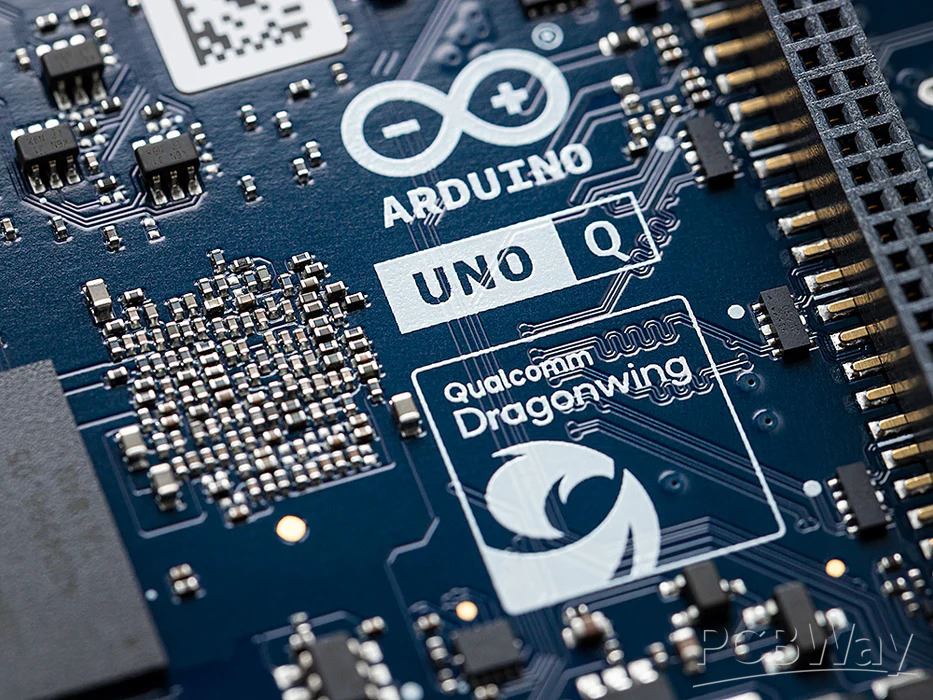
1. High component density and poor thermal spreading The UNO Q integrates its MPU, MCU, power-management ICs, voltage regulators, eMMC storage, and dual-band Wi-Fi/Bluetooth radio into the compact Uno footprint. Packing this much silicon into so little board area is an impressive feat of layout engineering, but it comes at a thermal cost: heat generated at the SoC package has a shorter path to neighboring components before it has anywhere to go, and the PCB itself has less continuous copper area available to act as a heat spreader compared to a larger board carrying the same components.
2. Mechanical fragility inherent to a stackable, densely-populated board The UNO Q is explicitly designed as a carrier board that other shields and Modulino nodes stack onto. That means its top-side components — RGB LEDs, the 8×13 LED matrix, antenna, and header pins — are directly exposed to contact stress every time a shield is mounted, removed, transported, or handled during prototyping. High-density boards are inherently less forgiving of this kind of repeated mechanical stress: solder joints around tightly-packed components (particularly near the SoC and PMIC cluster, where trace and pad spacing is tightest) are more susceptible to fatigue over repeated cycles than they would be on a more sparsely populated board.
3. No headroom for sustained, compute-heavy workloads Because the board is fanless by design, any workload that keeps the GPU, VPU, or DSP busy for an extended period — a continuous vision pipeline, an always-on audio classifier, a long-running inference loop — has only passive convection off bare FR4 to rely on for heat dissipation. Short bursts are not a concern. Sustained load is where the absence of thermal management starts to matter, and it is precisely the use case (persistent edge AI) that the UNO Q is marketed for.
The Solution — Design and Proof
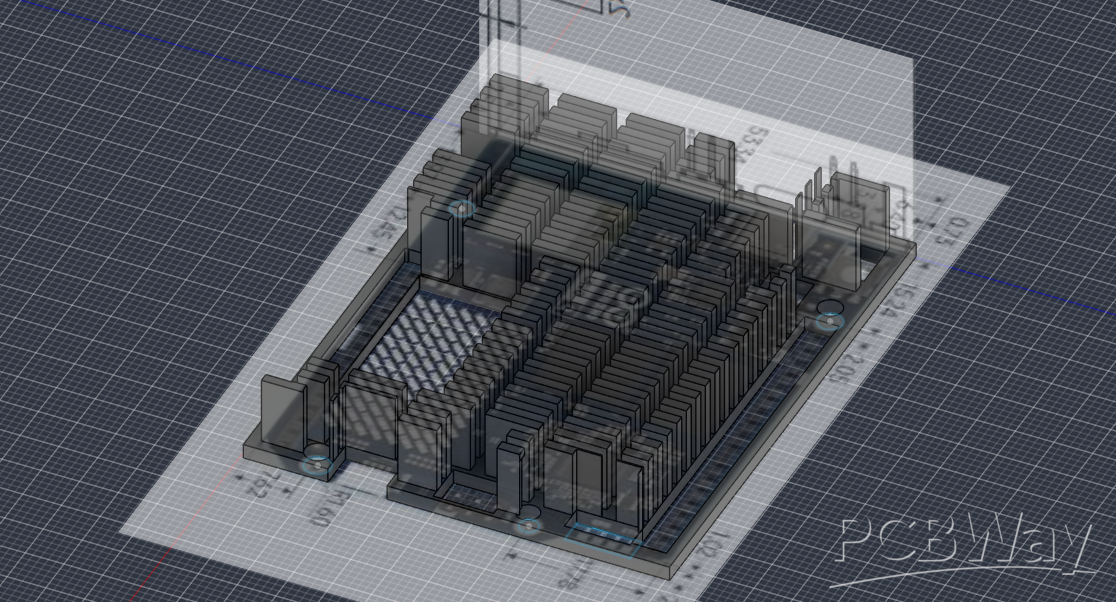
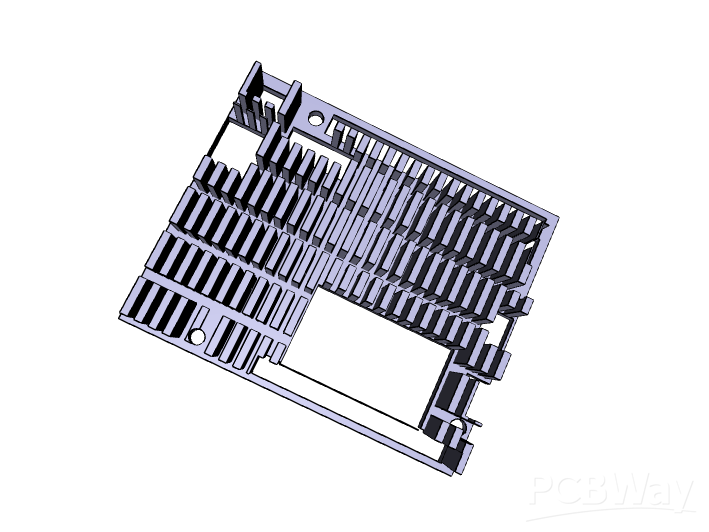
To address both the thermal and mechanical concerns with a single piece of hardware, I designed a passive heat sink that also functions as a protective shield, mounting in the standard Uno shield-stack position without breaking pin compatibility with the rest of the UNO Q ecosystem (Modulino nodes, future carrier boards, etc.).
The design works on two fronts simultaneously:
Thermally, it makes direct contact with the SoC/PMIC package cluster and spreads heat across a substantially larger finned surface area than the bare board alone provides, increasing the effective heat-dissipation area and lowering the board's overall thermal resistance to ambient.
Mechanically, it forms a rigid physical barrier over the exposed top-side components, absorbing contact stress from stacking and handling before it reaches the LEDs, antenna, or header pins — converting a repeated point-load risk into a distributed load the shield itself is designed to take.
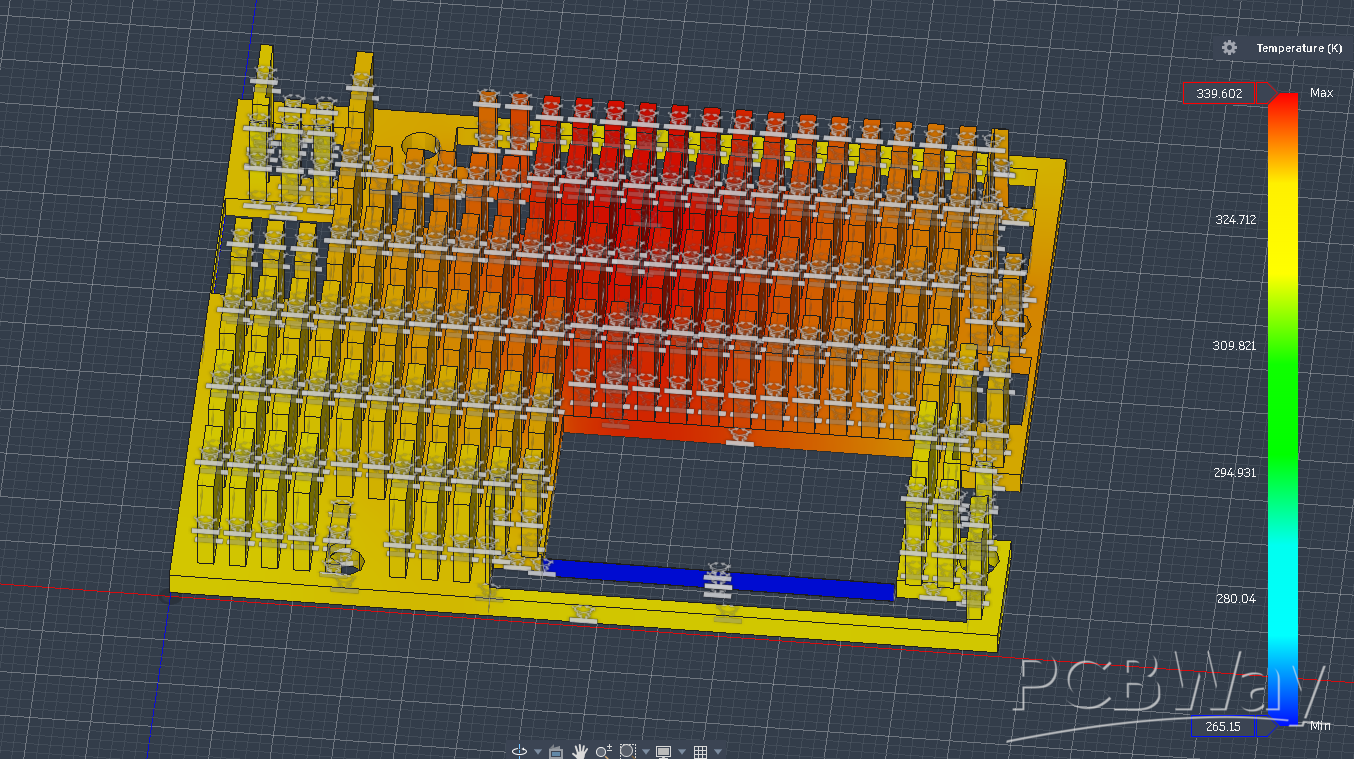
Simulation-based proof of performance: I validated this design with a full thermal simulation under sustained, full-power operating conditions — the worst-case scenario for a fanless board, where the SoC, radio, and peripherals are all active continuously rather than in short bursts. Under this load, the simulation shows the board's peak temperature stabilizing at approximately 55°C. This is a meaningful result for three reasons:
It sits well below the thermal-throttling threshold of the QRB2210 and its surrounding PMICs, meaning the board can sustain full clock speeds indefinitely under load rather than stepping down performance after a few minutes of continuous use.
It demonstrates that a passive solution — no fan, no moving parts, nothing to fail mechanically — is sufficient to fully manage worst-case thermal load on this platform, which matters for reliability in field deployments (e.g. outdoor or enclosed installations where active cooling isn't practical).
It was reached under full-power simulation conditions, not idle or light-load conditions, so the number reflects a genuine worst-case bound rather than a best-case demonstration.
Performance & Efficiency Impact
Sustained throughput: By keeping the SoC comfortably below its thermal-throttling threshold, the board maintains full clock speed through continuous, long-duration workloads instead of degrading performance mid-task — directly relevant for any persistent edge-AI application (vision, audio, environmental monitoring, and similar continuous inference use cases).
Power efficiency: Semiconductor leakage current increases with junction temperature, and voltage regulators run measurably closer to their rated efficiency curve when operating cooler. Holding the board at a lower steady-state temperature therefore has a secondary, compounding benefit on effective power draw per unit of sustained compute, on top of the primary thermal-safety benefit.
Reliability and longevity: Lower steady-state operating temperature reduces thermal cycling amplitude on solder joints across power-on/power-off and load/idle transitions — addressing the fragility concern raised earlier from a second angle (thermal fatigue), complementing the mechanical protection the shield provides against physical handling stress.
Taken together, the simulation results support a clear conclusion: a properly engineered passive heat sink is not a cosmetic addition to the UNO Q, but a genuine enabler of the sustained, full-performance edge-AI workloads the board was designed to run — while simultaneously solving a mechanical durability problem the board has by virtue of its own form factor.
You can download the step file and get one yourself.
WORDS TO PCBWAY
PCBWay,
I'd love your support turning this from a validated simulation into a real, fabricated board. The UNO Q is a genuinely exciting piece of hardware — Arduino's first fanless dual-brain board — but "fanless" and "sustained AI workload" are in quiet tension with each other, and that's a real gap worth solving properly rather than ignoring. I've done the thermal modeling to prove the concept works; what I need now is your manufacturing quality to prove it in copper and get it into other makers' hands. I'm an electronics enthusiast who's always chasing the next thing to learn, and I'd be glad to document the whole fabrication and validation process publicly, crediting PCBWay every step of the way.
Apply for sponsorship >>
- Comments(0)
- Likes(1)