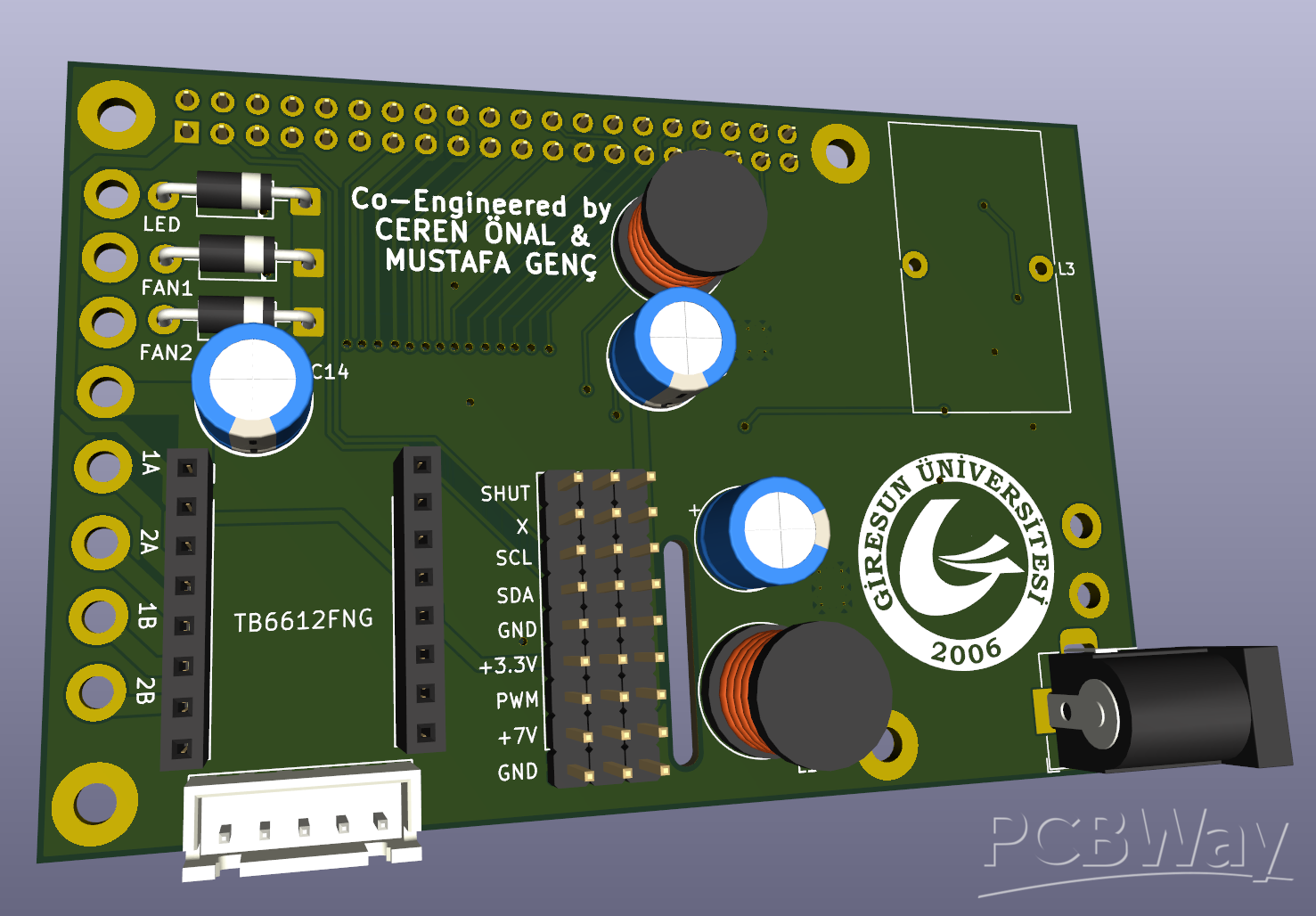
Raspberry Pi 5 Autonomous Robot HAT
## 🍎 What is This Project?
An AI-powered fruit sorting system developed for the
TEKNOFEST Agricultural Technologies competition.
Fruits travel along a conveyor belt into an inspection
chamber. A camera captures each fruit's image and feeds
it to the Raspberry Pi 5, which runs a trained AI vision
model in real time to classify the fruit as healthy or
rotten — in milliseconds.
Based on the AI decision:
✅ Healthy fruit → Servo arm stays closed →
fruit continues on the belt to the next stage
❌ Rotten fruit → Servo arm opens →
fruit is deflected off the belt to the reject bin
The entire process is fully autonomous, requiring
zero human intervention on the sorting line.
---
## ❓ Why Did We Design a Custom PCB?
When we started building the fruit sorting system, the
first question was: how do we power and control all of
this from a Raspberry Pi 5?
The Raspberry Pi 5 is a powerful single-board computer
but it is not designed to directly drive motors, servos,
fans, or high-current LEDs. Its GPIO pins output only
3.3V at a few milliamps — far from enough to run a
real-world electromechanical sorting system.
Off-the-shelf solutions created more problems than they
solved:
- Separate motor driver boards, servo controllers, and
power distribution modules would require a rats nest
of wiring between components
- Multiple power supplies for different voltage rails
(5V logic, 7V servos, 12V motors) with no clean
integration
- No unified solar + adapter dual-source input on any
ready-made board
- No compact form factor that mounts cleanly on the Pi
- Impossible to fit inside a compact sorting machine
enclosure with loose modules everywhere
The solution was clear: design a single, purpose-built
HAT that handles everything in one board — power,
motor drive, servo control, sensing interfaces,
illumination, and cooling.
---
## ⚙️ How It Works — Step by Step
1. DC motor drives the conveyor belt at a controlled speed
2. 3x laser ToF distance sensors detect when a fruit
enters the inspection zone and trigger the camera
3. Raspberry Pi 5 captures the image and runs the
AI classification model (trained on healthy/rotten
fruit datasets)
4. AI outputs a decision: healthy or rotten
5. If rotten: MG996R servo arm actuates, deflecting
the fruit to the reject channel
6. If healthy: servo holds position, fruit passes through
7. 28BYJ-48 stepper motor handles auxiliary
positioning/guidance mechanisms
8. LED lighting (Q1) provides constant, uniform
illumination inside the inspection chamber for
consistent AI vision input regardless of
ambient light conditions
9. Dual fans (Q2, Q3) keep the HAT's power components
and Raspberry Pi 5 cool during continuous
AI inference workload
---
## 🎯 What This HAT Solves
### 1. Unified Power Management
One board, two input sources (solar + 12V adapter),
three regulated output rails (5V, 7V, 12V) — all with
proper protection diodes, current sensing, and filtering.
No external power distribution board needed.
### 2. Logic Level Translation
Raspberry Pi 5 GPIO operates at 3.3V. Servos and the
TB6612FNG motor driver need 5V logic.
The SN74AHCT125DR level shifter on the HAT bridges
this gap transparently — no external modules required.
### 3. Controlled Illumination (Q1 — AO3400A)
AI vision quality depends entirely on consistent
lighting. Any variation in ambient light causes the
model's accuracy to drop dramatically.
The HAT provides a dedicated MOSFET-switched LED
output (Q1) that the Raspberry Pi 5 controls directly
via GPIO — ensuring the inspection chamber is always
illuminated at exactly the same intensity, regardless
of environment.
### 4. Dual Fan Thermal Management (Q2, Q3 — AO3400A)
Running a real-time AI vision model on Raspberry Pi 5
continuously generates significant heat. In an enclosed
sorting machine enclosure this becomes critical.
Two independent PWM-controlled fan outputs (Q2, Q3)
allow the system to manage thermal performance
intelligently:
- Q2: Cools the HAT's power components
(regulators, motor driver)
- Q3: Dedicated airflow for the Raspberry Pi 5
during peak AI inference load
### 5. Compact, Competition-Ready Form Factor
At exactly 85mm x 56mm — the Raspberry Pi 5 HAT
standard — the board stacks directly on top of the
Pi with no additional mounting hardware.
The entire compute + power + control stack fits in
the palm of your hand, making mechanical integration
inside the sorting machine enclosure straightforward.
### 6. Solar-Ready for Field Deployment
Agricultural sorting shouldn't be limited to
facilities with wall power. The HAT's dual-source
input (12V adapter + 100W solar panel) means the
system can operate anywhere — in a barn, in a
field, or at a TEKNOFEST demonstration booth.
---
## ⚡ Power Architecture — Dual Source (Solar + Adapter)
Designed for both field deployment and indoor use:
- J1: 12V / 6A DC Barrel Jack — indoor/workshop use
- J2: 100W Solar Panel input (~17V) — outdoor field use
Both sources are OR-ed via SS10100-SMC Schottky diodes
(10A/100V) to prevent back-feeding. Three switching
regulators distribute power:
- 17V → 12V (LM5118MH): Solar step-down
- 12V → 5V/3A (TPS5430DDA): Logic, sensors, USB
- 12V → 7V/5A (TPS54560BDDAR): MG996R servo motors
---
## 🦾 Actuator & Motor Summary
| Motor | Driver | Function |
|-------|--------|----------|
| 2x DC Motor | TB6612FNG (socketed) | Conveyor belt drive |
| 3x MG996R Servo | SN74AHCT125DR + GPIO | Fruit sorting arm |
| 28BYJ-48 Stepper | ULN2003ADR (U3) | Auxiliary positioning |
DC motor leads are soldered directly to PCB mounting
pads for vibration-resistant, connector-free attachment.
---
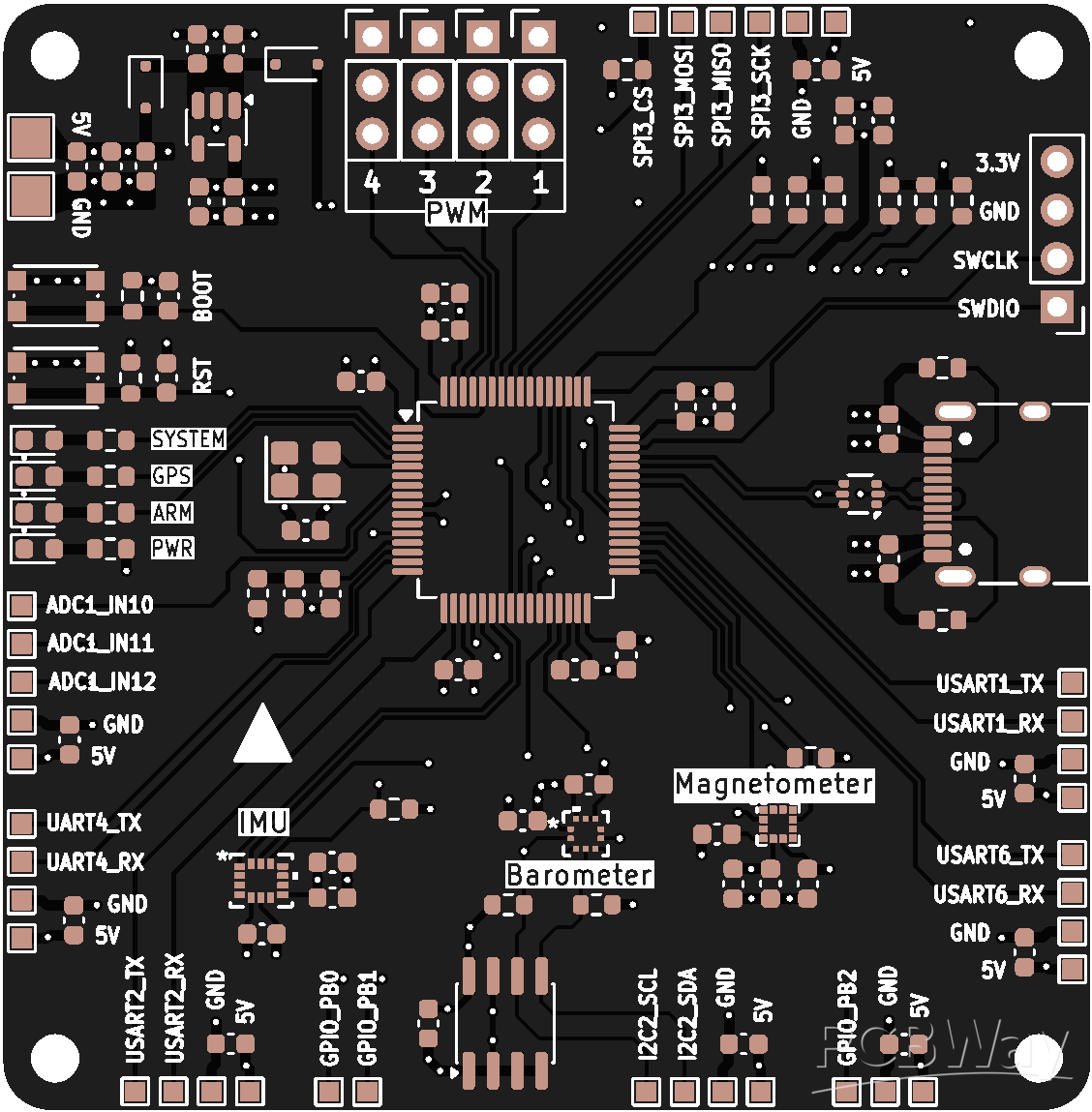
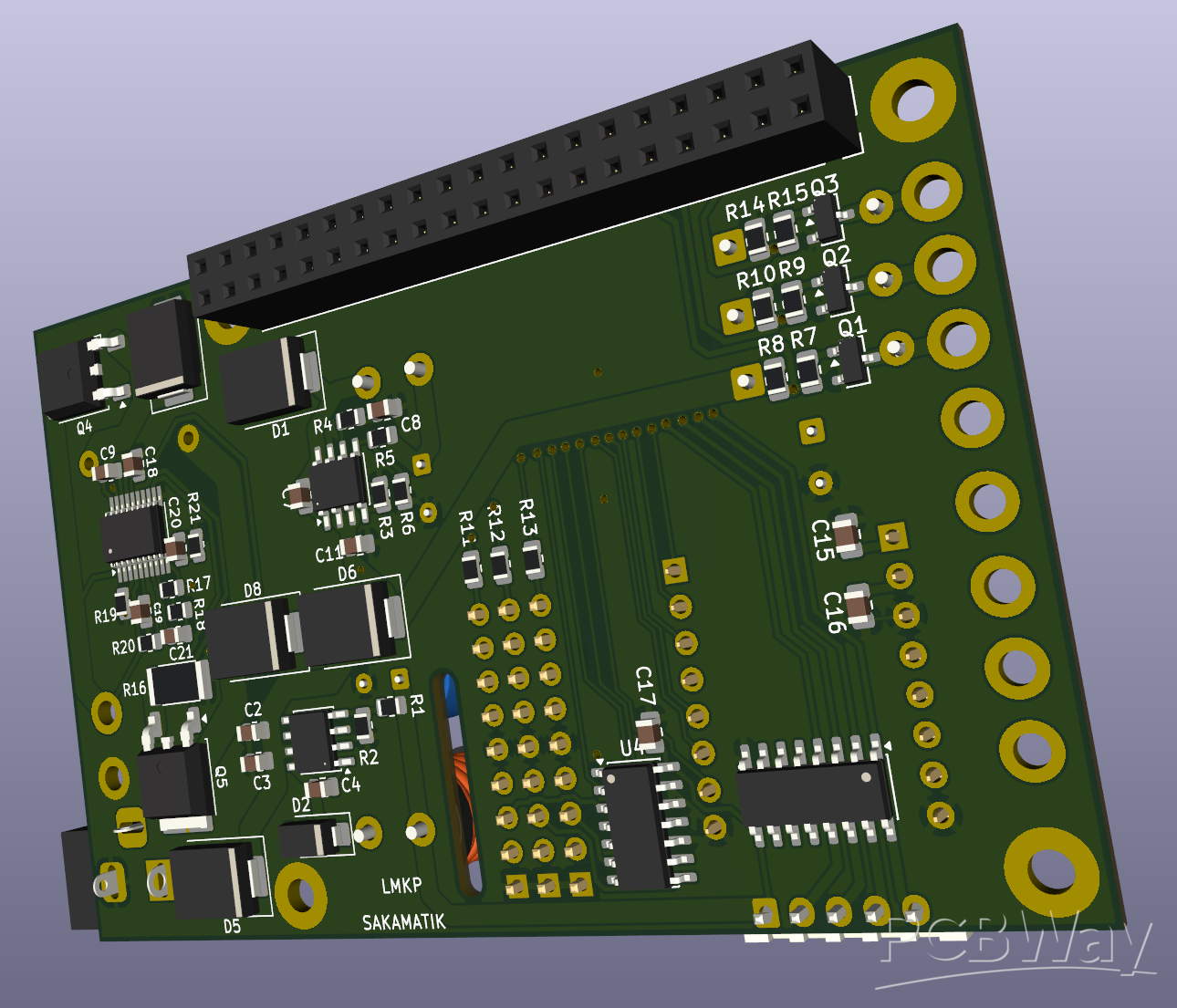
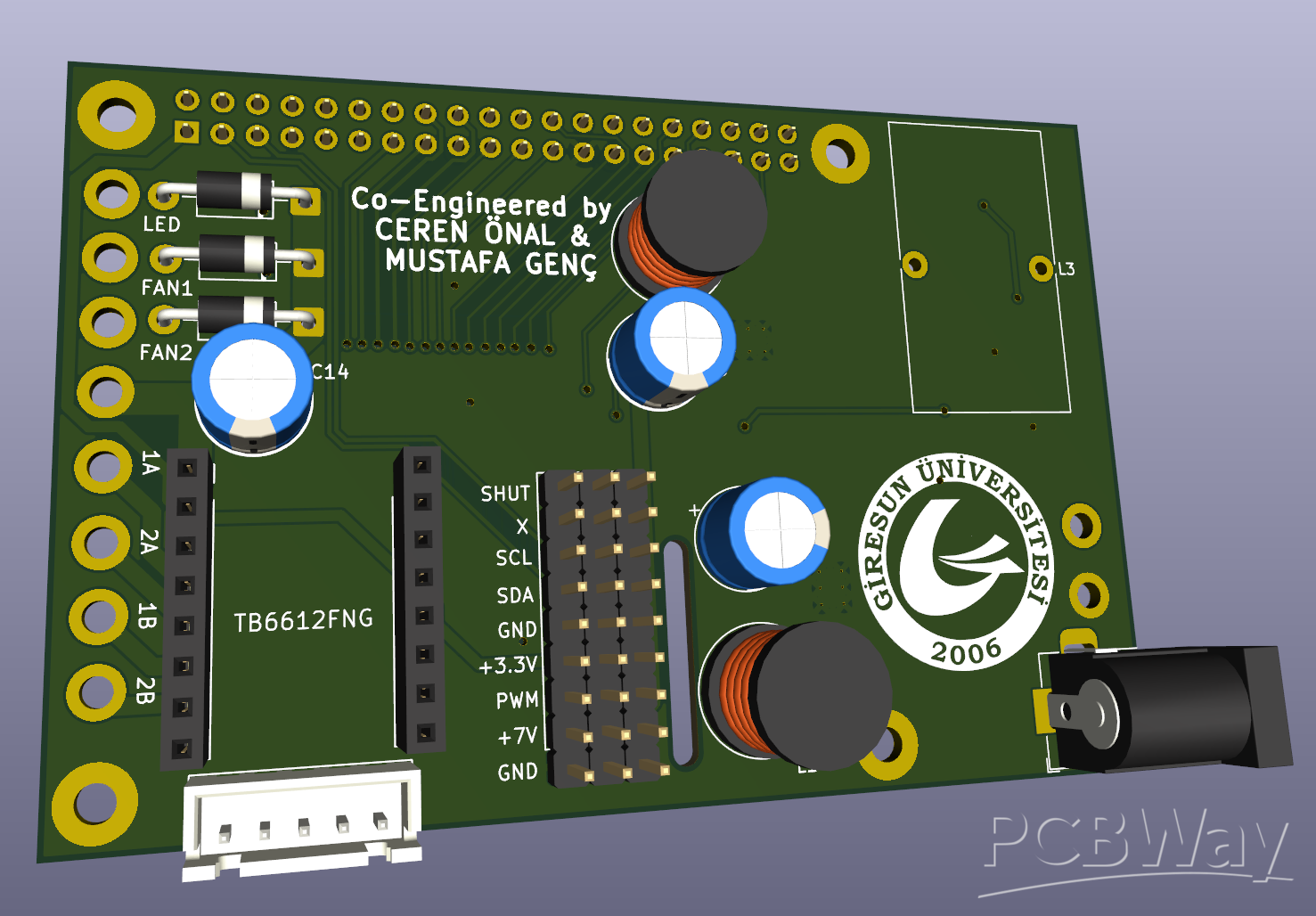
## 🛠️ PCB Specifications
- Layers: 2 (F.Cu, B.Cu)
- Dimensions: 85mm x 56mm (Raspberry Pi 5 HAT standard)
- Mounts directly on Raspberry Pi 5 via 2x20 GPIO header
- Full GND copper pour on both layers
- Power trace widths: up to 3mm (7V servo rail)
- Surface finish: HASL / ENIG
- Copper weight: 1oz
---
## 📚 About the Team
Designed by Ceren Önal and Mustafa, engineering students
competing in TEKNOFEST — Turkey's largest aerospace and
technology festival — under the Agricultural Technologies
category.
The project began as a graduation thesis and evolved into
a full competition system targeting real-world fruit
sorting automation for small and medium-scale farms.
---
## 💬 Words to PCBWay
This HAT board is the brain stem of an AI-powered fruit
sorting system competing at TEKNOFEST — Turkey's largest
technology competition with millions of viewers and
national media coverage.
Integrating dual-source power management, four motor
types, ToF sensing, AI-triggered camera, controlled LED
illumination, and dual fan thermal management — all on
a 2-layer 85x56mm PCB that mounts directly onto a
Raspberry Pi 5 — demanded manufacturing precision that
only PCBWay can deliver.
We would be honored to represent PCBWay at TEKNOFEST
and will document every stage: PCB assembly, AI model
training, sorting system tests, and our competition
results — sharing it all with the maker community!
Apply for sponsorship >>- Comments(0)
- Likes(0)