

Atmosis — AI Environmental Intelligence & Health Advisory
We usually think of an air-quality monitor as a device that measures the room and shows a few numbers. But those numbers don't always tell us what is actually happening, or what we should do about it. Atmosis was built to bridge that gap.
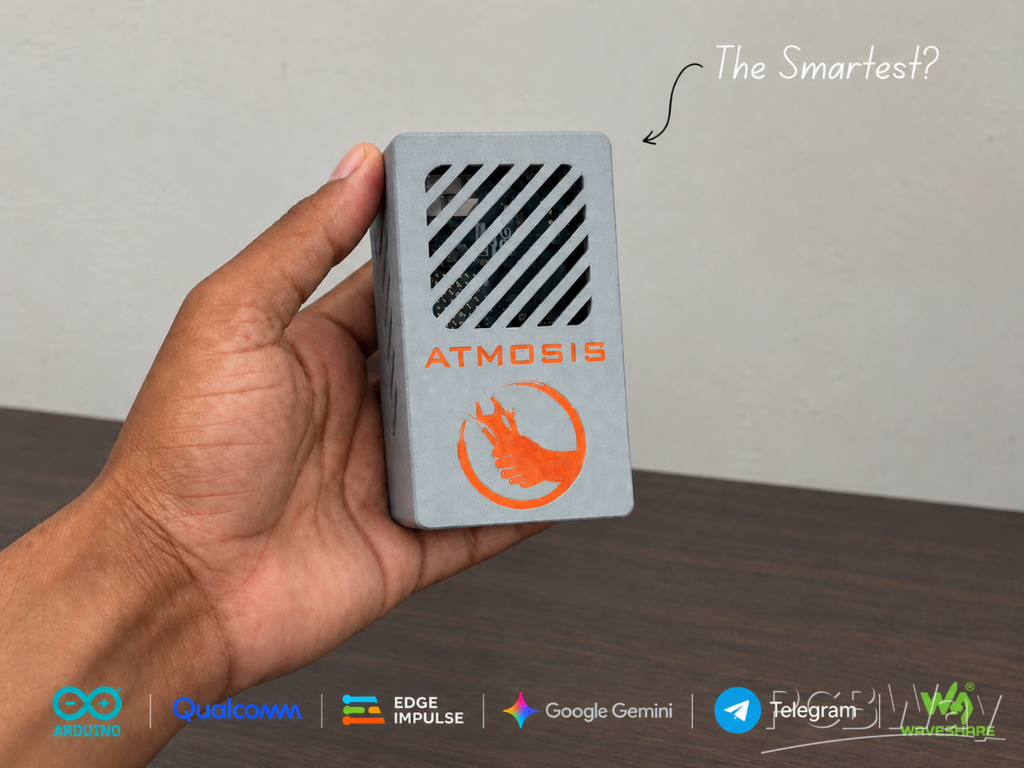
Atmosis is an environmental monitoring and advisory system built around the Arduino UNO Q. It combines real-time sensing, edge machine learning, a Linux application, generative AI and Telegram notifications to turn raw sensor data into information a person can act on.
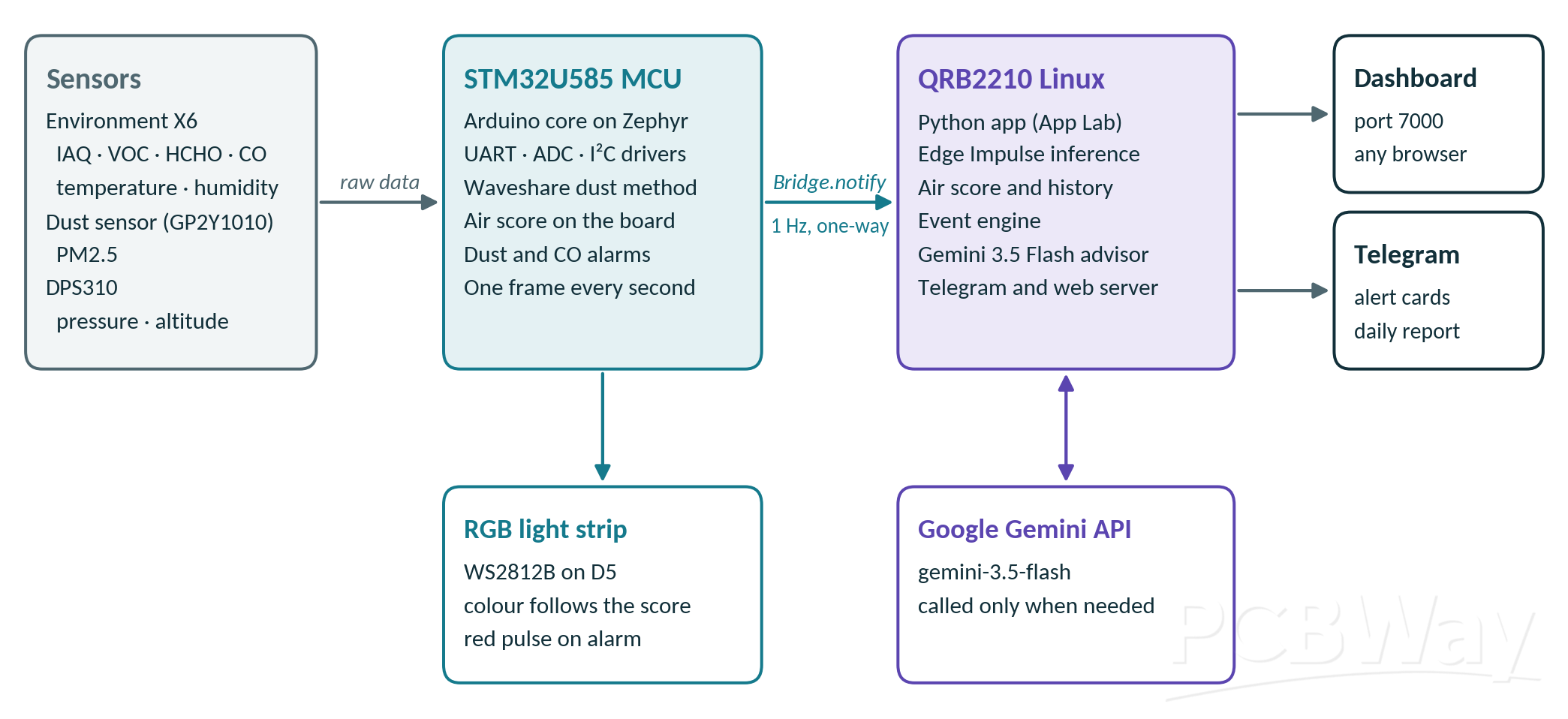
The system monitors IAQ, TVOC, formaldehyde (HCHO), carbon monoxide (CO), temperature, humidity, PM2.5, pressure and altitude. Instead of treating each value on its own, it looks at how they change together. An Edge Impulse model, trained on data from these same sensors, recognises conditions such as clean air, indoor pollution and poor ventilation, and it runs locally on the board.
When something needs attention, Google Gemini turns the processed data into a short, plain-language recommendation. Gemini does not take the measurements or make safety decisions; it only explains what the device has already found. Personal sensitivity settings stay on the UNO Q, and only environmental data and a privacy-safe sensitivity level are sent to the AI service.
The core monitoring and safety functions don't depend on the Internet. If the cloud services or the Linux application stop, the microcontroller keeps monitoring and keeps the hardware alarms working.
How Atmosis Works
Atmosis follows a simple flow: Sense → Understand → Interpret → Respond. The UNO Q makes this possible because it has two processors on one board.
• The STM32U585 microcontroller reads the three sensors in a non-blocking loop, calculates the air score, drives the WS2812B status light and handles the PM2.5 and CO alarms.
• Once per second it sends a compact data frame to Linux through the Arduino Router Bridge. The link is one-way, so the real-time side never depends on Linux.
• The Qualcomm QRB2210 runs Linux. The Python app validates each frame, keeps the history, runs the Edge Impulse model on a rolling window of the nine readings and decides when an event needs attention.
• When it does, the processed data goes to Gemini for a recommendation, and the result is shown on the local dashboard and sent through Telegram.
- Comments(0)
- Likes(1)
 More by Kishan Pratap Singh
-
 Atmosis — AI Environmental Intelligence & Health Advisory
We usually think of an air-quality monitor as a device that measures the room and shows a few number...
-
 DIY Compact UPS for WiFi Router (Easy to Build)
In villages and towns where electricity cut-offs are a daily challenge, one of the first things to g...
-
 IoT Smart Door Lock System With Real Time Alerts
My name is Kishan Pratap Singh, the founder and creator behind Next Builder, where I explore the wor...
-
 DIY Smart Battery Charger
The project involves creating a DIY smart battery charger that can charge 12V to 24V batteries. It f...