
ZZRX-40 Receiver build
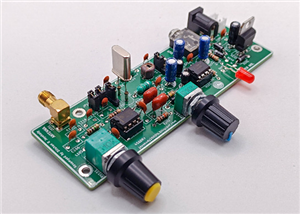
I found the ZZRX-40 receiver while going through some old issues of QEX magazine. Designed by Craig Johnson (AA0ZZ), this is a very simple and easy-to-build 40m direct conversion receiver. Even though it is a simple circuit, it performs quite well for its size.
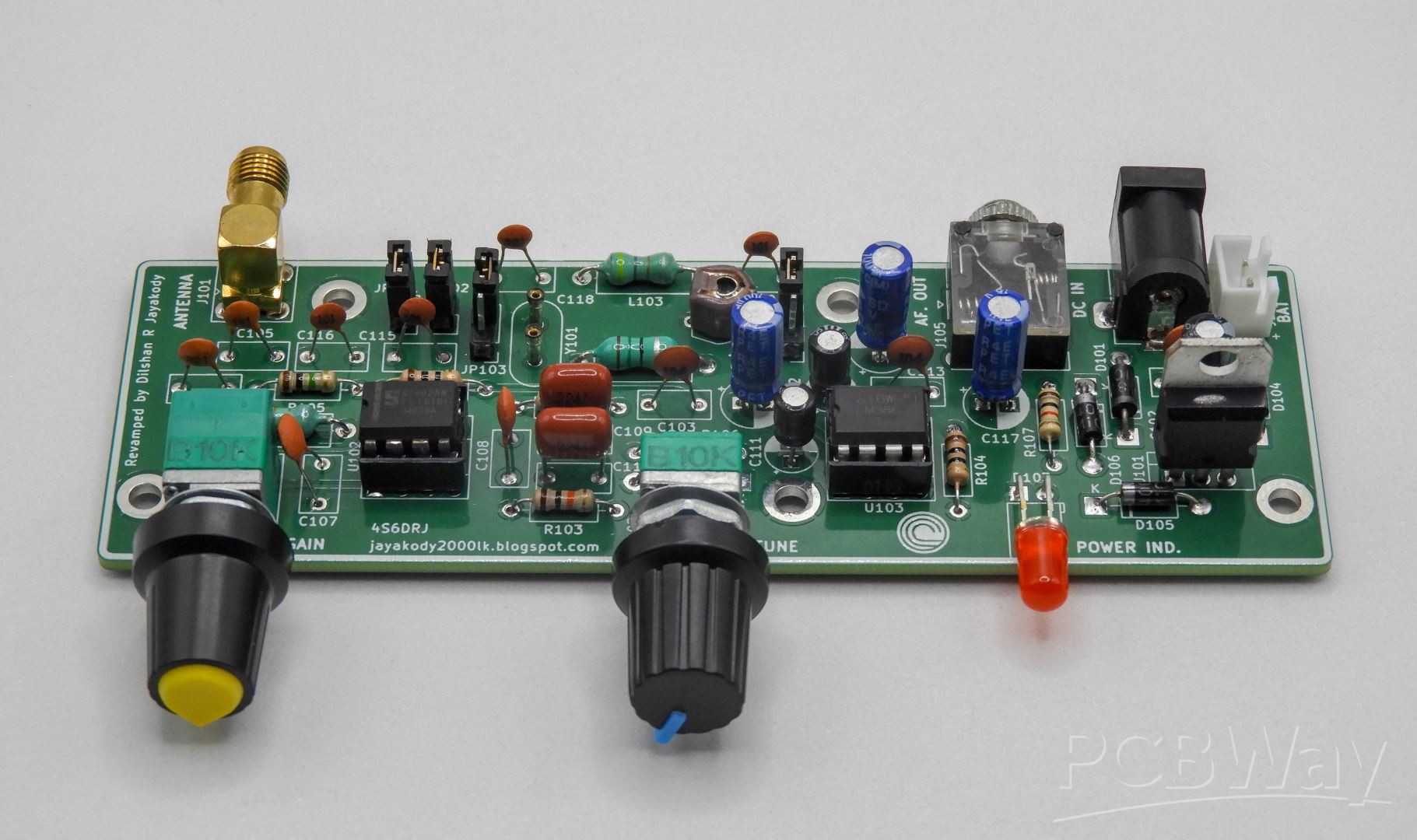
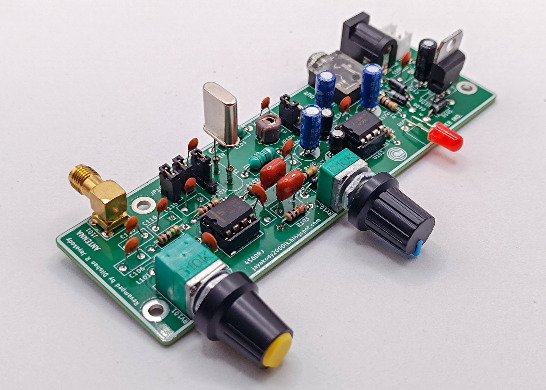
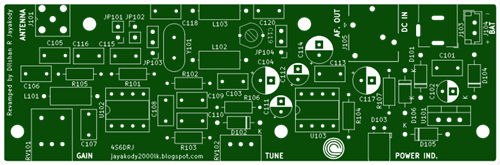
For this project, I decided to make my own PCB design because I wanted to use components that I could easily find in our local shops. Since I couldn't find any PCB files online, I drew the schematic in KiCad and designed a custom board. If you are interested in building this, I have shared the Gerber files and KiCad project files here: https://github.com/dilshan/zzrx40-clone.
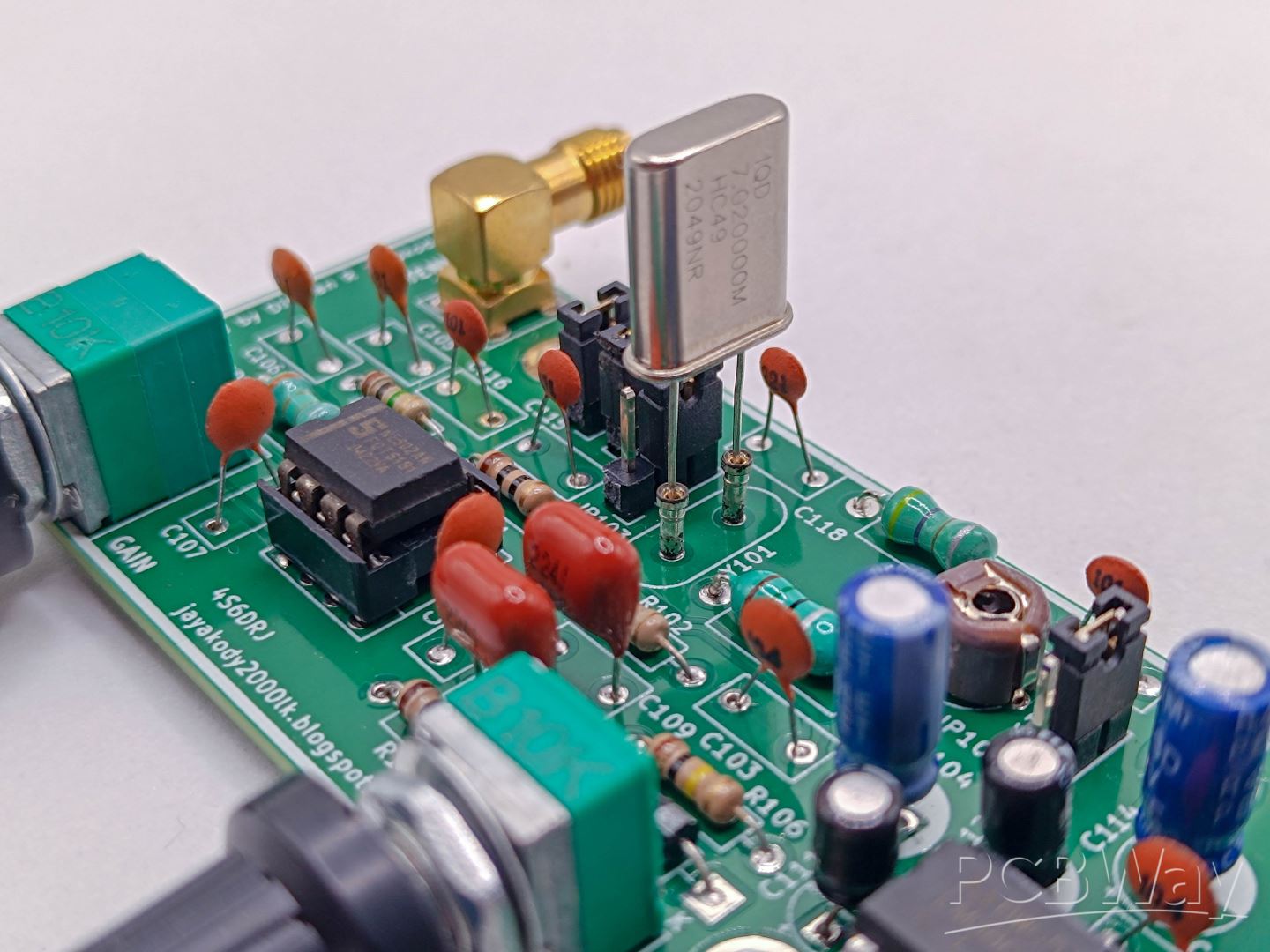
The heart of this receiver is the popular NE602 (or SA602) mixer chip. This single chip handles both the local oscillator and the product detector, which makes the whole circuit very compact. Although it is designed for the 40-meter (7 MHz) ham band, my prototype was also able to pick up 41-meter band shortwave stations, especially strong signals from China Radio International (CRI).
The receiver has two oscillator modes. The Crystal-Controlled (VXO) mode is definitely the most stable way to use it. By using the tuning potentiometer, I could shift the frequency a few kHz up or down from the crystal's main frequency. I tested this with many different crystals from 2E0HQU Lester Russell's collection, including 7.000, 7.020, 7.030, 7.040, 7.050, 7.1424, 7.159, and 7.200 MHz, and they all worked perfectly.
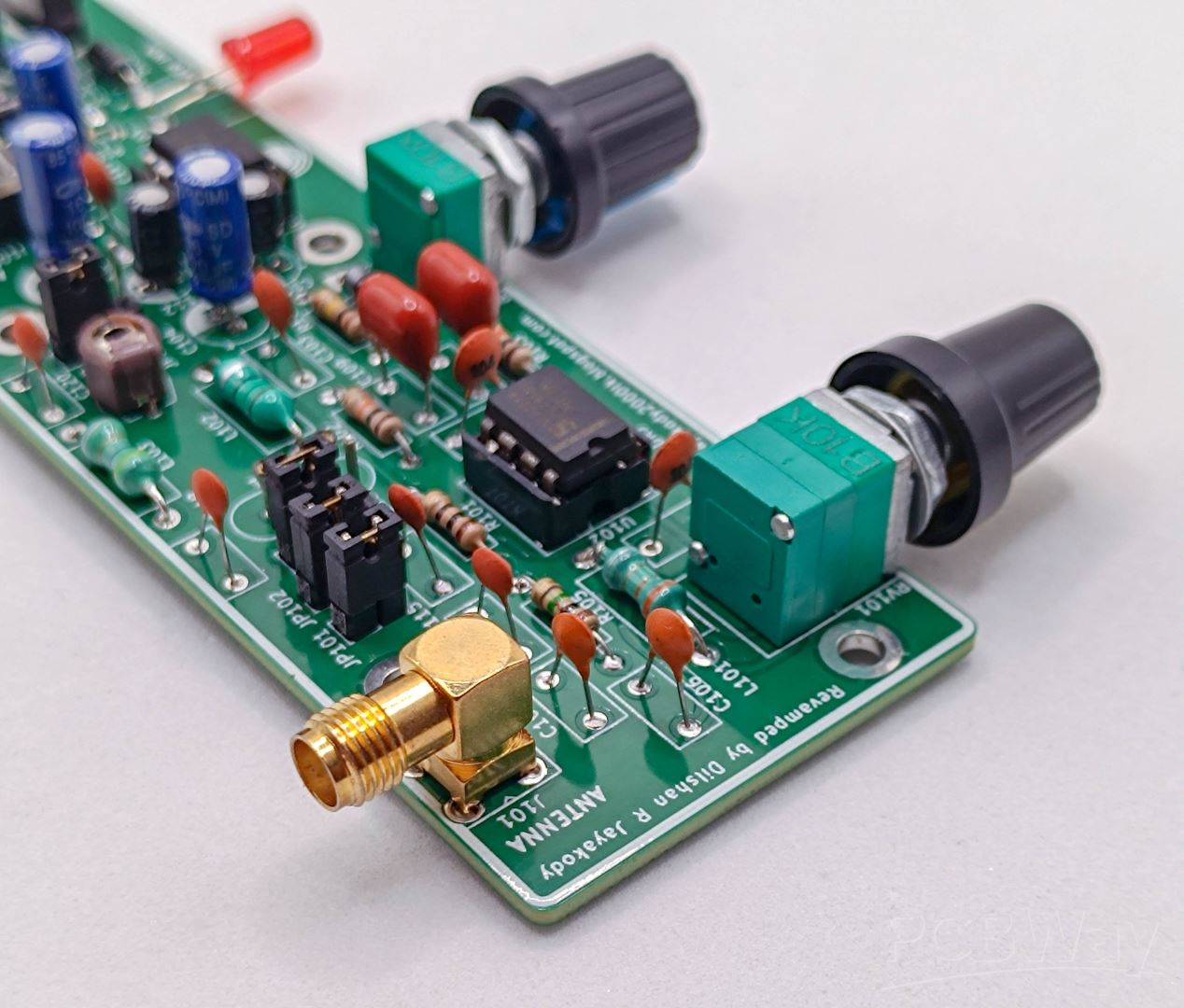
There is also a VFO mode, which uses a 50pF trimmer capacitor for calibration. In my experience, this mode is a bit "drifty" compared to the crystals. You have to do a lot of fine-tuning to keep the station locked in. After the mixer, the signal goes through a low-pass filter and then to an LM386 audio amplifier. I tested both LM386N-1 and LM386N-4 versions, and both worked fine. You can use a small 8Ω speaker, but using low-impedance headphones gives much better audio when listening for weak stations.
What I really like about the ZZRX-40 is that it's not just a receiver, but a great tool for learning radio design. I added on-board jumpers to my PCB so I can bypass the internal oscillator. This is very useful because you can plug in an external oscillator, like a Si5351 VFO or an Arduino signal generator, to see how it performs.
For my testing, I used a 9V DC power supply and my 50Ω outdoor wire antenna. Since I used the 1A version of the 7806 regulator in this design, it is safe to feed a 12V or 15V DC input to the circuit. For voltages under 12V, no heatsink is required for the 7806. Like the original ZZRX-40, this design also supports battery power, but it switches to battery only if the DC jack is removed (the manual power source selection switch was removed in my design).
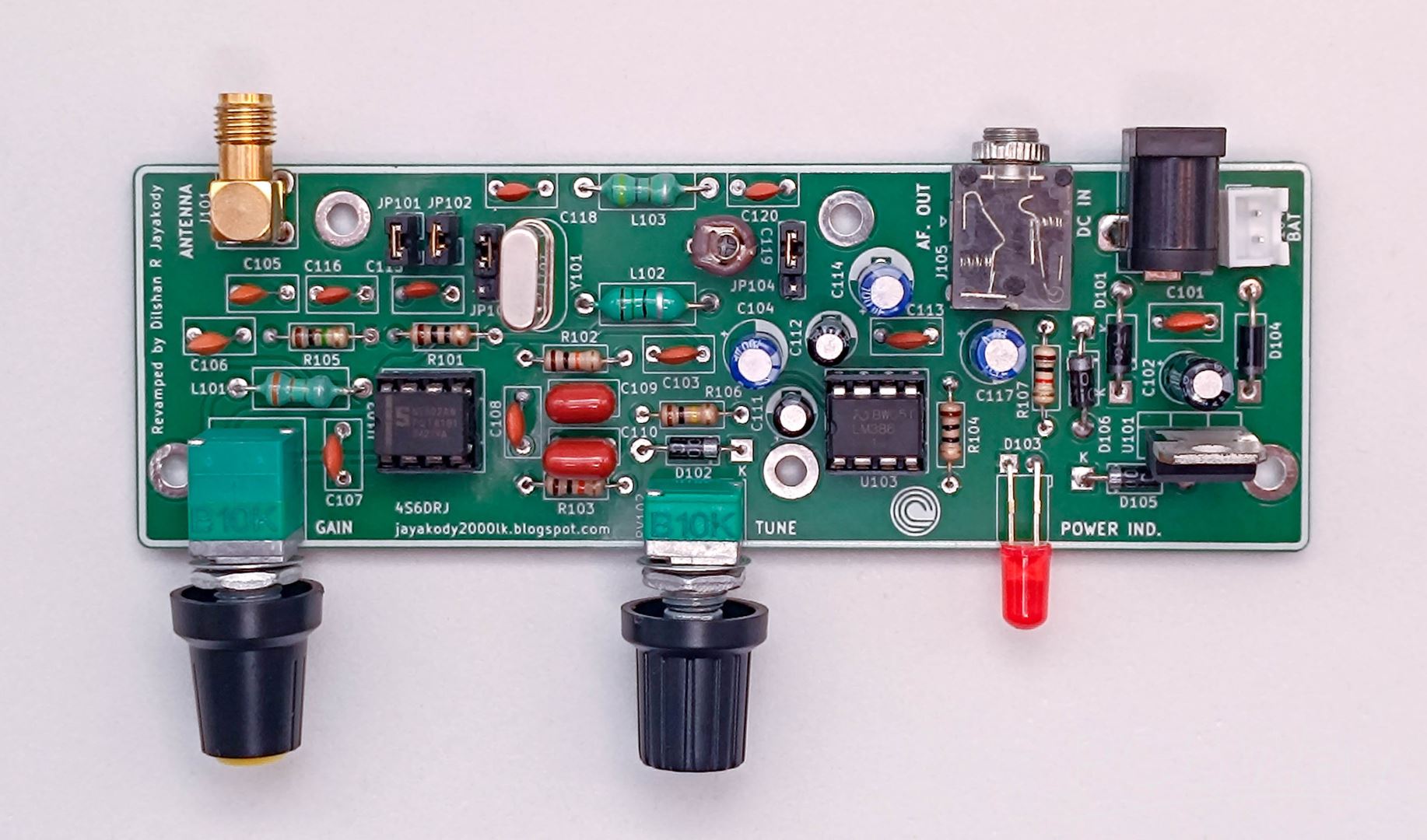
The receiver is excellent for listening to CW and shortwave broadcasts. However, like many simple direct-conversion designs, SSB signals proved a bit more difficult to tune, and the audio was less intelligible in the 7.040 - 7.060 MHz range compared to CW.
Building the ZZRX-40 was a great experience. It shows that you don't need a very complicated circuit to start listening to the shortwave radio bands. Even with a few limitations in SSB mode and VFO drift, the ability to experiment with different crystals and external oscillators makes this a perfect project for any electronics hobbyist.
ZZRX-40 Receiver build
Project images are for reference only. Actual production is based on the manufacturing files on the project page.
Please review the designer's notes (e.g., PCB thickness) and select the appropriate options.
PCBWay is not responsible
for issues caused by unsuitable parameter selections.
For more important ordering information, please refer to
Read More


Raspberry Pi 5 7 Inch Touch Screen IPS 1024x600 HD LCD HDMI-compatible Display for RPI 4B 3B+ OPI 5 AIDA64 PC Secondary Screen(Without Speaker)
BUY NOW


- Comments(0)
- Likes(3)
 More by Dilshan Jayakody
-
 A simple transistor based electronic siren
For some time, hobbyists have relied on dedicated sound generator ICs, such as the UM3561, UM3562 to...
A simple transistor based electronic siren
For some time, hobbyists have relied on dedicated sound generator ICs, such as the UM3561, UM3562 to...
-
 Analog pink noise generator
Pink noise is an essential tool in audio testing, widely used for analyzing speaker systems, room ac...
Analog pink noise generator
Pink noise is an essential tool in audio testing, widely used for analyzing speaker systems, room ac...
-
 ZZRX-40 Receiver build
I found the ZZRX-40 receiver while going through some old issues of QEX magazine. Designed by Craig ...
ZZRX-40 Receiver build
I found the ZZRX-40 receiver while going through some old issues of QEX magazine. Designed by Craig ...
-
 Arduino Mini Amplifier
The Arduino Mini Amplifier is a compact audio system that merges vintage analog and modern digital c...
Arduino Mini Amplifier
The Arduino Mini Amplifier is a compact audio system that merges vintage analog and modern digital c...
-
 24-channel USB high-voltage driver
When it comes to automation and control systems, there's often a need for multiple digitally control...
24-channel USB high-voltage driver
When it comes to automation and control systems, there's often a need for multiple digitally control...
-
 Echo Generator for Microphones
This project is about a single-channel microphone echo generator circuit. This circuit builds around...
Echo Generator for Microphones
This project is about a single-channel microphone echo generator circuit. This circuit builds around...
-
 Universal HD44780 LCD interface
YALI (Yet Another LCD Interface) is an open-source project to provide a universal interface to drive...
Universal HD44780 LCD interface
YALI (Yet Another LCD Interface) is an open-source project to provide a universal interface to drive...
-
 6-channel stereo speaker selector
This project is a DIY six-channel stereo speaker selector based on STC15W201 MCU. The purpose of thi...
6-channel stereo speaker selector
This project is a DIY six-channel stereo speaker selector based on STC15W201 MCU. The purpose of thi...
-
 5.1 channel analog audio processor
In this project, we developed a 5.1-channel analog audio processor using PT2322 IC. PT2322 is an ine...
5.1 channel analog audio processor
In this project, we developed a 5.1-channel analog audio processor using PT2322 IC. PT2322 is an ine...
-
 StarPointer - virtual electronic finderscope
StarPointer is a virtual electronic finderscope for astronomical telescopes. This device works with ...
StarPointer - virtual electronic finderscope
StarPointer is a virtual electronic finderscope for astronomical telescopes. This device works with ...
-
 Narrowband FM receiver for 2-meter band
This project is about MC3362 and ADF4351 based modularized, 2-meter narrow band FM receiver. In this...
Narrowband FM receiver for 2-meter band
This project is about MC3362 and ADF4351 based modularized, 2-meter narrow band FM receiver. In this...
-
 5.1 channel audio preamplifier
This project introduces a digitally controlled 5.1 channel audio preamplifier system. This amplifier...
5.1 channel audio preamplifier
This project introduces a digitally controlled 5.1 channel audio preamplifier system. This amplifier...
-
 NTP based digital clock panel
This project introduces an open-source, ATmega328 based, configurable NTP clock with a 2.3-inch, 7-s...
NTP based digital clock panel
This project introduces an open-source, ATmega328 based, configurable NTP clock with a 2.3-inch, 7-s...
-
 AVR High Voltage Programmer 2
AVR-HV2 is Arduino based high voltage parallel programmer for AVR microcontrollers. This programmer ...
AVR High Voltage Programmer 2
AVR-HV2 is Arduino based high voltage parallel programmer for AVR microcontrollers. This programmer ...
-
Programmable Mist Maker - XIAO / QT PY Extension
2186 2 2 -
RadioHAT - Raspberry Pi radio development platform
1873 0 4 -
-
-
-
ARPS-2 – Arduino-Compatible Robot Project Shield for Arduino UNO
4065 0 6 -
A Compact Charging Breakout Board For Waveshare ESP32-C3
4819 3 8 -
AI-driven LoRa & LLM-enabled Kiosk & Food Delivery System
5621 2 2 -