

|
|
IRFP460 mosfet |
x 1 | |
|
|
12V ZENER DIODE |
x 2 | |
|
|
U1540 fast diode |
x 2 | |
|
|
Rotary potentiometer |
x 1 | |
|
|
resistor 1k5 |
x 1 | |
|
|
capacitor 1µf/400V |
x 1 | |
|
|
Primary and Secondary coil |
x 1 |

|
Soldering Iron Kit |
Single Mosfet Mini SSTC Tesla coil with 10 + cm Spark
A Solid State Tesla Coil (SSTC) is a type of Tesla coil that uses solid-state components such as transistors, diodes, and capacitors to generate high-voltage, high-frequency alternating current electricity. This type has several advantages over traditional Tesla coils, which typically use spark gap switches. SSTCs have higher efficiency, the possibility of long-term work, as well as compact dimensions. In fact, compactness and small dimensions are the main characteristics of the Tesla coil, which the construction and operation are described in this project.
But despite the small size, the performance is surprisingly good. Another positive feature is its extreme simplicity, so even less experienced self-builders can make it. However, I would like to emphasize that generally making and adjusting any tesla coil, even though it looks simple, requires adequate knowledge and experience, especially at SSTC, where every small mistake and failed start means burnt components, which are not cheap.

Тhe device consists of only a few components
- Primary coil
- Secondary coil
- Topload specifically in the form of a cylinder
- Powerful Mosfet (currently I use BUZ325, but in the first prototype I used IRfP460 with the same results)
- Heatsink for the mosfet
- diode 5 amp, for example U1540
- Fast diode for Mosfet protection also U1540
- 1microfarad/250V MKP capacitor
- Potentiometer and Resistor
- Two Zener diodes for 12V
- Fuse 5A
- And source of alternating voltage - Transformer 50V /3A or more
This project is sponsored by PCBWay . They has all the services you need to create your project at the best price, whether is a scool project, or complex professional project. On PCBWay you can share your experiences, or get inspiration for your next project. They also provide completed Surface mount SMT PCB assemblY service at a best price, and ISO9001 quality control. Visit www.pcbway.com for more services

The primary coil contains 5 windings of 2.5mm copper wire on a plastic body with a diameter of 5cm, and it is desirable to make a lead on each winding to make it easier to adjust the device.

The secondary coil is wound on a plastic body with a diameter of 4cm and contains 520 turns of lacquered copper wire with a diameter of 0.2 mm. The height of the secondary is 12cm. The calculated resonant frequency of this secondary coil together with the topload is about 1.7 MHz.

For a topload I use a small aluminum box.

The power mosfet is specifically an BUZ325, but during testing I successfully used an IRFP460 which is also significantly more powerful. For voltages up to 60 V, IRFP260 can also be used. Of course, the mosfet should be mounted on a massive aluminum heatsink. The rectifying diode should be designed for a current of 5A or more, in this case I use a fast diode of the type U1540. A fuse is mandatory because relatively high voltages and currents are involved. It is very practical to use an automatic fuse as in this particular case. For the sake of constant monitoring of the operation of the circuit as well as the consumption, it is desirable to place a current clamp at the input.

The transformer that I use is taken out of an old defective audio amplifier

Now a few words about the first turn on and testing of the device. The best option is to use variac if we have it. The variac is actually an autotransformer where we can continuously change the voltage from 0V to the maximum value.

First, we turn on the transformer at a lower voltage so that it outputs about 15V. At start also we need to connect the primary coil with the most turns.(5 in my case). Next, with a fluorescent lamp close to the secondary, we slowly turn the potentiometer to the right. If everything is well connected, at some point the lamp should light up, which is a sign that the circuit has started to oscillate and generates a high voltage at the output.

If this does not happen, we need to reverse the poles of the primary and repeat the same procedure. Now If you connect the lamp again and it doesn't light up, the problem is somewhere in the connection of the components, or some defective component, which is usually the mosfet. If we do not have a variac autotransformer, it is best to start the tests with a transformer with an output voltage of 15 to 20 volts. When we solve the problem we can start increasing the voltage continuously while keeping an eye on the current clamp, and if the current suddenly increases, we should immediately reduce the input voltage. When we make sure that the tesla coil is working stably, we gradually decrease one by one turn of the primary until the largest spark is generated.


As you can see on the video, a fully tested and tuned Tesla coil performs amazingly good in real conditions, with rely long spark for this type of simple Tesla coil. Under these conditions, with a 50V power supply, the current was about 2.5 to 3 Amps, which is less than 150 Watts. Then I connect Arduino Staccato controller, the construction of which I described in one of the previous videos.

Now, at the same length of the spark, the current did not exceed 0,8 A at all and the Tesla coil can work for an unlimited time in these conditions. I managed to reduce the current even further by connecting a simple SCR voltage regulator to the variac input. I will explain how this trick works on a later occasion.
And finally a short conclusion
You can make this miniature and simple Tesla coil in less than a day along with winding the secondary coil which contains only 500 turns. In addition, the final result is surprisingly good with a generated spark with a length of 10cm and more and relatively low consumption, especially when using the Staccato controller.
SAFETY NOTE: Please do not attempt to recreate the experiments shown on this video unless you are familiar with High Voltage Safety Techniques! Direct Current even above 60V maybe lethal, even when the AC supply voltage has been disconnected due to the stored energy in the capacitors. I have no responsibility on any hazards caused by the circuit. Be very careful. This is a humble request.

Single Mosfet Mini SSTC Tesla coil with 10 + cm Spark


Raspberry Pi 5 7 Inch Touch Screen IPS 1024x600 HD LCD HDMI-compatible Display for RPI 4B 3B+ OPI 5 AIDA64 PC Secondary Screen(Without Speaker)
BUY NOW


- Comments(0)
- Likes(1)
More by Mirko Pavleski
-
 Arduino 3D Printed self Balancing Cube
Self-balancing devices are electronic devices that use sensors and motors to keep themselves balanc...
Arduino 3D Printed self Balancing Cube
Self-balancing devices are electronic devices that use sensors and motors to keep themselves balanc...
-
 Building a Mini Fostex Horn Speaker with a 2-Inch Full-Range Driver
A back-loaded horn speaker is a loudspeaker design that channels the rear sound wave of a driver th...
Building a Mini Fostex Horn Speaker with a 2-Inch Full-Range Driver
A back-loaded horn speaker is a loudspeaker design that channels the rear sound wave of a driver th...
-
 ESP32 Moon Lamp That Shows the Real Moon Phase on Crowpanel Round Dispaly
Recently on the Hackaday portal I came across a very interesting project called Moon Display by aut...
ESP32 Moon Lamp That Shows the Real Moon Phase on Crowpanel Round Dispaly
Recently on the Hackaday portal I came across a very interesting project called Moon Display by aut...
-
 40-Year-Old DIY Power Amplifiers – Do They Still Work - 500W MOSFET & Transistor Amps
This time I want to describe my two DIY super powerful audio amplifiers that I made about 40 years ...
40-Year-Old DIY Power Amplifiers – Do They Still Work - 500W MOSFET & Transistor Amps
This time I want to describe my two DIY super powerful audio amplifiers that I made about 40 years ...
-
 Wi-Fi HaLow Explained! Long-Range Camera Test up to 300m (ESP32 + ThinkNode G4 from ELECROW)
I recently needed to install a security camera at a relatively large distance from my home, more pre...
Wi-Fi HaLow Explained! Long-Range Camera Test up to 300m (ESP32 + ThinkNode G4 from ELECROW)
I recently needed to install a security camera at a relatively large distance from my home, more pre...
-
 Simple Object Recognition with the UNIHIKER K10 – No TensorFlow, No Internet, No Cloud AI
Object recognition has become one of the most popular applications of artificial intelligence and em...
Simple Object Recognition with the UNIHIKER K10 – No TensorFlow, No Internet, No Cloud AI
Object recognition has become one of the most popular applications of artificial intelligence and em...
-
 DIY PCL82 Tube Amplifier, Single-Ended Amp with Amazing Sound
The idea for this project came from a local electronics magazine called EMITER, issue 12/13 from 20...
DIY PCL82 Tube Amplifier, Single-Ended Amp with Amazing Sound
The idea for this project came from a local electronics magazine called EMITER, issue 12/13 from 20...
-
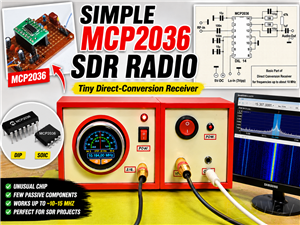 Simple MCP2036 SDR Radio - The Most Unusual Software Defined Radio
SDR (Software Defined Radio) is a radio communication system where many of the key electronic compo...
Simple MCP2036 SDR Radio - The Most Unusual Software Defined Radio
SDR (Software Defined Radio) is a radio communication system where many of the key electronic compo...
-
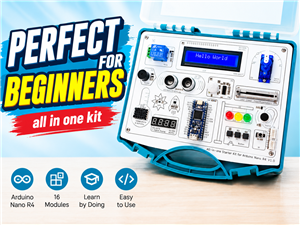 Elecrow All-in-One Arduino Starter Kit Review - 20 Projects & 16 Modules
This time I will describe a simple and practical way to enter the world of microcontrollers, specif...
Elecrow All-in-One Arduino Starter Kit Review - 20 Projects & 16 Modules
This time I will describe a simple and practical way to enter the world of microcontrollers, specif...
-
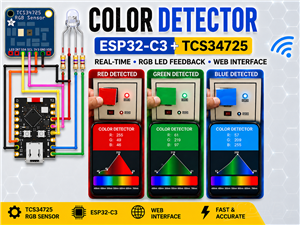 ESP32-C3 Color Detector with TCS34725, Real-Time RGB Detection & Web Interface
Color detection is a fundamental task in many embedded systems – from industrial sorting machines t...
ESP32-C3 Color Detector with TCS34725, Real-Time RGB Detection & Web Interface
Color detection is a fundamental task in many embedded systems – from industrial sorting machines t...
-
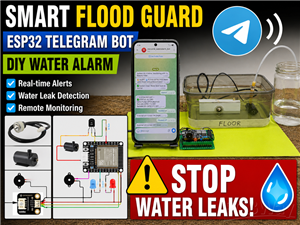 DIY ESP32 Telegram Flood Protection System - Smart Home Automation
Recently I had an unpleasant experience in my home, specifically my ground floor was flooded as a r...
DIY ESP32 Telegram Flood Protection System - Smart Home Automation
Recently I had an unpleasant experience in my home, specifically my ground floor was flooded as a r...
-
 Real-Time Air Traffic Radar using ESP32 + ADS-B Data
ADS-B, which stands for Automatic Dependent Surveillance-Broadcast, is the modern standard for trac...
Real-Time Air Traffic Radar using ESP32 + ADS-B Data
ADS-B, which stands for Automatic Dependent Surveillance-Broadcast, is the modern standard for trac...
-
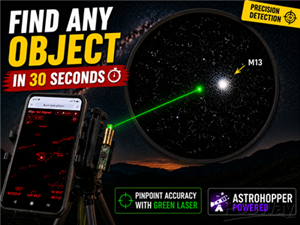 DIY Green Laser Night Sky Object Finder - Find Stars & Galaxies Instantly with great accuracy
As an amateur astronomer, especially at the beginning, the most difficult part of observing the nig...
DIY Green Laser Night Sky Object Finder - Find Stars & Galaxies Instantly with great accuracy
As an amateur astronomer, especially at the beginning, the most difficult part of observing the nig...
-
 DIY Avionics Simulator with ESP32 - Artificial Horizon, Compass & Altimeter
The inspiration for this project comes from classical aircraft cockpit instruments used for navigat...
DIY Avionics Simulator with ESP32 - Artificial Horizon, Compass & Altimeter
The inspiration for this project comes from classical aircraft cockpit instruments used for navigat...
-
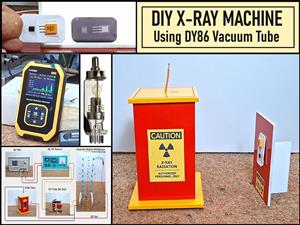 DIY Miniature X-Ray Machine using a TV Vacuum Tube DY86
An X-ray machine (or radiograph) is a quick, painless medical test that produces images of the struc...
DIY Miniature X-Ray Machine using a TV Vacuum Tube DY86
An X-ray machine (or radiograph) is a quick, painless medical test that produces images of the struc...
-
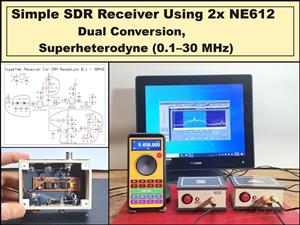 Simple SDR Receiver Using 2x NE612 - Dual Conversion, Superheterodyne (0.1–30 MHz)
SDR (Software Defined Radio) is a radio system in which most of the functions of a classic radio (f...
Simple SDR Receiver Using 2x NE612 - Dual Conversion, Superheterodyne (0.1–30 MHz)
SDR (Software Defined Radio) is a radio system in which most of the functions of a classic radio (f...
-
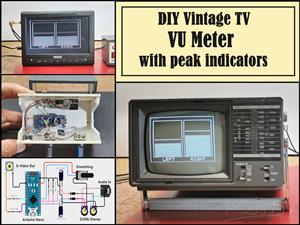 DIY Vintage TV VU Meter with peak indicators
Some time ago in one of my projects I presented you a way to turn a black and white old mini TV int...
DIY Vintage TV VU Meter with peak indicators
Some time ago in one of my projects I presented you a way to turn a black and white old mini TV int...
-
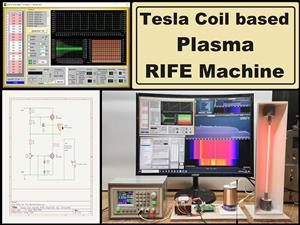 DIY Tesla Coil based Plasma Rife Machine
In several of my previous videos, I presented you with different ways to make a Rife Machine, from ...
DIY Tesla Coil based Plasma Rife Machine
In several of my previous videos, I presented you with different ways to make a Rife Machine, from ...
-
Programmable Mist Maker - XIAO / QT PY Extension
2242 2 2 -
RadioHAT - Raspberry Pi radio development platform
1930 0 4 -
-
-
-
ARPS-2 – Arduino-Compatible Robot Project Shield for Arduino UNO
4108 0 6 -
A Compact Charging Breakout Board For Waveshare ESP32-C3
4871 3 8 -
AI-driven LoRa & LLM-enabled Kiosk & Food Delivery System
5656 2 2 -