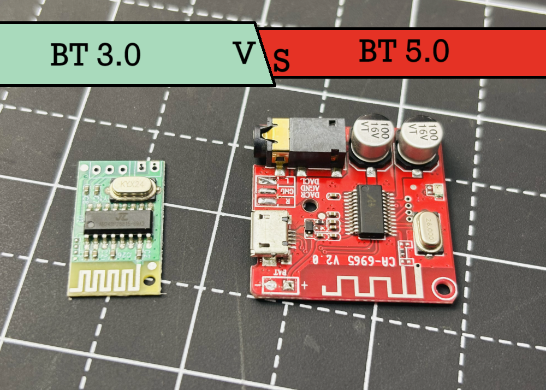
Comparison of Audio Bluetooth 3.0 and 5.0
Coming to bluetooth in audio applications, we have versions from 3.0 to 5.4. In the practical audio application we have to keep 2-3 things in mind. Like we need what is the max power it is consuming, what is the SNR of the received signal and what is the ideal power conditions. Some other parameters like wireless range, noise in signal, DAC resolution and number of bits also play an important role here. Today in the article we will plot them all and see the difference in performance of a 3.0 and 5.0 bluetooth in real time.
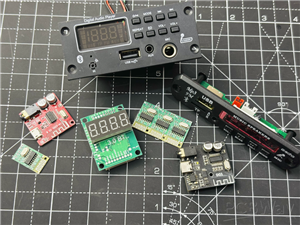
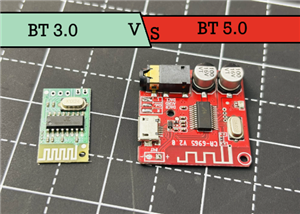
I have available a lot of them in stock, ranging from 3.0 to 5.0 but here specifically using these two. I have covered an article in detail about these cheap bluetooth modules. There is one manufacturer from China named JIELI who has been working on these BT nodes for a long time. Although the information is not open sourced, so we can not make any changes to the firmware without proper software. Some of the datasheets are shared in the previous article when I am designing my own board using them. https://github.com/halfstudents/bt5.0-NEW-PCB-DESIGN
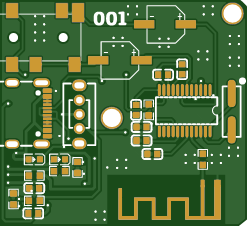
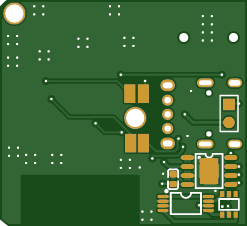
This article is sponsored by PCBWAY. I have created my own BT5.0 with USB-C, you can see the whole project in a github repo here. After plugging an external battery as a power source we can convert any wired headphones/earphones into BT controlled. The PCB is shared below. I am pleased by the quality of PCBWAY services, the PCBs are awesome and work well.
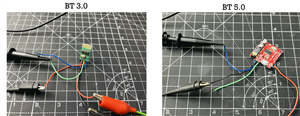
Bluetooth 3.0 and 5.0 Testing RIG/CASE:
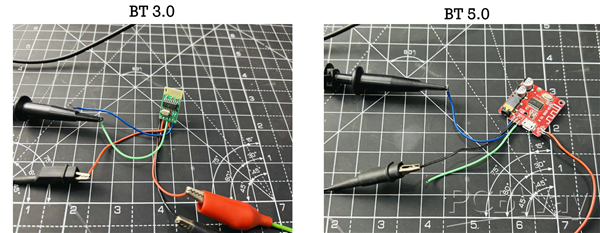
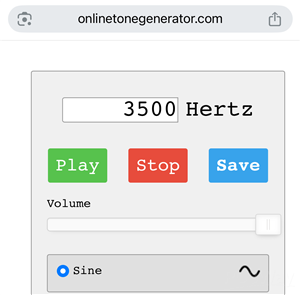
I am using 5.10 volts out from a constant power supply. The signal is taken from an online signal generator, maxed to all levels @3500Hz sine wave. I chose this signal specifically because it is not much low and not much high frequency comes in hearing range. If we choose between low and high frequency extremes there will be a certain kind of attenuation in signal. I do not want to go in depth but they are because of digital filters used inside the chip. They have a wavy effect in the pass and stop band. To make the test more ideal, the sine wave chosen here is sampled at 44.1KHz which surpasses the nyquist limit almost 40 times. So obviously it is an ideal signal, an ideal 3500 Hz sine wave.
Test 1 - Peak-Peak Amplitude Test:
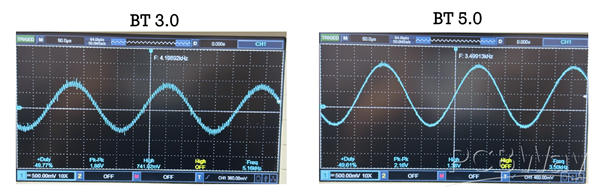
Both the bluetooth has onboard signal conditioning circuit, in 3.0 we have seen a high amplitude pulse superimposed in signal which is nothing but due to its low resolution will talk about it later. The peak-peak output of 3.0 is 1.90V and in case of 5.0 it is 2.15V. Which is 13% increment over 3.0 Gen BT.
Test 2- Resolution and Number of Bits:
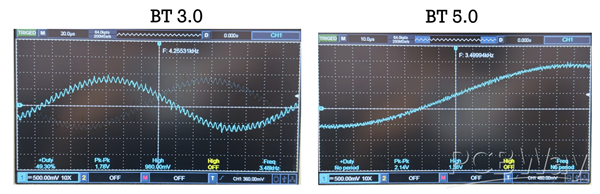
Due to not open sourced documentation we can not get the exact number of bits, and resolution but from a signal engineer perspective we can see something on a scope. It is basically the DAC resolution but here I have seen something different, A high frequency wave superimposed over 3500 Hz wave, which can be seen through FFT but here I don’t available that option. In the case of 3.0 this superimposed wave is of somewhat a lower frequency than 5.0 so it looks awful here. By the way overall 5.0 gives me a smoother signal which also I can see when hooking it with an amplifier there is no any HUM or noise in 5.0 on the other hand 3.0 performs very much worse.
Test 3 - Noise in Ideal Mode:
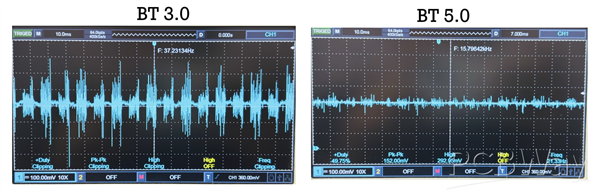
Here ideal mode is defined as the bluetooth is connected to the source but there is no signal given. The noise is compared with both BT modules. Ideally we should get a straight line when there is no signal but that is not the condition with these DSPs. I have seen a P-P noise of 650mV in 3.0 and 158mV in 5.0. This is where the 5.0 dominates and eliminates the competition. It is almost a 400% reduction in noise levels.
Test 4 - Power Consumption in Ideal Mode:
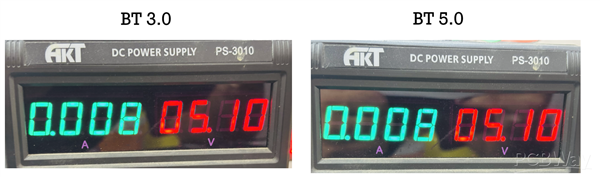
Here ideal mode is defined as the bluetooth is connected to the source but there is no signal given. In this both the BT modules perform the same. Both are consuming 40mW of power.
Test 5 - Power Consumption in Full Signal Mode:
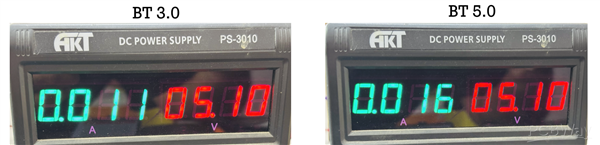
When both BT modules output full signal the scene changes, usually what we see is that a 5.0 BT comes with low power here consuming 80mW and 3.0 around 55mW. This may also depend upon the P-P output signal of both BT modules.
Test 6 - Ideal State Signal Analysis:
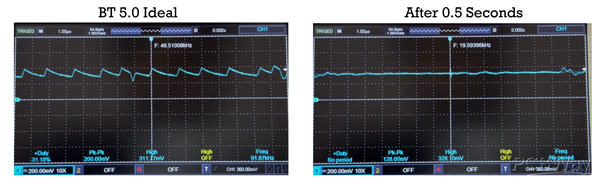
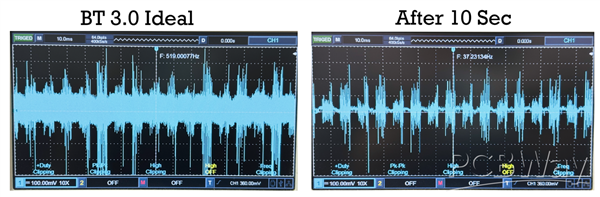
Here ideal mode is defined as the bluetooth is connected to the source but there is no signal given. In the ideal state when bluetooth notices a no signal condition then to reduce the overall noise level the low power mode is implemented automatically inside the chip. Which cuts the power to the output hence we will see a dip in ideal state noise level after some time. In 5.0 this low power is implemented within 0.5 seconds of time in 3.0 the chip processing takes around 10 seconds time.
My designed 5.0 BT:
Get the full project from this REPO here, you can download the gerber and order the parts, assemble them and get everything done. I have a lot of them lane around. Let me know if you need a detailed comparison of any other or any specific. I designed this PCB and got it done from PCBWAY. After assembly it works fine, has USB C, onboard antenna, 3.5mm connector and key button. Connect your wired headphones, power it up with a 3.7 Lipo and you convert your headphones into wireless ones. So simple, cheaper and of superb quality.
https://github.com/halfstudents/bt5.0-NEW-PCB-DESIGN
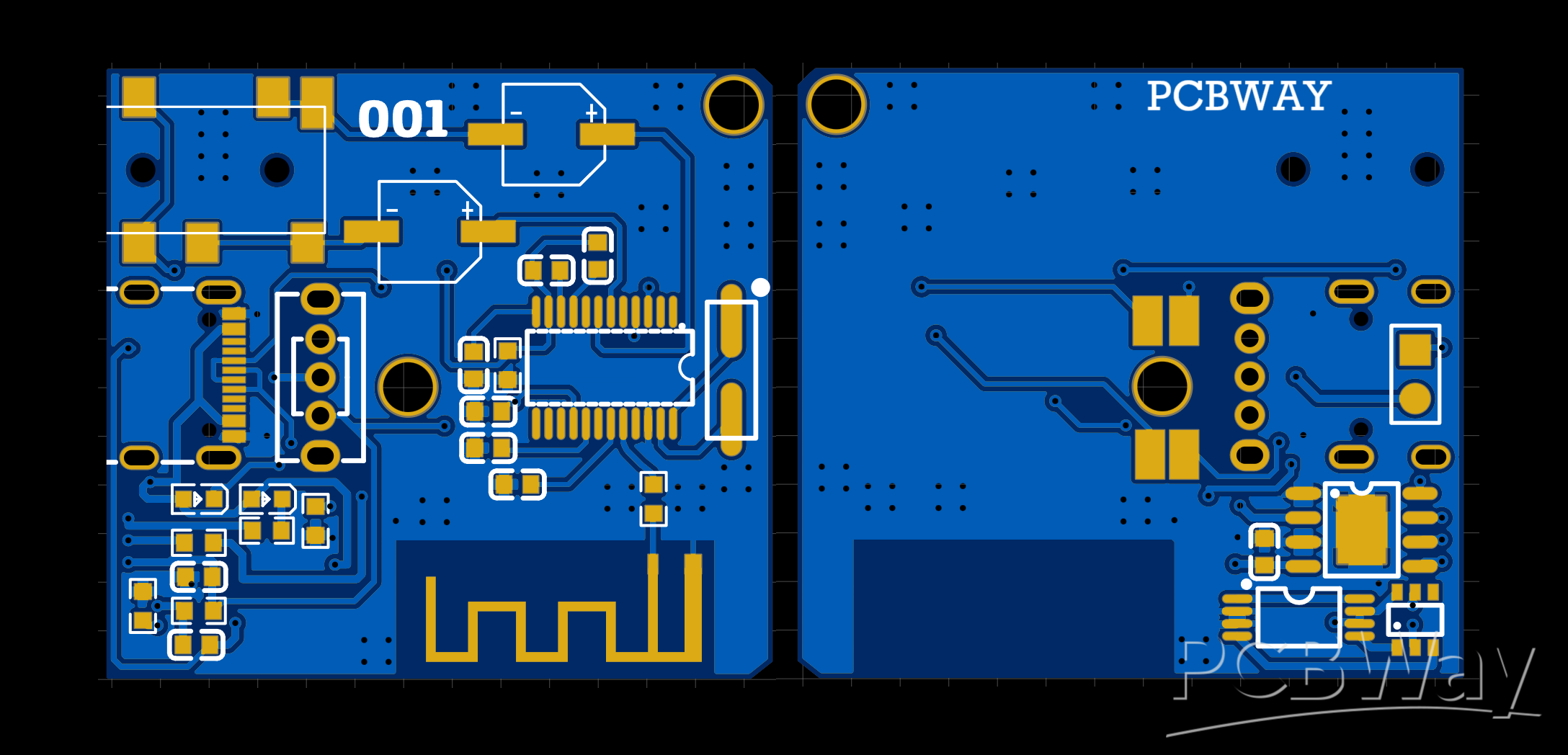
Need to charge the battery, the onboard circuit can do it. All this is possible due to PCBWAY services, PCBWAY is the one of topmost manufacturers in China which fulfil all the prototyping requirements of your project. Explore now and get your PCBs done, get free coupons on first sign-up.
Outro:
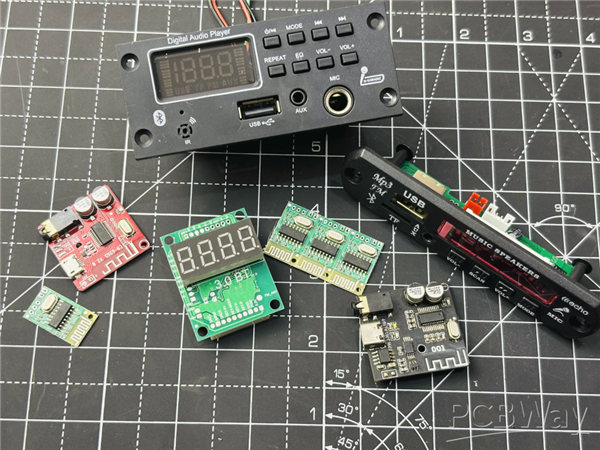
These are the tests I have performed using my scope, due to limitation of lab equipment I am not able to measure the fast fourier transform. These are the beauty of digital signal processing units inside these small chips. They are basically 32 BIT microcontrollers which are adapted for bluetooth and signal processing applications. I always wonder how I got my hands on them so cheaply. 3.0 costs me around $0.8 and 5.0 is around $2.5 not the chips but the whole assembled boards. If you love the work, consider supporting me through web channels. And if you are working on PCB projects try PCBWAY services to make your projects look more good.
https://www.patreon.com/THEIITBOY/membership
Comparison of Audio Bluetooth 3.0 and 5.0
Project images are for reference only. Actual production is based on the manufacturing files on the project page.
Please review the designer's notes (e.g., PCB thickness) and select the appropriate options.
PCBWay is not responsible
for issues caused by unsuitable parameter selections.
For more important ordering information, please refer to
Read More


Raspberry Pi 5 7 Inch Touch Screen IPS 1024x600 HD LCD HDMI-compatible Display for RPI 4B 3B+ OPI 5 AIDA64 PC Secondary Screen(Without Speaker)
BUY NOW


- Comments(0)
- Likes(3)
 More by Engineer
-
 DIY a Smart NiMH/NiCd Battery Charger
When talking about standalone single cell battery chargers only one popular name came into my mind t...
DIY a Smart NiMH/NiCd Battery Charger
When talking about standalone single cell battery chargers only one popular name came into my mind t...
-
 LiFePO4 Battery Charger With Protection
In the previous few months I tried to cover almost all types of battery charging integrated circuits...
LiFePO4 Battery Charger With Protection
In the previous few months I tried to cover almost all types of battery charging integrated circuits...
-
 Comparison of Audio Bluetooth 3.0 and 5.0
Coming to bluetooth in audio applications, we have versions from 3.0 to 5.4. In the practical audio ...
Comparison of Audio Bluetooth 3.0 and 5.0
Coming to bluetooth in audio applications, we have versions from 3.0 to 5.4. In the practical audio ...
-
 4 Channel SOLID STATE RELAY Module
I have designed a triac and optocoupler based project in the past, in which triac act as a relay and...
4 Channel SOLID STATE RELAY Module
I have designed a triac and optocoupler based project in the past, in which triac act as a relay and...
-
 A Look at Capacitive Water Overflow Sensor
Detection of Water overflow in a tank is one of the main topics when it comes to energy saving appli...
A Look at Capacitive Water Overflow Sensor
Detection of Water overflow in a tank is one of the main topics when it comes to energy saving appli...
-
 Offline Voice Recognition Hub Based on ESPNOW
An offline voice recognition hub, no internet connection, no wifi router. Just a pair of ESP8266 wit...
Offline Voice Recognition Hub Based on ESPNOW
An offline voice recognition hub, no internet connection, no wifi router. Just a pair of ESP8266 wit...
-
 DIY a 200W Precise Electronic Load
Whenever I want to test some USB power supplies, drawing I-V characters of a power supply and workin...
DIY a 200W Precise Electronic Load
Whenever I want to test some USB power supplies, drawing I-V characters of a power supply and workin...
-
 Smallest 220V to 5V Supply for IOT applications
The requirement of stable DC power supplies in the IOT applications and in electronics designed prod...
Smallest 220V to 5V Supply for IOT applications
The requirement of stable DC power supplies in the IOT applications and in electronics designed prod...
-
 I made 200Watt Class D amplifier
I have designed this 200W Class D amplifier board, which is separated into 100+100 Watt stereo chann...
I made 200Watt Class D amplifier
I have designed this 200W Class D amplifier board, which is separated into 100+100 Watt stereo chann...
-
 iPAD Pencil Backup Pocket Charger
I have a clone iPAD pencil which works in the similar way of Apple pencil, but this one comes with C...
iPAD Pencil Backup Pocket Charger
I have a clone iPAD pencil which works in the similar way of Apple pencil, but this one comes with C...
-
 Digital Radio Transmitter and Receiver 433Mhz
Radio technology is the best monitoring and control solution for small and long range wireless hobby...
Digital Radio Transmitter and Receiver 433Mhz
Radio technology is the best monitoring and control solution for small and long range wireless hobby...
-
Programmable Mist Maker - XIAO / QT PY Extension
2334 2 2 -
RadioHAT - Raspberry Pi radio development platform
2022 0 4 -
-
-
-
ARPS-2 – Arduino-Compatible Robot Project Shield for Arduino UNO
4181 0 6 -
A Compact Charging Breakout Board For Waveshare ESP32-C3
4946 3 8 -
AI-driven LoRa & LLM-enabled Kiosk & Food Delivery System
5723 2 2 -