The PMU (Power Management Unit) is the core of power supply systems in electronic devices such as smartphones and computers. It is responsible for voltage and current regulation, power switching, battery management, power optimization, and hardware protection—directly impacting device battery life, stability, and safety. A PMU typically consists of DC-DC converters, LDO (Low Dropout) regulators, and control circuits. The quality of its PCB layout and routing plays a critical role in ensuring power performance and overall system reliability.
Based on practical engineering experience, the PCBWay design team summarizes the key points of PMU PCB design in this article to help engineers avoid common pitfalls.
PMU Core Functions and Components
Core Functions
- Power Supply Management: Provides appropriate voltage and current to different system modules
- Power Switching: Seamless transition between battery and external power sources
- Battery Management: Monitors battery status and provides overcharge/over-discharge protection
- Power Optimization: Dynamically adjusts power consumption to extend battery life and improve performance
- Hardware Protection: Monitors voltage, current, and temperature, triggering protection mechanisms when necessary
Main Components
- DC-DC Power Conversion Module: Provides high-efficiency voltage conversion, mainly used for core power rails
- LDO (Low Dropout) Regulators: Deliver low-noise and stable voltage, suitable for analog and sensitive circuits
- Control Circuit: Handles power sequencing, voltage/current monitoring, and system communication (e.g., I2C / SPI)
- Protection Circuit: Implements over-voltage, over-current, and over-temperature protection to enhance system safety
- Filtering Network (External): Uses capacitors and LC structures to reduce ripple and noise
- Auxiliary Modules: Include battery management, charging control, and fuel gauging functions
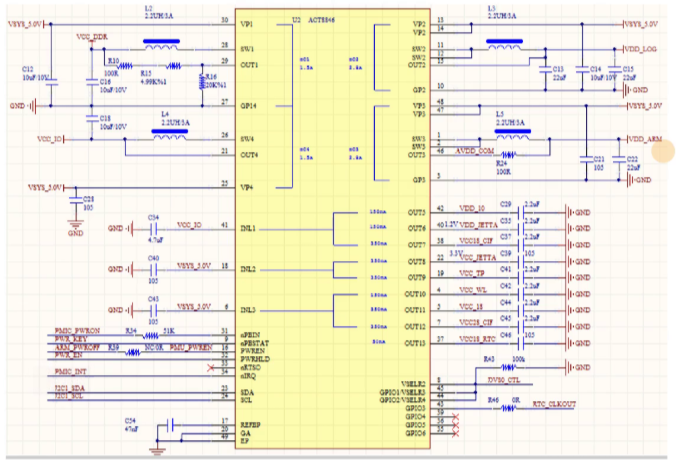
Key Points for PMU PCB Layout
The layout should follow the sequence: DC-DC first, then LDO, and finally the control circuit, with a focus on power loop integrity and thermal performance:
- Prioritize DC-DC placement: Keep the connection between the inductor and IC pins as short as possible; place adjacent inductors orthogonally to reduce coupling
- Inductor placement rules: Do not place any components underneath inductors, and avoid routing sensitive signals below them
- LDO layout: Place LDOs after completing the DC-DC section; small capacitors can be placed on the backside; keep them away from thermal pads to reserve via space
- Component spacing: Maintain sufficient clearance between components and ICs for fan-out and heat dissipation
- Overall optimization: Place control circuits last and fine-tune the layout for optimal performance
Key Points for PMU PCB Routing
Routing should follow the principles of sufficient current capacity, shortest return paths, and minimal interference:
- DC-DC fan-out first: Keep power output traces short and wide to meet current requirements
- Via placement rule: Add vias after the last output filter capacitor; ensure the number of power vias matches the number of GND vias
- Fan-out sequence: Follow the actual PCB pin arrangement (clockwise or counterclockwise), not the schematic order
- Feedback routing: Place feedback components close to IC pins and keep feedback traces away from high-current power planes
- Input vias: Determine via quantity based on input current requirements
- Thermal design: Add GND vias under thermal pads for heat dissipation; ensure all pads with nets are properly fanned out
- Final check: verify current-carrying capability and routing integrity to eliminate potential design issues
Conclusion
As the central hub of power delivery, PMU PCB design requires a layout-first and routing-focused approach. DC-DC design emphasizes inductor placement and loop minimization, while LDO design focuses on thermal management and capacitor placement. By balancing current capacity, heat dissipation, and noise control, engineers can achieve stable and efficient power management, ensuring long-term system reliability.
A well-designed PMU PCB is essential for stable and reliable power delivery. The PCBWay design team can help optimize your design based on real-world engineering experience.



