

Safety seat
☆☆EMERGENCY SURVIVAL SEAT SYSTEM
Feature-by-Feature Investor and Engineering Brief
Created for: Athy'nn Pryor and Dianna Pryor
PURPOSE
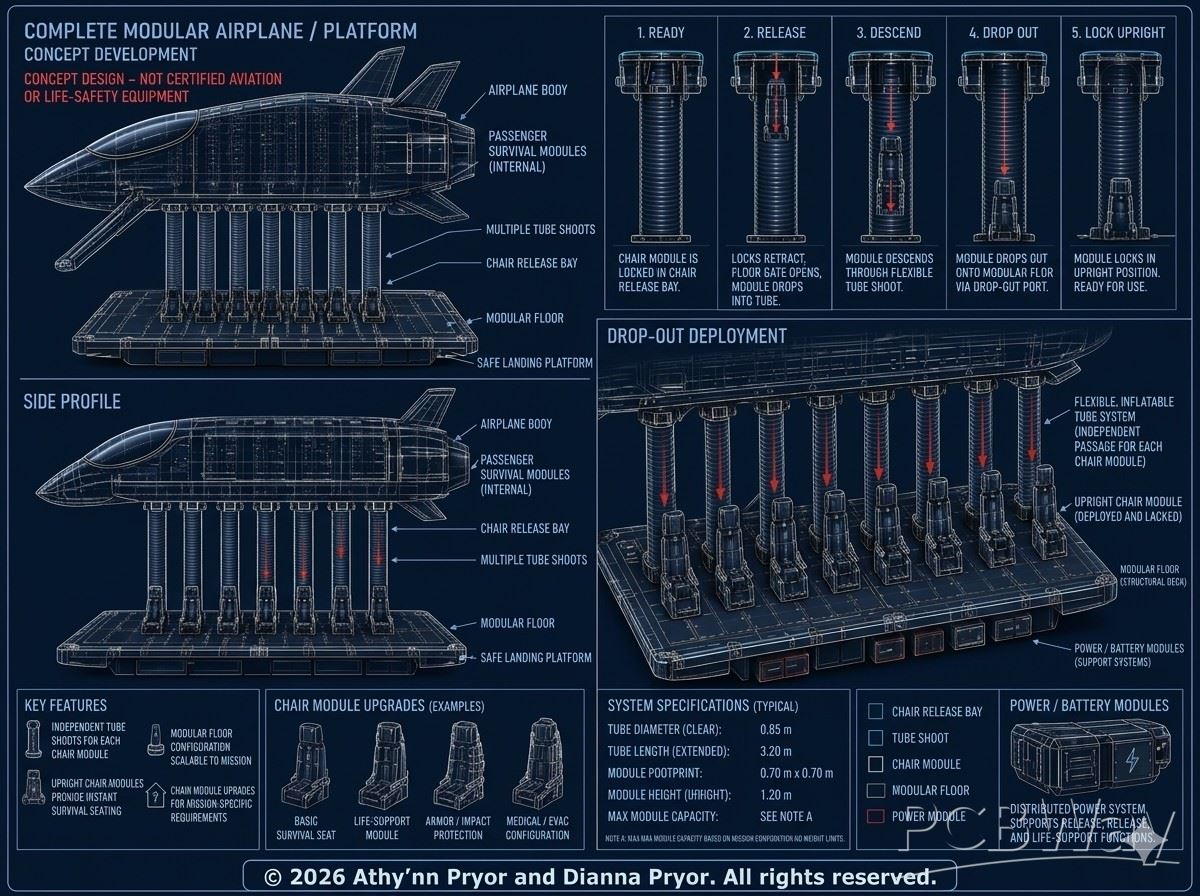
The upright deployable seat is envisioned as more than a chair. It is a modular emergency-survival platform designed to give a deployed occupant organized access to shelter, communication, hydration, nutrition, warmth, flotation, signaling, and instructions after an aircraft emergency. The concept uses tube-only deployment: multiple seats are released through separate shoots or flexible tubes beneath the aircraft and land on a modular floor or, in a water-landing scenario, a safety raft system.
This document explains the proposed additions step by step. It is a concept-development brief, not an operating manual or a claim that the system is currently safe, legal, certified, or technically proven.
1. UPRIGHT SEAT STRUCTURE
What it is: A tall upright backrest, seat cushion, side supports, head support, foot platform, locking base, protective side rails, guide rollers, and a modular floor lock.
Why it is necessary: The upright geometry helps organize the occupant, equipment, restraints, and deployment loads in a defined position. The locking base is intended to keep the chair stable after it exits the tube and reaches the platform.
Validation needed: Human-factors studies, restraint design, impact testing, structural analysis, center-of-gravity analysis, egress testing, and independent safety review.
2. MULTIPLE TUBE / SHOOT DEPLOYMENT
What it is: Separate vertical flexible tubes or shoots, each sized for one chair module, connected to aircraft-side release bays.
Why it is necessary: Individual tubes create an organized path for multiple chairs and keep each module separated during release. The concept removes physical ladder hardware; the tubes are the only deployment route.
Concept sequence: The chair unlocks in the release bay, enters its assigned tube, travels downward through the tube under controlled conditions, exits below the aircraft, lands on the modular floor or raft interface, and locks upright.
Validation needed: Controlled descent, tube strength, heat and abrasion resistance, entanglement prevention, synchronization, separation distances, aircraft integration, and failure-mode testing.
3. FOLDING SPECIALIZED PARACHUTE
What it is: A compact descent or stabilization canopy stored in a protected seat compartment.
Why it is necessary: A controlled descent concept could reduce fall energy in scenarios where deployment conditions permit it. The design must never be represented as a guaranteed parachute or as suitable for every aircraft emergency.
Validation needed: Aerodynamic modeling, canopy deployment testing, load paths, aircraft wake analysis, altitude and speed limits, automatic/manual controls, redundancy, and aviation certification.
4. PARACHUTE-TO-TENT CONVERSION
What it is: A proposed conversion in which the canopy, after deployment and recovery, becomes a weather-resistant shelter using poles, lines, stakes, or integrated supports.
Why it is necessary: One packed system could serve two survival functions: descent support where approved and temporary shelter afterward.
Validation needed: Fire resistance, wind and rain performance, structural stability, safe repacking, contamination control, and a design that prevents users from confusing the shelter mode with descent mode.
5. SNAP-DETACHMENT WARM CLOTHING LAYER
What it is: A layered protective garment stored with the seat or canopy. Detachment panels snap apart and fold into emergency clothing for warmth, wind protection, and basic environmental coverage.
Why it is necessary: Hypothermia and exposure can become life-threatening after an emergency, especially at night, at altitude, or in cold or wet terrain.
Validation needed: Thermal performance, flame resistance, sizing, mobility, donning time, tear resistance, visibility, and compatibility with flotation or restraints.
6. SOLAR POWER SYSTEM AND RESERVE BATTERIES
What it is: Foldable solar charging surfaces paired with protected reserve batteries, charge controllers, and device ports.
Why it is necessary: Power supports the SOS beacon, communications devices, purifier controls, lighting, and other critical equipment after the primary battery is depleted.
Validation needed: Weatherproofing, realistic energy production, battery fire safety, cold-weather performance, storage life, connector standards, and safe isolation after damage.
7. AIR-TO-WATER PURIFIER AND WATER RESERVOIR
What it is: A proposed atmospheric water-generation or air-to-water device, combined with a sealed reservoir and a secondary water-treatment pathway.
Why it is necessary: Water is a survival priority, and a sealed system could reduce reliance on unknown surface water sources.
Validation needed: Actual production rate under different humidity and temperature conditions, energy consumption, filter and sterilization performance, maintenance, contamination protection, and a dependable backup water supply. Atmospheric water generation cannot be treated as a guaranteed source in dry environments.
8. NON-PERISHABLE FOOD AND MRE STORAGE
What it is: Sealed, rationed non-perishable food and MRE packs stored in the seat base or modular side compartments, with a target stock duration of up to one month subject to weight and volume analysis.
Why it is necessary: Food reserves support survival when rescue is delayed and help preserve decision-making ability and physical strength.
Validation needed: Total mass, shelf life, temperature stability, allergies and dietary needs, packaging, ration instructions, water requirements, and a realistic mission-specific duration. A one-month supply is a design target, not a guaranteed capacity.
9. COMMUNICATIONS: WALKIE-TALKIE AND SATELLITE PHONE
What it is: A short-range emergency walkie-talkie, satellite phone or satellite communicator, charging accessories, spare batteries, and a quick-reference contact card.
Why it is necessary: Different devices provide different communication ranges. A walkie-talkie can support a local group; a satellite device can support long-range contact where service and sky visibility permit.
Validation needed: Regulatory approvals, network coverage, subscription requirements, antenna exposure, waterproofing, battery duration, emergency-call procedures, and user training.
10. SOS BEACON AND SIGNALING EQUIPMENT
What it is: A dedicated SOS beacon, visual signal mirror, high-visibility markers, light, whistle, and location card.
Why it is necessary: Rescue teams need a reliable way to find survivors, especially when voice communication is unavailable or batteries are limited.
Validation needed: Beacon registration, satellite compatibility, false-alarm prevention, antenna clearance, weather resistance, visibility tests, and procedures for activation.
11. SAFETY RAFT, FLOTATION COLLAR, AND WATER-LANDING MODE
What it is: A compact safety raft pack, flotation collar, seat flotation inserts, inflation system, sea anchor or stabilization accessories, and water-resistant storage.
Why it is necessary: A water landing creates drowning, cold exposure, separation, and drift risks. The raft and flotation system are intended to keep the occupant buoyant and visible while supporting survival equipment.
Concept sequence: Secure the upright seat, trigger or manually deploy the raft pack when safe, inflate the raft, don the flotation collar, transfer or remain seated as designed, activate SOS, secure the raft, and follow the handbook’s water-survival procedures.
Validation needed: Buoyancy, stability, inflation reliability, puncture resistance, occupant transfer, cold-water performance, salt-water corrosion, raft capacity, and aircraft/seat separation behavior.
12. LAMINATED EMERGENCY HANDBOOK
What it is: A waterproof, laminated guide with illustrated steps for deployment, communications, water treatment, food rationing, fire and shelter safety, first aid, signaling, raft use, navigation, and decision-making after an aircraft emergency.
Why it is necessary: Stress reduces memory and attention. A simple, durable reference can turn complex equipment into a sequence of understandable actions.
Validation needed: Human-factors review, large-print accessibility, multilingual versions, low-light readability, waterproof testing, icon comprehension, update control, and usability testing with people who have no technical background.
13. FIRST-AID, FIRE, AND REPAIR KIT
What it is: Compact first-aid supplies, fire starter where legally and environmentally appropriate, thermal blanket, gloves, repair patches, cutting tool, tape, cordage, and basic maintenance items.
Why it is necessary: Minor injuries, cold exposure, damaged tubes, and shelter repairs can become serious without basic tools.
Validation needed: Safe storage, child and accidental-activation protection, medical labeling, shelf life, training, and compatibility with the raft and clothing systems.
RECOMMENDED EMERGENCY ORDER OF ACTION
1. Stabilize and lock the upright seat.
2. Confirm the scene and follow approved deployment conditions; do not activate a parachute or tube system without validated procedures.
3. If water is present, deploy flotation and raft equipment first when safe.
4. Activate the SOS beacon and establish communications.
5. Check for injuries and use first-aid supplies.
6. Purify and ration water; do not rely solely on atmospheric water generation.
7. Unpack thermal clothing, blanket, food, and MREs.
8. Convert the canopy into shelter only after descent equipment is safely separated and the handbook confirms the configuration.
9. Use signaling tools and maintain a communication schedule.
10. Follow the laminated handbook and conserve power.
ENGINEERING AND INVESTOR PRIORITIES
The next responsible step is not to promise a finished life-saving product. It is to build a weighted, dimensioned mock-up; analyze the seat, tubes, release bays, and platform; conduct human-factors research; test each survival subsystem separately; and work with qualified aviation, parachute, maritime-safety, medical, communications, and regulatory specialists.
The modular architecture creates a clear development path: a base upright seat, a tube interface, a protected equipment spine, and mission-specific survival packs. The system should be designed so equipment can be removed, inspected, replaced, and upgraded without changing the fundamental seat structure.
PROTOTYPE MATERIALS LIST
(Non-Functional Scale Model Only)
This list is for a small, hand-held tabletop demonstrator to show the modular concept and tube-only deployment. It is NOT for a flight, parachute, or life-safety prototype.
1. CORE SEAT MODULE (Scale: 1:10 or 1:20)
- Material: Stiff cardboard, 3D-printed PLA, or balsa wood.
- Features: Tall upright backrest, seat cushion, and side rails.
- Attachment: Small magnets or Velcro on the base to simulate the "Modular Floor Lock."
2. DEPLOYMENT TUBES
- Material: Clear PVC tubing, flexible dryer vent hose (small diameter), or clear plastic mailing tubes.
- Purpose: To show the "Multiple Drop Tubes / Shoots" concept.
3. AIRCRAFT INTERFACE
- Material: Foam core board or a large cardboard box.
- Purpose: To simulate the "Chair Release Bay" beneath the aircraft.
4. SURVIVAL EQUIPMENT (Visual Representation)
- Solar Panel: Small piece of dark blue reflective cardstock.
- Parachute/Tent: Lightweight ripstop nylon scrap or tissue paper.
- Water/Food: Small painted wooden blocks or beads.
- Handbook: A tiny 1-inch stapled paper booklet.
5. MODULAR PLATFORM
- Material: A flat wooden board or stiff foam board with a grid drawn on it.
- Purpose: To show the "Safe Deployment Zone" where the chairs land.
Apply for sponsorship >>- Comments(0)
- Likes(0)