

PDB for TSP-1X: 16" Hexacopter Thermal & Autonomy Testbed
Hi, I'm Theo, 17 years old, currently in 11th grade at a Gymnasium in Germany. I got into drones a while back and since then I've been learning CAD design, 3D printing, soldering and now PCB design too. I like actually building stuff and seeing if it works, and if it doesn't, figuring out why. Other than that I'm pretty much a normal teenager, gaming and hanging out with friends.
The Project: TSP-1X
I'm building a 16 inch hexacopter using a ZD850 frame, six Tarot 4114 motors and a 6S Li-Ion battery setup. Right now I'm still fairly early in the build. I don't have the frame yet (will be delivered soon) and only have 4 of the 6 motors and props so far, so I'm getting the rest together while I finish the electronics.
The idea behind the whole platform is to have a big, stable multirotor that I can use as a long-term testbed. Its planed like that so its is not a one-off build, but a platform I keep extending with new sensors and eventually autonomous flight capability. A hexacopter this size gives me the payload capacity and redundancy (it can still fly on 5 motors) to carry real sensor payloads instead of toy-sized ones.
The mission: finding fawns before the mower does
Every spring, farmers across Germany and much of Europe mow their fields and every spring, fawns die in the process. Roe deer hide their newborns in tall grass instead of running, since that's their natural defense against predators. It works against wolves and foxes. It doesn't work against a mower moving at walking speed through a field the fawn can't see over.
Farmers know this happens and don't want it to happen either, but walking every field by hand before mowing isn't realistic, especially for larger farms. A drone that can fly over a field in a few minutes and flag heat signatures in the grass is a far more practical solution, and thermal cameras on drones are already used for exactly this in some regions in germany (but also in the eu in general), the problem is that the ready to fly systems are expensive, and I want to build one myself, learn everything involved in the process, and hopefully make it cheap enough that more farms can actually use it.
Phase 1 (current): Build a reliable, stable hexacopter platform.
Phase 2: Mount a thermal camera and manually scan fields, flagging fawns for the farmer to move before mowing.
Phase 3: Add an NVIDIA Jetson Orin onboard and run real-time object detection on the thermal feed, so the drone can flag fawn locations automatically instead of requiring someone to watch a screen the entire flight.
What I'm Asking PCBWay to Sponsor this
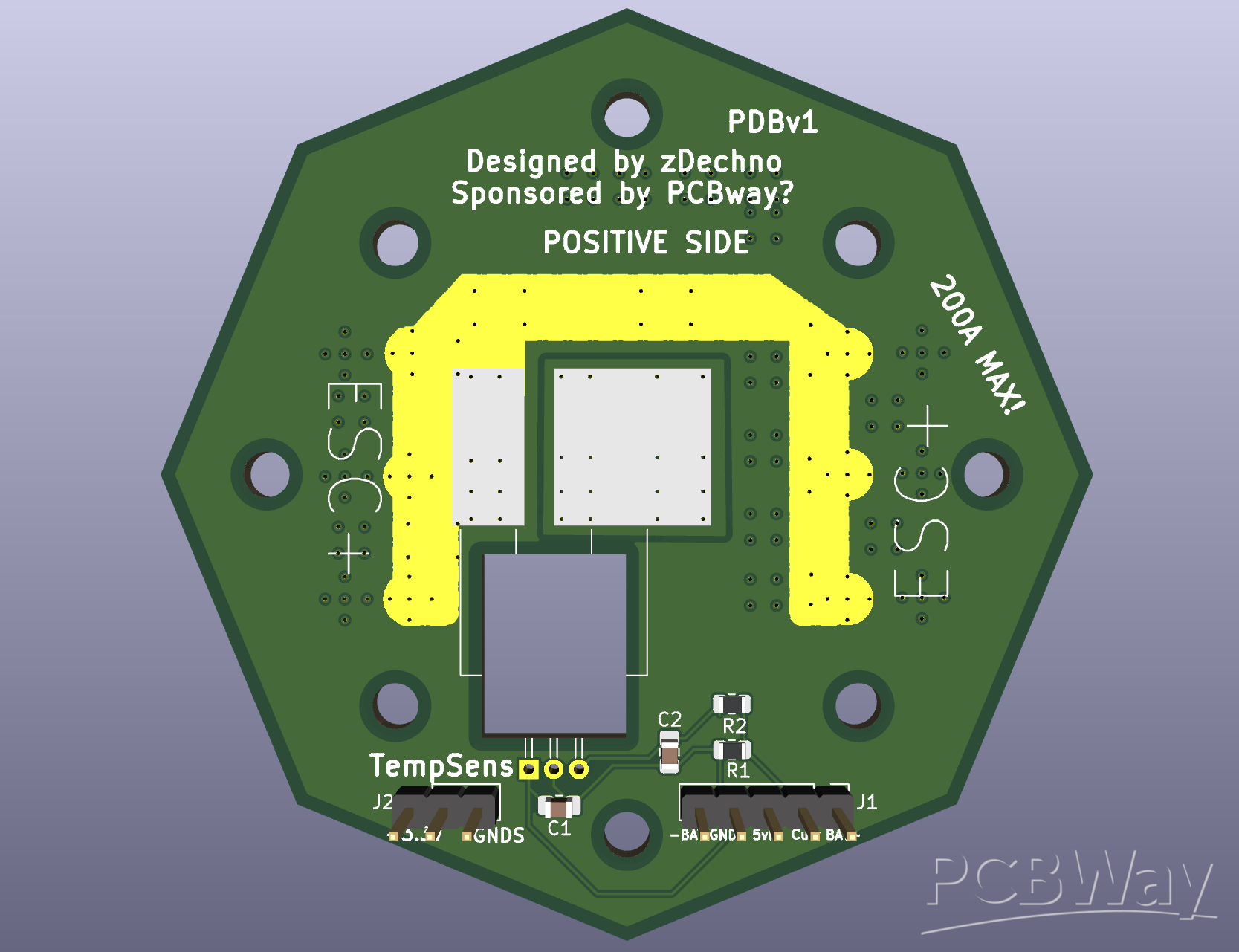
The board I need sponsored is the Power Distribution Board (PDB). It is the piece that sits between the 6S Li-Ion battery and all six ESCs, and it's the part of the build I can't move forward without.
Power input & distribution
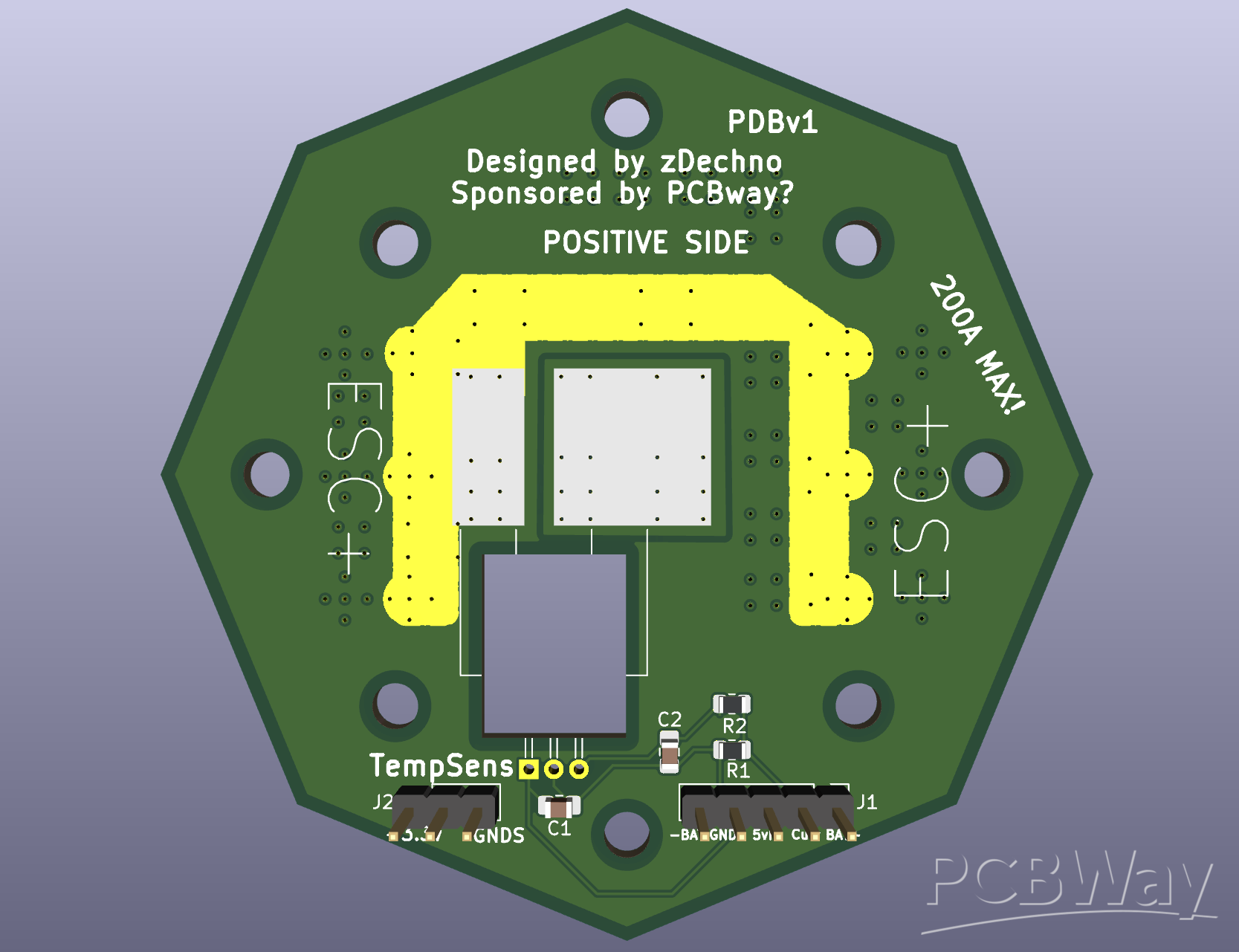
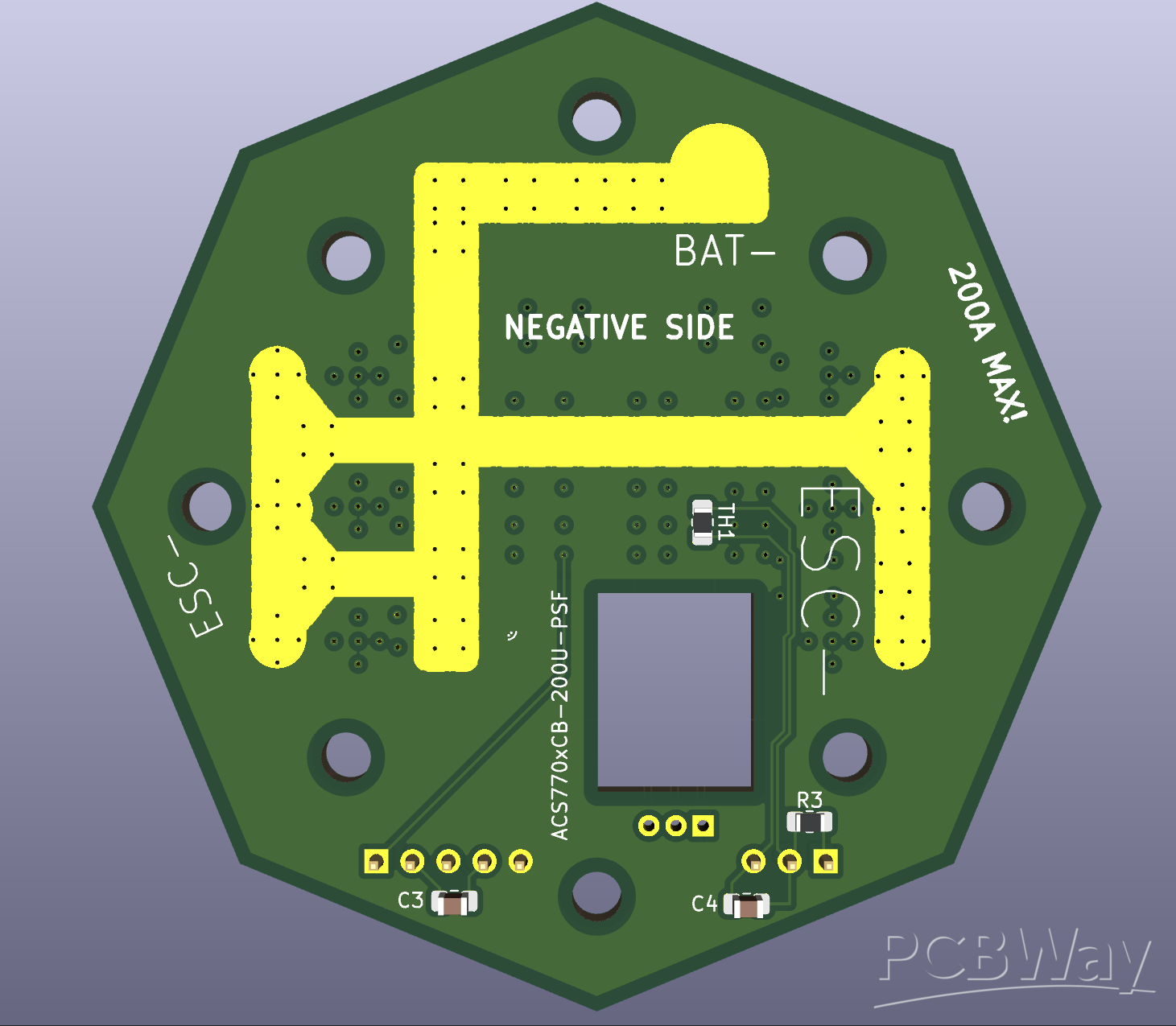
The board takes the full pack voltage directly from the 6S Li-Ion battery and splits it into six independent output paths, one per ESC. It's rated for up to 200A total, which covers the six Tarot 4114 motors at full power plus headroom for the payload additions planned in later phases (thermal camera, companion computer). Copper pours are sized generously and the layout keeps current paths short to minimize resistive losses and heating under load. On the high-current traces I deliberately left the soldermask off over the copper (the yellow areas in the layout) as exposed copper can be built up further with solder, which increases the effective copper thickness on those paths and pushes up how much current they can carry without excessive heating.
Current sensing:
Each output is monitored through an ACS770xCB-200U-PSF current sensor. This gives me real-time current draw data I can log during flight useful both for diagnosing motor or ESC issues and for watching power consumption once the thermal camera and Jetson are added later.
Temperature monitoring
A temperature sensor is placed on the board itself so I can monitor the thermal behavior of the PDB while it's under load, especially during the higher-current draws. This is important on a board pushing up to 200A, catching a hot spot in testing is a lot better than finding out mid-flight, which would mean the drone crashed because the motor wires desoldered.
Mechanical design
The board itself is cut to an octagonal outline with eight M3 mounting holes (3.5mm clearance diameter) arranged in a fully symmetric radial pattern, spaced 45° apart around the center on a 5–5.5cm radius. This matches the ZD850's center plate bolt pattern directly, so the PDB stacks straight onto the frame without any adapter or rework. The hole pattern was dimensioned precisely in CAD (with 3D prints as tests) before being carried over into the PCB layout, so mechanical fit and electrical layout were designed together rather than bolted on as an afterthought. Keeping the board symmetric also keeps wiring runs to each of the six arms short and even in length, which matters for balanced current delivery to all six ESCs.
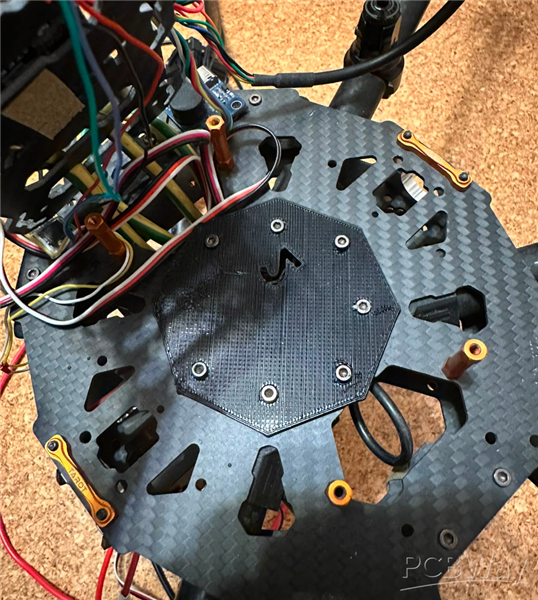
The design is done, the schematic and layout are finished, and the Gerber files are ready to go.
What I Have So Far
- Frame: ZD850, 16 inch (bought)
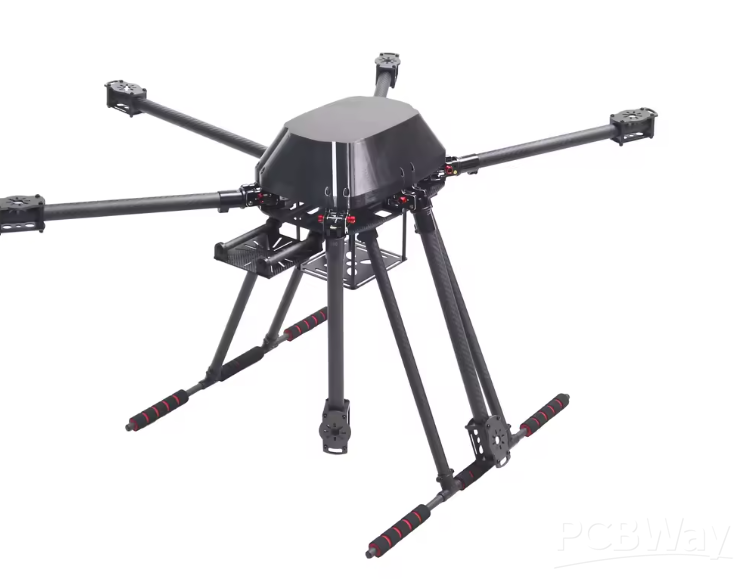
- Motors: Tarot 4114, 4 out of 6 so far
- Battery: 6S Li-Ion
- PDB: designed, ready to manufacture
- Later: thermal camera, Jetson Orin for onboard object detection
Everything so Gerber files, schematic, photos and current progress is on my GitHub: https://github.com/theocool123123-cmd/TSP-1X-16-
To PCBWay
Thanks for running this program, it genuinely makes a difference for someone like me who's still learning and doesn't have a big budget to throw at prototyping mistakes. Getting the PDB manufactured is the bottleneck standing between me and actually powering up the hexacopter, so this sponsorship would let me get the electronics side moving while I finish collecting the remaining motors and props. Once it's flying, I'll post build updates and flight test results and hopefully, eventually, this ends up helping save a few fawns too.
:)
Apply for sponsorship >>- Comments(2)
- Likes(1)