

Diy Digital Quad Night Vision Goggles
WHO I AM?
Hello! I'm a computer engineering student with a strong passion for hardware, embedded systems, and microcontrollers.
I enjoy designing custom devices inspired by real-world and fictional technologies, with the goal of recreating them at a significantly lower cost so that other students, hobbyists, and makers can build them using accessible components.
This project is only the beginning of a larger series of builds I plan to develop, with each future project increasing in complexity, functionality, and technical challenge.
Current Status
The electronic and mechanical architecture of the project is currently being developed around a custom four-channel digital night vision system.
Each optical channel operates independently and has its own dedicated PCB containing an OV9281 monochrome camera, ESP32-P4 processor, and 466×466 QSPI display. A separate central PCB will connect the four modules together and handle power distribution, battery management, and the IR LED driving circuitry.
The next stage of the project will focus on finalizing the schematics and PCB layouts, manufacturing the first prototypes, validating the individual modules, and integrating all four channels into the complete goggle.
As an independent open-source developer, prototype manufacturing is currently one of the largest obstacles to moving the project forward. PCBWay sponsorship would make it possible to manufacture the first boards, validate the design, improve the hardware, and release a fully tested version to the community.
Project Overview
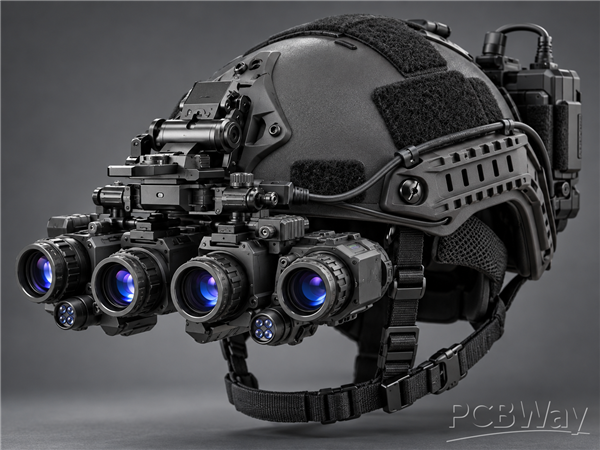
This project is an open-source digital quad night vision goggle based on four independent camera, processing, and display modules.
The objective is to recreate the panoramic layout of quad-tube night vision goggles while using digital components that are significantly more accessible and affordable than traditional image-intensifier-based systems.
Each channel consists of:
OV9281 monochrome camera → ESP32-P4 → 466×466 QSPI display
Each OV9281 camera has an approximately 97° field of view and is particularly suitable for monochrome imaging and near-infrared illumination.
Because the system is completely digital, external infrared illumination is required for operation in darkness. The project will use 940 nm IR LEDs, providing illumination that is generally not visible to the unaided human eye.
The four channels use the standard quad night vision arrangement, providing a wide combined field of view while keeping each optical and processing system independent.
Cost is also one of the main motivations behind the project. Comparable commercially available quad-channel digital night vision systems commonly cost well above €700, with some current products costing considerably more. My current estimated hardware cost is approximately €208, making the proposed system significantly more affordable while also providing a fully customizable and open-source hardware and software platform.
One of the most important aspects of the project is the processing capability available inside each individual optical channel. Each ESP32-P4 processes its own OV9281 camera independently. This means that the system is not limited to simply displaying the camera image. The available processing power can also be used for local computer vision applications, including object or person detection, highlighting detected objects directly on the display, and generating custom graphical overlays, symbols, warnings, or textual information. This creates the possibility of using the goggles not only as a digital night vision device, but also as an experimental wearable computer-vision platform.
Features
- Four completely independent digital night vision channels
- 4× OV9281 monochrome cameras
- 97° camera field of view
- 4× ESP32-P4 processors
- 4× 466×466 QSPI displays
- One dedicated PCB for each optical channel
- Central PCB for interconnection, power distribution, battery management, and IR illumination control
- 940 nm IR LED illumination
- Approximately 50 m target illumination range
- Real-time digital video processing
- Local AI and computer vision capabilities
- Object/person detection and display highlighting
- Custom display overlays, icons, and text
- Rear helmet-mounted LiPo battery pack
- Standard quad night vision layout
- Modular electronic and mechanical construction
- Expandable architecture for future firmware and hardware improvements
Estimated Hardware Cost
OV9281 monochrome cameras: 4 × approximately €25 = €100
ESP32-P4 processors: 4 × approximately €10 = €40
466×466 QSPI displays: 4 × approximately €7 = €28
Additional electronics and components: Approximately €40
This includes components such as the 940 nm IR LEDs, LED driving circuitry, battery-management electronics, connectors, voltage regulation components, passive components, wiring, and other supporting hardware. The current estimated hardware cost is therefore approximately €208, excluding possible variations in PCB manufacturing, mechanical fabrication, shipping, and future revisions. For comparison, commercially available quad-channel digital night vision goggles can cost €700 or more, with higher-end digital systems reaching considerably higher prices. This means that the target hardware cost of this project is less than one third of the €700 reference point.
Reducing the cost is one of the primary objectives of the project. The intention is to make a functional quad digital night vision platform accessible to students, makers, airsoft players, and electronics enthusiasts who cannot justify the cost of existing commercial systems. At the same time, because the electronics and firmware are custom-designed, the project can offer capabilities that are difficult to implement on closed commercial devices, particularly programmable display overlays and onboard computer vision.
Open Source
All hardware design files, firmware, software, 3D models, and documentation are or will be released under open-source licenses. The goal is to provide a platform that anyone can study, manufacture, modify, and improve without unnecessary restrictions. PCB source files, schematics, manufacturing files, firmware, computer vision software, mechanical designs, documentation, and future revisions will all be made publicly available through my linked GitHub repository.
Why I'm Requesting Sponsorship
This project is developed independently in my spare time and is not funded by a company, university, or commercial organization.
PCBWay's sponsorship would directly enable the production of the first custom PCBs required for the four independent night vision modules and the central control and power board. This would allow the electronic design to be manufactured, assembled, tested, verified, and improved before being released as a proven open-source project.
After receiving and assembling the boards, I will document the complete build process, perform electrical and functional validation, integrate the four digital night vision channels, test the infrared illumination system, develop and optimize the firmware and computer vision software, publish project updates, and release the design files and documentation publicly.
PCBWay will be credited as the project sponsor throughout the development documentation and published project material.
WORDS TO PCBWAY
Thank you for taking the time to review my project.
I truly appreciate PCBWay's continued support of the open-source hardware and maker communities. Many independent developers have been able to transform ambitious ideas into real, fully documented projects through your sponsorship program, and I hope to do the same with this digital quad night vision platform.
Your support would allow me to manufacture the first custom PCBs, validate the electronic and mechanical design, integrate and test the four independent night vision modules, develop the firmware and computer vision functionality, publish testing results, and release a reliable open-source platform that others can study, reproduce, modify, and build upon.
The project combines custom PCB design, embedded processing, digital imaging, infrared illumination, wearable electronics, and onboard computer vision into a single system, while targeting a hardware cost of approximately €208 compared with the €700+ price range commonly associated with commercially available quad digital night vision systems.
This project also represents the beginning of a larger series of increasingly complex open-source hardware projects that I intend to develop and document publicly. I will document the complete development process, share the assembled boards and finished night vision system, publish future revisions, and proudly acknowledge PCBWay's sponsorship throughout the project.
Thank you for considering my application.
Apply for sponsorship >>- Comments(0)
- Likes(1)