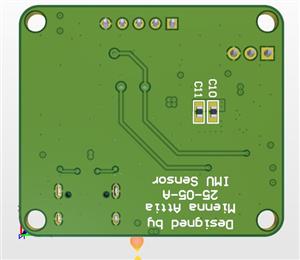
IMU Sensor Board
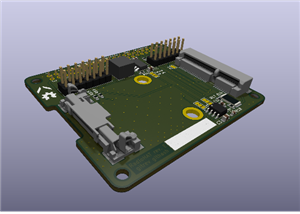
IMU Sensor Board designed to bridge an Inertial Measurement Unit (IMU) with a computer or external controller via USB or a JST connector. It features robust power management and signal protection.
1. The Sensor: BNO055 IMU
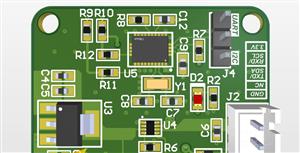
The core of the board is the BNO055, a high-performance Intelligent 9-axis Absolute Orientation Sensor.
Capabilities: It integrates an accelerometer, gyroscope, and magnetometer with an on-board processor to handle sensor fusion.
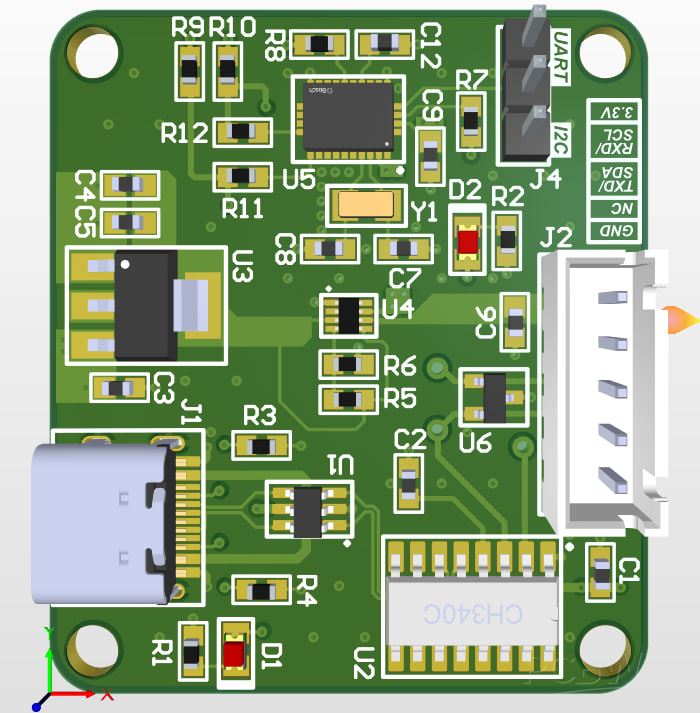
Configuration: The board includes a selector labeled "UART or I2c" (J4), allowing the user to choose the communication protocol for the sensor.
Timing: A $32.768\text{kHz}$ Crystal oscillator (Y1) provides the precise clock signal required for the IMU's internal operations.
Filtering: The "Input Voltage for IMU Sensor" section shows several decoupling capacitors ($C9, C10, C11$) used to stabilize the power delivery to the sensor's VDD and VDDIO pins.
2. Communication and Interface
The board provides two primary ways to interact with the IMU:
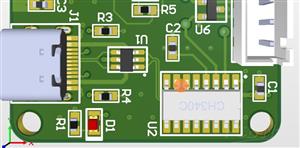
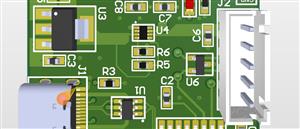
USB Type C (J1): This serves as the modern interface for power and data.
USB-UART Converter (CH340C): This chip (U2) converts the USB signals into serial UART signals that the IMU or a microcontroller can understand.
5 PINS JST (J2): An alternative connector (XH-5A) is provided for external serial connections, labeled with RXD, TXD, and power pins.
Signal Protection: * Unidirectional Protection (U1): Protects the USB data lines from static discharge.
Bidirectional Protection (U6): A PSM712-ES diode array protects the TXD and RXD lines from voltage spikes.
3. Power Management System
This board features a sophisticated "Switch Over" power architecture to ensure it can run from multiple sources.
LDO 5V to 3.3V (U3): An LD1117S33CTR voltage regulator takes the 5V from the USB (VBUS) and converts it to a stable +3V3(1) rail.
Switch Over (TPS2116DRLR): This power multiplexer (U4) automatically selects between the 3.3V generated from the USB (+3V3(1)) and the 3.3V provided by the JST connector (+3V3(2)). It outputs a unified +3V3 rail to power the rest of the board.
Indicators: Two LEDs (D1 and D2) provide visual confirmation that the VBUS (5V) and +3V3 power rails are active.
4. Physical and Utility Components
MH (Mounting Holes): Four mounting holes (H1–H4) are included for securing the PCB into an enclosure or onto a frame.
Pull-up Resistors: The $I^{2}C$ lines utilize $5.1k\Omega$ resistors ($R9, R10$) to ensure reliable data communication when that mode is selected.
IMU Sensor Board
Project images are for reference only. Actual production is based on the manufacturing files on the project page.
Please review the designer's notes (e.g., PCB thickness) and select the appropriate options.
PCBWay is not responsible
for issues caused by unsuitable parameter selections.
For more important ordering information, please refer to
Read More


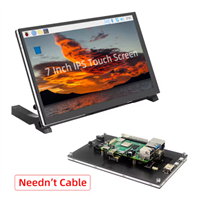
Raspberry Pi 5 7 Inch Touch Screen IPS 1024x600 HD LCD HDMI-compatible Display for RPI 4B 3B+ OPI 5 AIDA64 PC Secondary Screen(Without Speaker)
BUY NOW

- Comments(0)
- Likes(1)
 More by Engineer
-
SmallOLED - Live PC Stats, Animated Clocks & Audio Visualizer
738 0 3 -
"Talking Multimeter": Arduino-Based Speech Add-on for Multimeters with SCPI Protocol
419 0 1 -
Programmable Mist Maker - XIAO / QT PY Extension
2864 2 3 -
RadioHAT - Raspberry Pi radio development platform
2455 0 4 -
-
-
-
ARPS-2 – Arduino-Compatible Robot Project Shield for Arduino UNO
4540 0 6