




|
Visual Studio Code |
|

|
ESP-PROGEspressif
|
G-EDM Gapstorm Pulseboard (deprecated)
Outdated! Link to the new Gapstorm Pro board:
Please order the new Gapstorm Pro board instead of this version: https://www.pcbway.com/project/shareproject/G_EDM_Gapstorm_Pro_Pulseboard_a0db8e30.html
G-EDM Gapstorm (Pulseboard)
The G-EDM Gapstorm was designed to replace the EVOIII Pulseboard with a more user-friendly, compact, and efficient version. It simplifies the build process, reduces size, and enhances performance.
Overview: The Gapstorm is the new standard switching unit in the G-EDM topology, built around a DPH8909 or DPM8605 step-down converter. It enables makers to cut various metals with high precision on DIY wire or RAM EDM machines. Note: DPH8909 (or DPM8605) are available with different interfaces. The TTL version is required and the baud rate needs to be set to 115.2k in the menu in order for the communications with the firmware to work. Read the manual on how to set the baudrate on those devices.
For more details, visit: https://gedm.org
To build a G-EDM it also requires the motionboard that can be found here: https://www.pcbway.com/project/shareproject/W532897ASC41_motionboard_evoIII_rev3_bb113e0f.html
Max current capabilities are currently not known and it is recommended to use this board only for wire EDM and hole popping and have the DPM/DPH set to max 3A. I will run some stress tests soon to get the max ratings but for larger sinker jobs it may not be sufficient.
Key Improvements compared to the EVOIII Board:
- Compact Size:
PCB footprint reduced to only 99mm x 99mm.
- Simplified Manufacturing:
Some through-hole (THT) components replaced with surface-mount (SMD) versions for easier assembly.
Integrated Current Shunt:
- The current shunt resistor is now onboard, reducing wiring complexity.
- Upgraded Op-Amps:
Replaced LM358 with OPA350 for improved performance.
- Advanced Gap Proximity Sensing:
Features two sensing channels: one for current feedback and one for voltage.
Unlike EVOIII, which connected voltage sensing to the power bus and detected only hard shorts via voltage drops, Gapstorm’s voltage sensing provides fast, linear, real gap proximity detection.
Requires firmware update to utilize this feature.
The PCB includes a footprint for converting between gap proximity sensing and bus voltage sensing by unsoldering and repositioning a resistor.
Wiring and Calibration Enhancements:
- The onboard shunt resistor simplifies wiring, eliminating the need for an external shunt wire.
- Uses a fixed voltage divider for voltage feedback, removing the need for calibration potentiometers and making setup plug-and-play.
Power Mosfet Improvements:
- Replaces four parallel IRFP260N Mosfets with a single, screw-mounted SOT-227 package.
- The new Mosfet's package is electrically isolated from the drain, allowing direct mounting onto the metal enclosure. The surface of the enclosure still needs to be sufficient as heatsink. If it is thin walled it requires a heatsink.
- No soldering needed; just screw the Mosfet onto the enclosure with a touch of cooling paste recommended.
- This design simplifies assembly and enhances thermal management.
Mechanical Recommendations:
- Use 2mm thick PCBs to prevent flexing when opening the large Heavy duty WAGO terminal levers.
- The PCB features four mounting holes for custom installations but is primarily mounted by screwing the Mosfet into the enclosure and securing the board onto the Mosfet.
Firmware:
The firmware to run this board is available on GitHub:
https://github.com/G-EDM/G-RBLv3
The upcoming firmware unlocks the new sensing features, optimizes performance and improves the surface finish.
Users that already have an EVOIII board can upgrade it without much issues to match the Gapstorm performance and also have the new voltage sensing. It is easy to do and a tutorial will be provided together with the firmware.
Image showing how to wire everything is available here:
https://gedm.org/photos/1/album/a655d21b876f5ba21783beb6c846ac8f
Features:
- Optically isolated PWM input to drive the Mosfet Gate (Low Side switch)
- Two isolated feedback channel (voltage and current) using HCNR201 linear optocouplers
- High side INA293 current sensor with onBoard shunt resistor
- Large WAGO Terminal
- Supports up to 85v
- Single 1090W Power Mosfet screwed to the Board
Layers (from top to bottom):
Top: pb-gapstorm-F_Cu.gbr
Second: pb-gapstorm-In1_Cu.gbr
Third: pb-gapstorm-In2_Cu.gbr
Bottom: pb-gapstorm-B_Cu.gbr
G-EDM Gapstorm Pulseboard (deprecated)
Project images are for reference only. Actual production is based on the manufacturing files on the project page.
Please review the designer's notes (e.g., PCB thickness) and select the appropriate options.
PCBWay is not responsible
for issues caused by unsuitable parameter selections.
For more important ordering information, please refer to
Read More


Raspberry Pi 5 7 Inch Touch Screen IPS 1024x600 HD LCD HDMI-compatible Display for RPI 4B 3B+ OPI 5 AIDA64 PC Secondary Screen(Without Speaker)
BUY NOW


- Comments(1)
- Likes(0)
More by Roland Lautensack
-
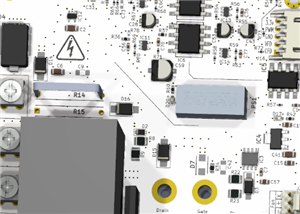 G-EDM Gapstorm Pro Pulseboard
G-EDM Gapstorm ProDIY EDM has made significant progress, and so has the G-EDM.After months of tinker...
-
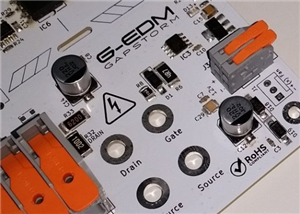 G-EDM Gapstorm Pulseboard (deprecated)
Outdated! Link to the new Gapstorm Pro board:Please order the new Gapstorm Pro board instead of this...
-
 G-EDM EVOIII Motionboard
https://gedm.org/This board comes with a more thoughtful placement of all th...
-
 G-EDM Motionboard
Note from PCBWay: This page only includes the motionboard. To build the G-EDM it also requires the p...
-
SmallOLED - Live PC Stats, Animated Clocks & Audio Visualizer
771 0 3 -
"Talking Multimeter": Arduino-Based Speech Add-on for Multimeters with SCPI Protocol
437 0 1 -
Programmable Mist Maker - XIAO / QT PY Extension
2889 2 3 -
RadioHAT - Raspberry Pi radio development platform
2468 0 4 -
-
-
-
ARPS-2 – Arduino-Compatible Robot Project Shield for Arduino UNO
4550 0 6