Extra-long, extra-wide, ultra-thick, and heavy copper PCBs play a critical role in modern electronic devices. They are mainly used in high-power, high-current, harsh-environment, and space-constrained applications. By providing larger routing space, higher current-carrying capacity, and superior thermal performance, these PCBs address the limitations of traditional boards. In fields such as renewable energy, energy storage, drones, high-power motors, and industrial power supplies, heavy copper PCBs have become almost standard.
In the PCB industry, copper thickness is usually measured in ounces (oz), referring to the weight of copper per square foot. The thickness conversion is as follows:
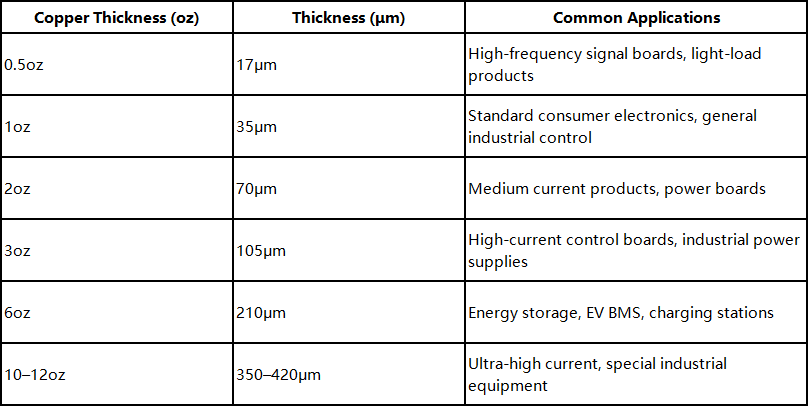
Tip: In the industry, PCBs ≥2oz are generally considered heavy copper PCBs, while those >10oz are regarded as ultra-heavy copper boards.
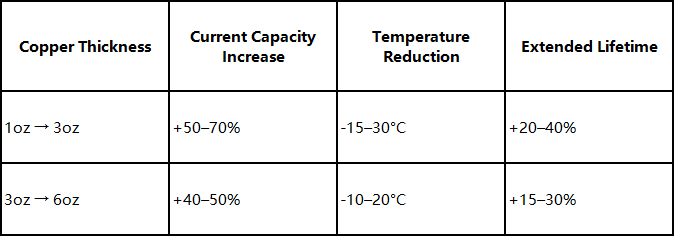
Thicker copper not only increases current-carrying capacity but also reduces temperature rise and extends service life. For example: under the same 10A current, a 3oz copper PCB can have a temperature rise more than 20°C lower than a 1oz PCB, significantly benefiting component longevity.
Performance comparison:
When a circuit must carry continuous high current and standard 1–2oz copper cannot meet the current or temperature requirements, heavy copper PCB design should be considered. Typical scenarios include power modules, inverters, and motor drivers.
Heavy copper can effectively reduce trace resistance, minimizing voltage drop and heat generation in circuits requiring high voltage stability.
Thick copper helps dissipate and conduct heat, suitable for designs with high power density or localized heating, though proper thermal design is still necessary.
When board space is constrained and widening traces is not feasible to increase current capacity, increasing copper thickness is a more practical solution.
Heavy copper PCBs are suitable for industrial and automotive environments, providing resistance to thermal cycling, vibration, and long-term operational stress.
If maintaining PCB integration is desired without adding external copper bars, cables, or complex assemblies, heavy copper PCBs offer a convenient compromise.
For more details on considerations for heavy copper PCB design, refer to this Heavy Copper PCB Design Guide to ensure optimal performance and reliability: High Current Trace Design Considerations in PCB Layout
Heavy copper PCBs are the foundation for high-current, high-reliability products, and PCBWay has proven its expertise in heavy copper PCB design, manufacturing capabilities, and delivery speed through hundreds of successful projects.
For your heavy copper PCB needs, you can choose PCBWay to get the boards you want.



