Compared with traditional FR4 boards, glass PCBs offer advantages such as heat resistance, transparency, and stability, and are widely used in high-end fields like 5G communications and medical devices. PCBWay now offers this advanced glass PCB technology, enabling manufacturers to leverage its unique properties for high-frequency, high-precision, and high-reliability applications.
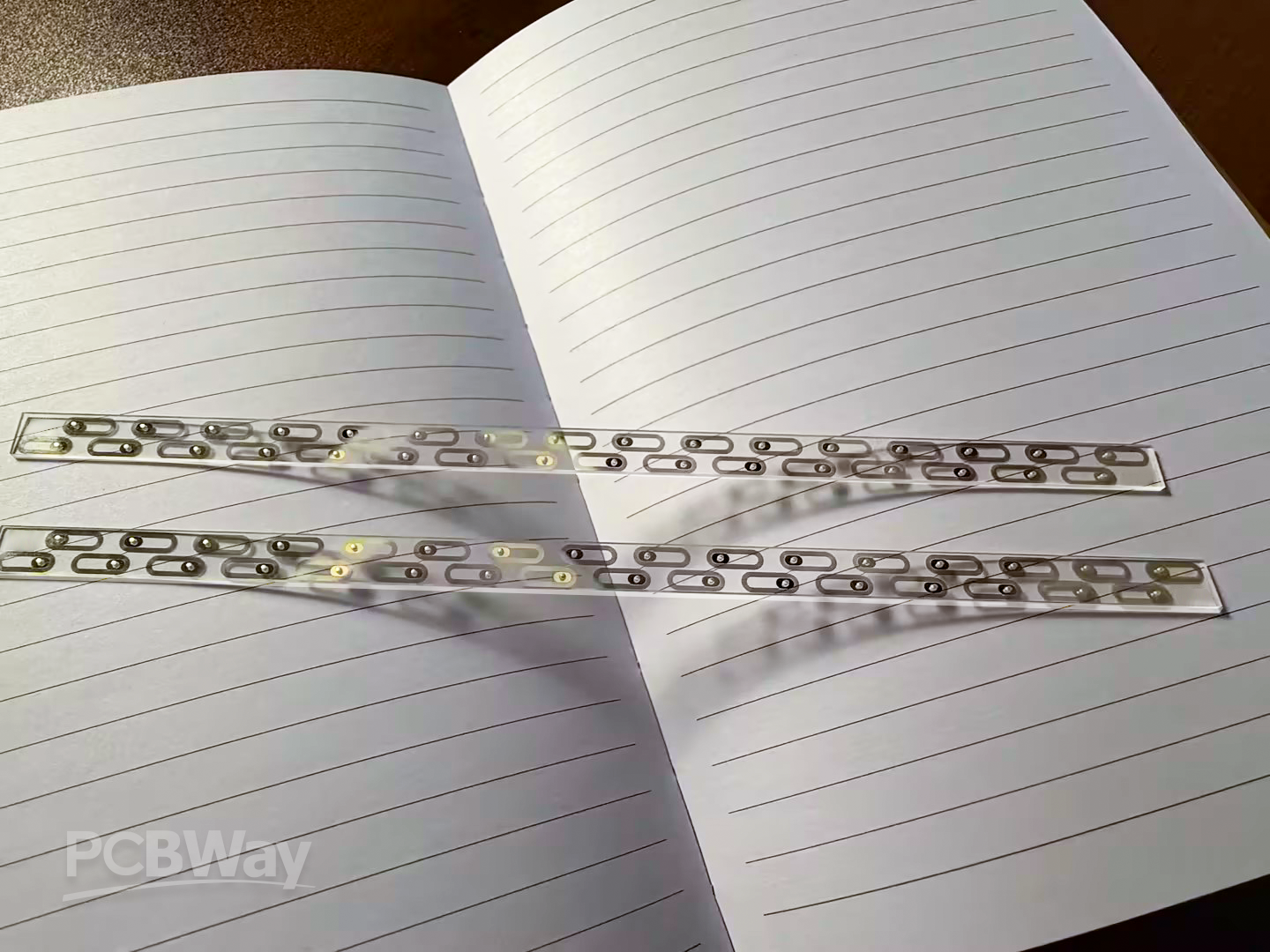
Layer Count: Single-sided and double-sided glass PCB
Copper Thickness: 6 µm – 35 µm
Board Thickness: 0.4 mm – 4.0 mm
Maximum Panel Size: 1500 mm × 500 mm
Minimum Trace Width / Spacing: ≥ 0.075 mm
High Temperature Resistance: Glass PCBs have a softening point of up to 1000°C, and their thermal expansion coefficient matches that of silicon chips, maintaining dimensional stability under extreme temperatures.
Stable Signal Transmission: With extremely low dielectric loss and stable dielectric constant, glass PCBs ensure almost no attenuation or distortion during high-frequency signal transmission.
Slim and Lightweight Design: Ultra-thin thickness below 100 µm can be achieved while maintaining excellent flatness and mechanical strength, meeting the requirements of high-density integration.
Aerospace: Able to withstand drastic temperature changes and space radiation; low outgassing prevents contamination of precision equipment.
Optoelectronics: Leveraging glass transparency and integrated optical waveguides to enable efficient optoelectronic co-packaging and board-level optical interconnects.
Microelectronic Packaging: Used as 2.5D/3D interposer boards, supporting high-density interconnections and matching chip thermal expansion characteristics.
RF and Microwave Devices: Maintains ultra-low loss in millimeter-wave frequency bands, significantly improving antenna array efficiency and signal reception sensitivity.
If you need glass PCB manufacturing, you can place an order on our Advance PCB page and specify that you need glass PCB in "Other special request".
A fully transparent glass PCB requires a single-layer with non-plated holes. Plated vias or double-sided copper will affect optical transparency.