




|
KiCad 9.0 |
Raspberry Pi Dac Hat Isolator and Reclocker
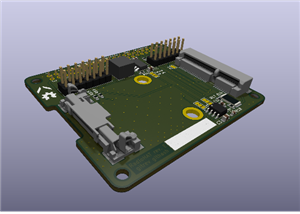
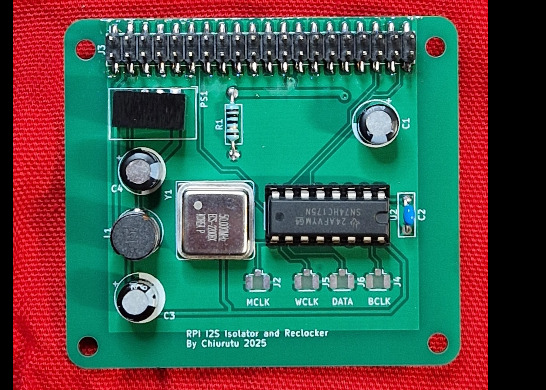
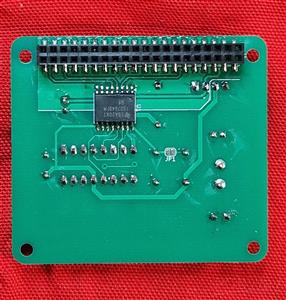
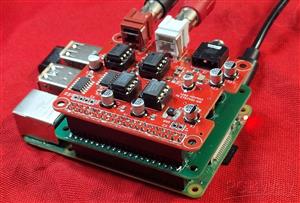
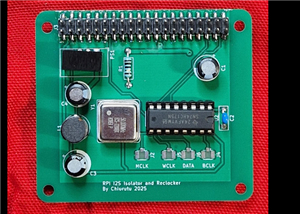
It's essentially a board that integrates an optoisolator for digital signals, a DC/DC converter to regenerate the supply voltage, an L-C shunt filter to filter out any residual high-frequency noise, and an asynchronous reclocker. Let's look at the four stages in detail. The optoisolator breaks any ground loops, eliminates noise conducted by the Raspberry Pi or its power source, significantly reduces HF interference "dirty" from the digital signals, and protects the DAC from upstream noise and spikes. The DC/DC converter creates an independent power source, completely decouples the logic from the rest of the system, and isolates it from switching noise on the Raspberry Pi's 5V supply. This allows the reclocker to operate with its own power, without inheriting external noise. (And this in itself is a game changer in the I²S world.) The L-C shunt suppresses DC/DC residuals, eliminates high-frequency harmonics, and prevents noise from returning to the ground or power supply. The reclocker's electronics become extremely quiet. It's the final block of the asynchronous reclocker that works its magic; no PLL → no loop jitter; the edges are regenerated with a fixed, stable delay. The clock is clean, always identical, and independent of the Raspberry Pi. This is precisely the biggest advantage over chips with PLLs: a PLL always introduces residual jitter due to the loop filter and the locking process. On the contrary, an asynchronous reclocker regenerates the edges without depending on the input clock, resulting in sharper transitions and a cleaner I²S signal. The result is the I²S waveform is completely reconstructed. Last but not least, simplicity. The board is almost entirely discrete. Only the insulator, because none exist, and the connectors, because I was asked to build it without mechanical shifts, need to be soldered as SMDs, requiring a little more care than with traditional assembly. But it can be done. And then there's the operation, which avoids all those more or less complex reconstructions of the data flow in the digital domain. This is a barrier, a filter, that cleans and arranges the bit stream coming from the Raspberry Pi, without alteration. Ultimately, the DAC used, especially the "direct" ones like the "original" Protodac, significantly improves stability, signal-to-noise ratio, and overall sound imaging.
Raspberry Pi Dac Hat Isolator and Reclocker
Project images are for reference only. Actual production is based on the manufacturing files on the project page.
Please review the designer's notes (e.g., PCB thickness) and select the appropriate options.
PCBWay is not responsible
for issues caused by unsuitable parameter selections.
For more important ordering information, please refer to
Read More


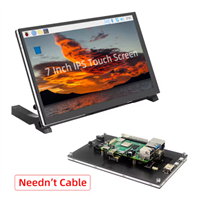
Raspberry Pi 5 7 Inch Touch Screen IPS 1024x600 HD LCD HDMI-compatible Display for RPI 4B 3B+ OPI 5 AIDA64 PC Secondary Screen(Without Speaker)
BUY NOW


- Comments(6)
- Likes(1)
More by Stefano Taccini
-
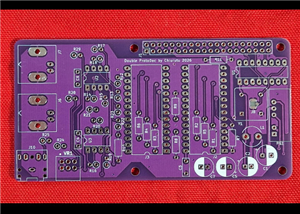 Double Protodac Headphone Output Version
The quality of a DAC is best assessed through headphones, where the intimacy with the music is compl...
Double Protodac Headphone Output Version
The quality of a DAC is best assessed through headphones, where the intimacy with the music is compl...
-
 Discrete OP
We know the importance of this device, which has always been used in various audio circuits. It is n...
Discrete OP
We know the importance of this device, which has always been used in various audio circuits. It is n...
-
 TDA1541 DAC HAT for Raspberry Pi
The TDA1541 HAT Project can be described as "The Golden Age of R2R." With this chip, the board embod...
TDA1541 DAC HAT for Raspberry Pi
The TDA1541 HAT Project can be described as "The Golden Age of R2R." With this chip, the board embod...
-
 Amachiaro (Amanero alternative) to Protodac (Raspberry Hat Dac) Adaptor
I designed a small PCB that connects Amanero-type XMOS receivers to GPIO-capable DAC HATs. This make...
Amachiaro (Amanero alternative) to Protodac (Raspberry Hat Dac) Adaptor
I designed a small PCB that connects Amanero-type XMOS receivers to GPIO-capable DAC HATs. This make...
-
 Raspberry Pi Dac Hat Isolator and Reclocker
It's essentially a board that integrates an optoisolator for digital signals, a DC/DC converter to r...
Raspberry Pi Dac Hat Isolator and Reclocker
It's essentially a board that integrates an optoisolator for digital signals, a DC/DC converter to r...
-
Programmable Mist Maker - XIAO / QT PY Extension
2143 2 2 -
RadioHAT - Raspberry Pi radio development platform
1822 0 4 -
-
-
-
ARPS-2 – Arduino-Compatible Robot Project Shield for Arduino UNO
4031 0 6 -
A Compact Charging Breakout Board For Waveshare ESP32-C3
4766 3 8 -
AI-driven LoRa & LLM-enabled Kiosk & Food Delivery System
5583 2 2 -