
|
KiCad 9.0 |
|

|
FreeCad |
|
|
|
OpenSCADOpenSCAD
|
Peak-Ignitor - Mini 120W 12V Power Bank
Why?
Have you ever tried to light a cigarette on a mountain in strong wind at –10 °C?
I have. And none of my lighters worked — not gas, not electric, not plasma.
Cold batteries, wind, and reduced gas pressure make most portable lighters unreliable exactly when you need them most.
What does work in those conditions is a glowing car cigarette lighter.
Those are brutally simple, immune to wind, and don’t care about temperature - as long as you can supply enough current.
Typical car lighters draw between 6 A and 10 A at 12 V, which immediately defines the real requirement: at least 120 W of output power for aound 20 seconds.
That simple observation became the starting point for the Peak Ignitor.
What it became
Building something exactly to spec is hard - and when real-world constraints meet uncertainty, overengineering becomes the safe option.
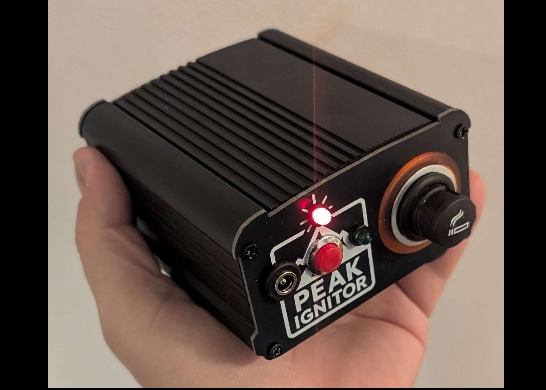
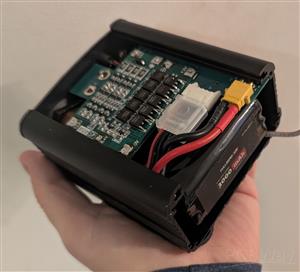
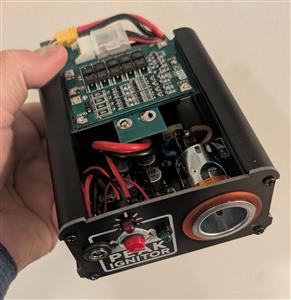
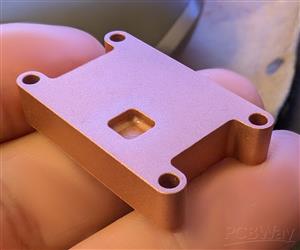
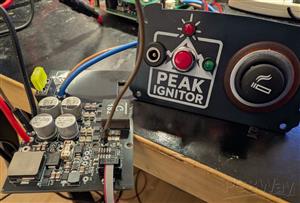
The result is a hand-sized, battery-powered supply delivering 120 W of continuous output, powered by a 4S Samsung 18650 pack and thermally managed through a custom copper heatsink coupled to the aluminum enclosure.
An ESP32-S3 (MINI-1) handles monitoring and control, while an integrated ~2 A charging circuit keeps the system fully self-contained.
Everything fits into a 95 × 100 × 55 mm aluminum case.
Discharge at up to 160 W is possible, but sustained operation is intentionally limited by battery temperature rather than electronic constraints.
What the project shows
The project demonstrates a surprisingly wide range of concepts that most people rarely encounter outside of professional electronics development.
It combines energy storage, power electronics, thermal engineering, mechanical design, and embedded systems into a single, compact device — and shows how tightly coupled these disciplines become once power levels leave the “USB toy” domain.
At its core, the Peak Ignitor is a battery-powered high-power system, including:
- A multi-cell Li-Ion battery pack operated close to its practical limits
- A proper BMS, treated as a first-class design constraint rather than an afterthought
- An integrated Li-Ion charging circuit, making the device fully self-contained
- A high-power buck/boost converter operating efficiently across wide voltage and load ranges
- Thermal design as a system feature, not an accessory
A key aspect of the project is its mechanics-first design approach:
The complete 3D design of the enclosure, internal layout, heatsink geometry, PCB outline, mounting points, and front-panel elements was created before any PCBs or components were ordered
(with the small exception of the car cigarette lighter connector — measurements had to come from a real part, so that one was ordered first).
This ensured that PCB layout, connector placement, control elements, and thermal paths were derived from the mechanical model rather than being adapted afterward.
This approach tightly couples:
- 3D CAD design
- PCB layout and form factor
- Front-panel design and user interaction
- Thermal and mechanical constraints
into a single coherent system. The result is a device where the PCB, heatsink, battery pack, and enclosure are not separate parts, but co-designed elements of one integrated structure.
Thermal management is a direct consequence of this philosophy:
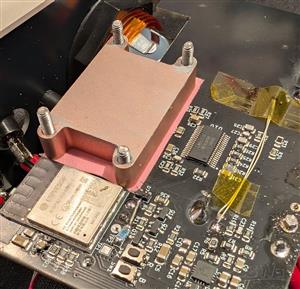
heat is transferred from the power electronics into a custom-machined copper heatsink and from there directly into the aluminum enclosure, effectively turning the entire case into an active thermal component — a design style typically seen in industrial or automotive hardware, but rarely in DIY projects.
Beyond hardware, the project also touches the embedded software side:
- Real-time monitoring of voltage, current, power, and temperature
- Safety limits enforced by software rather than purely electronic ceilings
- A Wi-Fi–based Web UI, because even a brutally practical device deserves observability 😎
Overall, the Peak Ignitor is less about lighting a cigarette — and more about showing what happens when real-world requirements, harsh environmental constraints, and a refusal to accept “almost good enough” are combined with a design-first, system-level engineering mindset.
Web UI
Every device needs Wi-Fi — so of course the Peak Ignitor has it too 😎
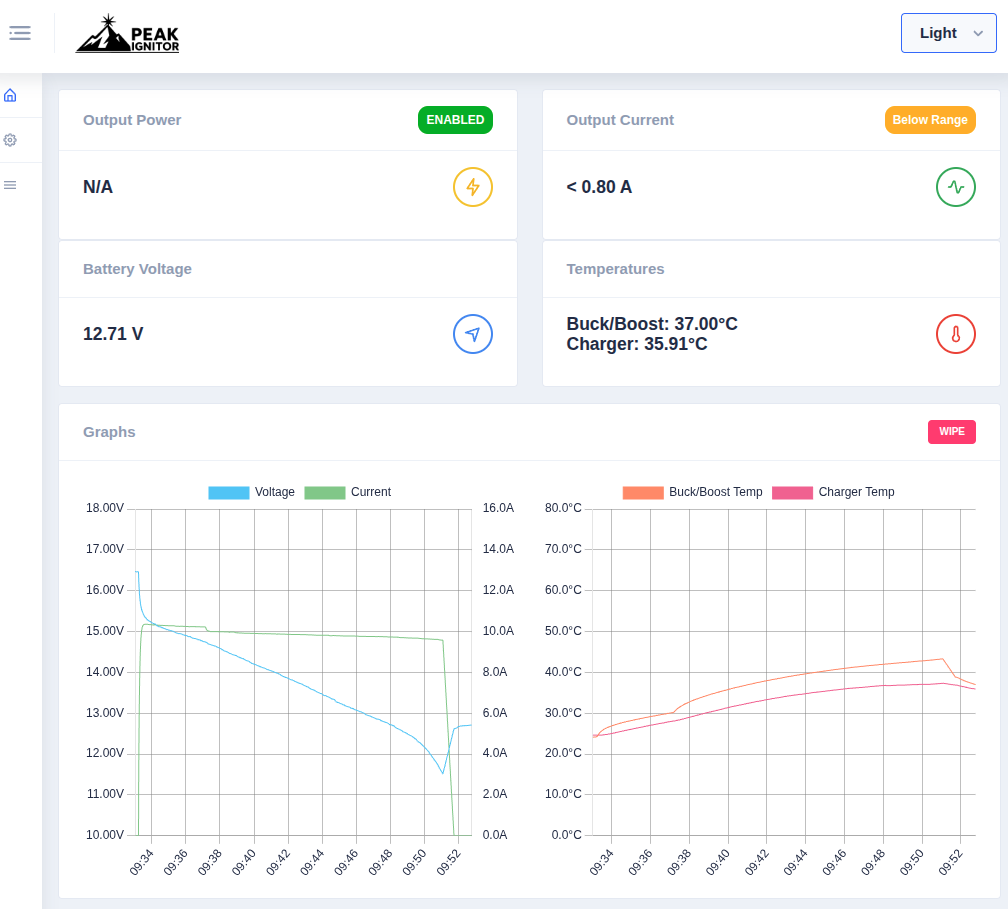
By the way, the image shows a full discharge cycle at around 120 W, with a total discharge time of about 17 minutes.
The right half of the plot shows the measured temperature.
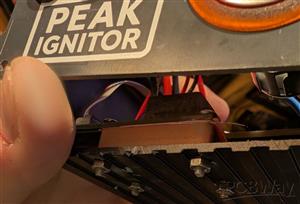
The temperature sensor is mounted on the bottom side, directly beneath the heatsink. That’s exactly why the custom copper heatsink includes a small pocket — it’s there to make room for the tiny TMP1075 temperature sensor!
What’s really impressive is how effectively the heat is transported away from the buck/boost converter area and thermally coupled into the aluminum enclosure. The thermal path works extremely well, and the case itself becomes a very efficient secondary heatsink.
Note:
This project consists of 4 part:
- This Peak Ignitor main pcb
- BMS carrier board (https://www.pcbway.com/project/shareproject/Peak_Ignitor_BMS_carrier_6cd662c9.html)
- Front panel pcb (https://www.pcbway.com/project/shareproject/Peak_Ignitor_Front_Panel_8555a839.html)
- Back panel pcb (https://www.pcbway.com/project/shareproject/Peak_Ignitor_Back_Panel_1ed7a906.html)
Peak-Ignitor - Mini 120W 12V Power Bank
*PCBWay community is a sharing platform. We are not responsible for any design issues and parameter issues (board thickness, surface finish, etc.) you choose.


Raspberry Pi 5 7 Inch Touch Screen IPS 1024x600 HD LCD HDMI-compatible Display for RPI 4B 3B+ OPI 5 AIDA64 PC Secondary Screen(Without Speaker)
BUY NOW


- Comments(2)
- Likes(1)
More by Thomas Pmaxuw
-
 Peak-Ignitor Back Panel
Back-Panel for Peak-Ignitor: https://www.pcbway.com/project/shareproject/Peak_Ignitor_25a13cdf.htmlT...
Peak-Ignitor Back Panel
Back-Panel for Peak-Ignitor: https://www.pcbway.com/project/shareproject/Peak_Ignitor_25a13cdf.htmlT...
-
 Peak-Ignitor Front Panel
Front-Panel for the Peak-Ignitor:https://www.pcbway.com/project/shareproject/Peak_Ignitor_25a13cdf.h...
Peak-Ignitor Front Panel
Front-Panel for the Peak-Ignitor:https://www.pcbway.com/project/shareproject/Peak_Ignitor_25a13cdf.h...
-
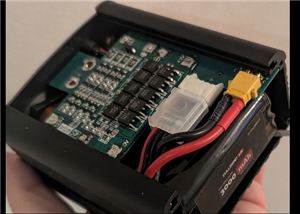 Peak-Ignitor BMS carrier
BMS Carrier Board for https://www.pcbway.com/project/shareproject/Peak_Ignitor_25a13cdf.htmlBOM:- XT...
Peak-Ignitor BMS carrier
BMS Carrier Board for https://www.pcbway.com/project/shareproject/Peak_Ignitor_25a13cdf.htmlBOM:- XT...
-
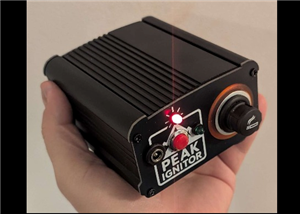 Peak-Ignitor - Mini 120W 12V Power Bank
Why?Have you ever tried to light a cigarette on a mountain in strong wind at –10 °C?I have. And none...
Peak-Ignitor - Mini 120W 12V Power Bank
Why?Have you ever tried to light a cigarette on a mountain in strong wind at –10 °C?I have. And none...
-
ARPS-2 – Arduino-Compatible Robot Project Shield for Arduino UNO
540 0 0 -
A Compact Charging Breakout Board For Waveshare ESP32-C3
994 3 6 -
AI-driven LoRa & LLM-enabled Kiosk & Food Delivery System
875 2 0 -
-
-
-
ESP32-C3 BLE Keyboard - Battery Powered with USB-C Charging
1148 0 1 -
-
mammoth-3D SLM Voron Toolhead – Manual Drill & Tap Edition
978 0 1