|
KiCad 8.0KiCad
|
|

|
FreeCad |
|

|
OnShapeOnShape
|
Balancing Robot BCP ver 0.1
A balancing robot is a self-stabilizing, two-wheeled device that uses sensors, a microcontroller, and actuators to maintain balance and navigate its environment. Similar to how a human balances on two legs, the robot constantly adjusts its position to avoid tipping over.
Key components include:
- Sensors (e.g., gyroscope and accelerometer) measure the robot's tilt and orientation.
- Microcontroller: This processes sensor data and controls the motors.
- Motors: Adjust the wheels' speed and direction to maintain balance.
- PID Control Algorithm: Used to fine-tune the robot's balance by correcting its movements based on real-time data.
Balancing robots are often used in robotics education and research due to their complex control requirements and applications in autonomous navigation and mobile robotics.
Mathematic skills:
The PID (Proportional-Integral-Derivative) controller is a widely used control system that adjusts output based on three terms: proportional, integral, and derivative. The general equation for the PID controller output \( u(t) \) is:

Where:
- u(t) is the control signal (output).
- e(t) = r(t) - y(t) is the error, the difference between the desired setpoint \( r(t) \) and the measured process variable \( y(t) \).
- Kp is the proportional gain, which scales the present error.
- Ki is the integral gain, which scales the accumulated past error.
- Kd is the derivative gain, which scales the rate of change of the error.
Explanation of Terms:
1. Proportional term (P): Reacts to the current error, adjusting the output proportionally to the error size.

2. Integral term (I): Addresses accumulated past errors, reducing steady-state error by summing the error over time.

3. Derivative term (D): Predicts future error by considering the rate of change of the error, providing a damping effect.

These terms help a system like a balancing robot respond to disturbances and maintain a stable, balanced state.

Image generated by DALLY AI
Balancing Robot BCP ver 0.1
Project images are for reference only. Actual production is based on the manufacturing files on the project page.
Please review the designer's notes (e.g., PCB thickness) and select the appropriate options.
PCBWay is not responsible
for issues caused by unsuitable parameter selections.
For more important ordering information, please refer to
Read More


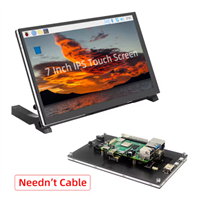
Raspberry Pi 5 7 Inch Touch Screen IPS 1024x600 HD LCD HDMI-compatible Display for RPI 4B 3B+ OPI 5 AIDA64 PC Secondary Screen(Without Speaker)
BUY NOW


- Comments(0)
- Likes(1)
More by Mohammed TAMALI

-
Programmable Mist Maker - XIAO / QT PY Extension
1940 2 2 -
RadioHAT - Raspberry Pi radio development platform
1641 0 3 -
-
-
-
ARPS-2 – Arduino-Compatible Robot Project Shield for Arduino UNO
3896 0 6 -
A Compact Charging Breakout Board For Waveshare ESP32-C3
4624 3 8 -
AI-driven LoRa & LLM-enabled Kiosk & Food Delivery System
5432 2 2 -