
|
|
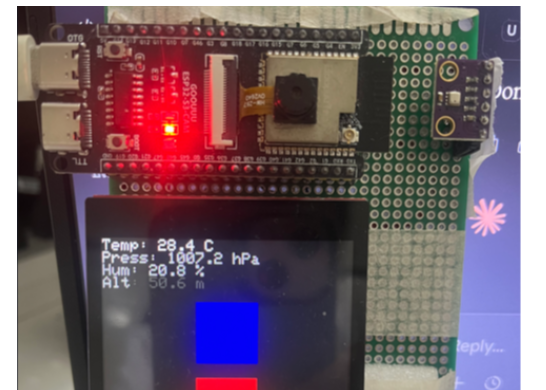
ESP32-S3-WROOM-1-N16R8Espressif
|
x 1 | |

|
3.5 inch SPI serial LCD screen module 480*320 TFT ILI9488 |
x 1 | |
|
|
BME280 |
x 1 |
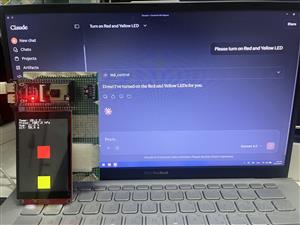
AI based hardware control
AI-Powered Hardware Control via Natural Language
Abstract
This project presents a system for controlling physical hardware components using natural language commands, interpreted by a Large Language Model (LLM). The goal is to create an intuitive interface for hardware interaction that abstracts away the need for traditional programming. By interfacing Claude AI with an ESP32-based microcontroller, users can manage devices like LCDs and sensors simply by typing commands in plain English. This project showcases a practical application of AI in the realm of electronics and human-computer interaction.
System Overview
The system is comprised of three main components: a cloud-based AI, a host PC, and a custom USB hardware device.
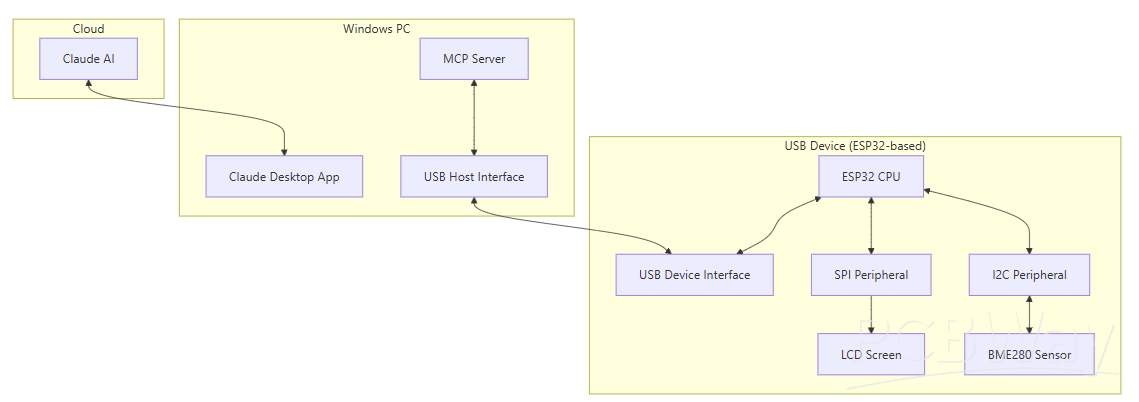
The workflow is as follows:
1. The user issues a command to the **Claude AI desktop application**.
2. The AI interprets the command's intent and sends a corresponding instruction to the **MCP (Machine Control Protocol) server** running on the host PC.
3. The MCP server translates this instruction and forwards it to the **USB hardware device** via a Python-based USB host interface.
4. The **ESP32 firmware** receives the command and executes the appropriate action, such as writing to the LCD via SPI or reading data from the BME280 sensor via I2C.
A video demonstration of this core functionality is available below:
Implementation Details
1. Firmware (ESP32 USB Device)
The device firmware is developed using the Arduino framework. It leverages the **"TinyUSB" library** to implement a generic vendor-specific USB device, enabling robust communication with the host PC.
- **Source Code:**
https://github.com/wichayen/AI_experimental/blob/main/arduino/vendor_generic_inout_ili9488_ai.ino
2. Host Software (PC)
The PC runs the server-side logic that bridges the AI with the hardware.
2.1. USB Interface
A Python script using the **"pyusb" library** manages low-level USB communication. This script is responsible for finding the correct USB device and transmitting data packets to it.
- **Source Code:**
https://github.com/wichayen/AI_experimental/blob/main/mcp_server/simpleio.py
- **Driver Note:** The **Zadig utility** ([https://zadig.akeo.ie/](https://zadig.akeo.ie/)) is required to install the correct WinUSB driver for the device, allowing `pyusb` to access it.
2.2. MCP Server
The "FastMCP" library** is used to create a lightweight server that exposes the hardware control functions to the AI.
- **Source Code:**
https://github.com/wichayen/AI_experimental/blob/main/mcp_server/server.py
3. AI Configuration (Claude)
The Claude AI desktop application must be configured to recognize the MCP server as an available tool. This is done by editing the `claude_desktop_config.json` file to define the server endpoint.
- **Configuration File:**
https://github.com/wichayen/AI_experimental/blob/main/claude_desktop_config.json
**Example Configuration:**
{
    "mcpServers": {
        "usb_device_bot": {
            "command": "uv",
            "args": [
                "--directory",
                "D:/mcp_server/usb_device_bot",
                "run",
                "server.py"
            ]
        }
    }
}
Advanced Demonstration: Flowchart-Based Control
Beyond simple commands, the system can interpret and execute complex, multi-step logic described in a **Mermaid flowchart**. This demonstrates the AI's ability to understand sequential and conditional tasks.
**Example Prompt:**
> Please execute the following flowchart.
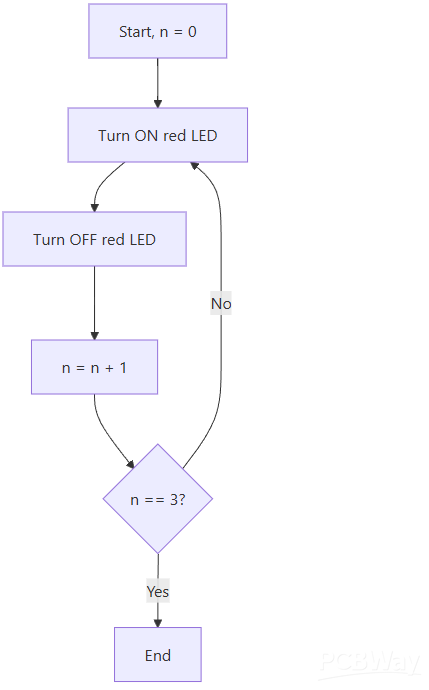
The AI will parse this flowchart and generate the corresponding commands to blink an LED three times.
A video of this advanced control is available here:
AI based hardware control


Raspberry Pi 5 7 Inch Touch Screen IPS 1024x600 HD LCD HDMI-compatible Display for RPI 4B 3B+ OPI 5 AIDA64 PC Secondary Screen(Without Speaker)
BUY NOW


- Comments(2)
- Likes(0)
More by Wichayen Luangsopapan
-
Émetteur Récepteur Optique Expérimental (communication UART ATtiny + fibre optique)
155 0 1 -
SmallOLED - Live PC Stats, Animated Clocks & Audio Visualizer
1008 0 3 -
"Talking Multimeter": Arduino-Based Speech Add-on for Multimeters with SCPI Protocol
576 0 1 -
Programmable Mist Maker - XIAO / QT PY Extension
3045 2 3 -
RadioHAT - Raspberry Pi radio development platform
2595 0 4 -
-
-