


|
KiCADKicad
|
Nutrino0 - Robotics Dev Board
Nutrino0 - Ultimate Edge-AI & High-Density Robotics Development Platform
What is your project about?
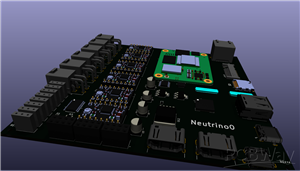
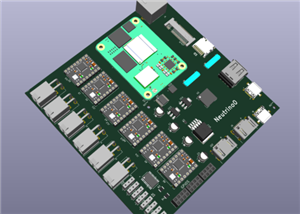
Nutrino0 is an ultra-dense, dual-engine robotics development board designed to function as a consolidated, industrial-grade "nervous system" for advanced autonomous machines.
It integrates high-level AI edge computing and real-time, deterministic hardware execution into a single, high-speed PCB. By packing massive processing power, multi-protocol communication interfaces, onboard multi-axis sensors, and heavy-duty direct-drive actuation onto a single layout, Nutrino0 completely eliminates the chaotic, failure-prone external wiring and signal degradation networks typically found in complex custom robots.
Why did you decide to make it?
Modern advanced robotics demands both heavy semantic processing (like vision-based Edge AI, SLAM, and spatial reasoning) and precise, latency-free physical execution (like multi-axis inverse kinematics, field-oriented control, and micro-stepping). Traditionally, developers are forced to daisy-chain a Single Board Computer (SBC), a separate microcontroller, multiple external motor drivers, sensor breakout boards, and discrete power distribution modules. This approach introduces significant points of failure, severe signal degradation, electromagnetic interference (EMI), and an oversized physical footprint.
I engineered Nutrino0 to break this paradigm. By combining a cutting-edge compute module, an advanced neural-capable MCU, comprehensive environmental telemetry, and massive direct-drive motor capabilities onto a single, tightly optimized KiCad canvas, this project demonstrates how thoughtful PCB layout can turn an entire, fractured hardware ecosystem into a single, robust, unified industrial-grade solution.
How does it work?
The architecture of Nutrino0 is systematically segregated into distinct, optimized functional blocks operating in parallel over high-speed local buses:
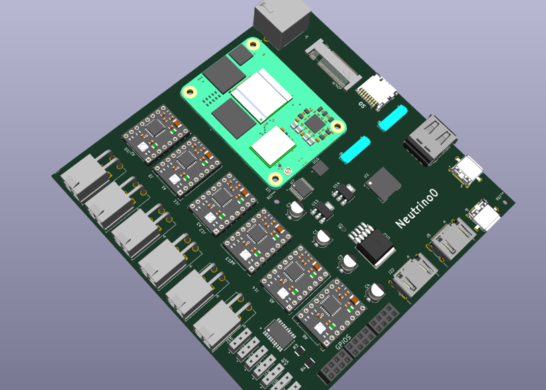
1. The Dual-Brain Heterogeneous Compute Architecture High-Level Compute (The Cerebrum): Powered by the Raspberry Pi Compute Module 5 (CM5), handling resource-heavy workloads including computer vision via native high-speed MIPI CSI/DSI ports, ROS2 orchestration, and high-level AI navigation tasks.Real-Time MCU with Hardware Acceleration (The Brainstem): Driven by the STM32N657, a next-generation microcontroller featuring an integrated hardware Neural Processing Unit (NPU). It handles time-critical task management, deterministic sensor filtering, and high-frequency motor control loops, completely offloading these tasks from the CM5.
2. Direct-Drive Actuation & Advanced Motion Control 6 Stepper Control & 7 Servo Control: Features onboard hardware sockets to drive 6 independent stepper motors directly using Pololu_Breakout_A4988 modules. To eliminate connector melting and terminal failures, these outputs are routed directly to heavy-duty, locking Molex Mini-Fit Jr. 39301040 4-pin connectors. Includes a dedicated PCA9685PW 16-channel, 12-bit controller running hardware-timed channels to drive 7 servo motors simultaneously through high-reliability Samtec ESW 3-pin headers, safeguarding the MCU from high-current switching transients.
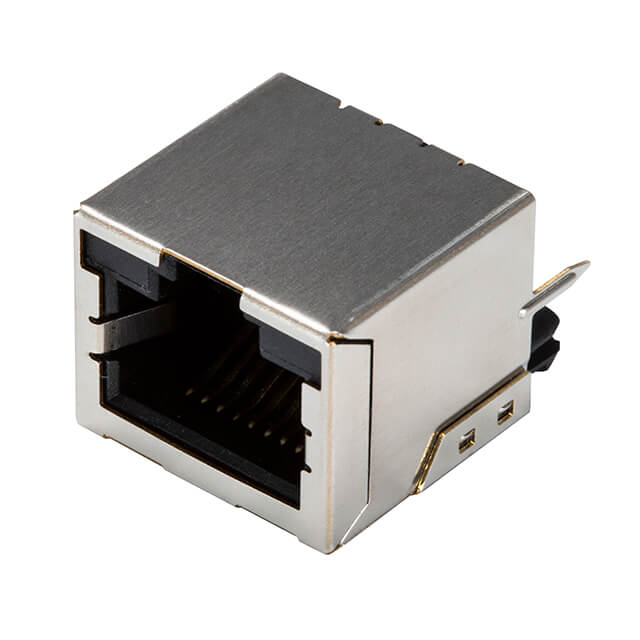
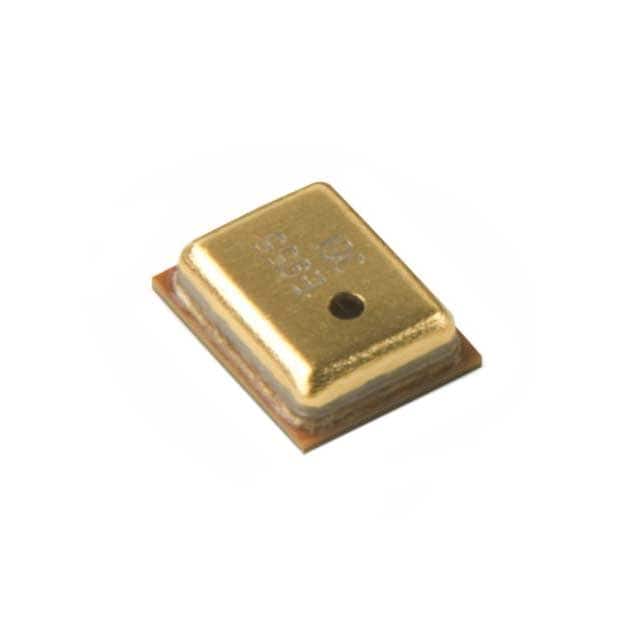
3. Integrated Peripherals, Telemetry & High-Speed I/O Onboard Sensory Fusion: Embedded directly onto the PCB is an MPU-6050-A 6-axis Inertial Measurement Unit (IMU) for real-time spatial orientation, paired with a BD1020HFV Rohm high-precision analog temperature sensor for thermal profiling, and an integrated Microphone circuit for acoustic logging and voice-driven autonomy. Storage & Network Bandwidth: Includes a dedicated high-bandwidth M.2 Key M NVMe SSD slot utilizing an Amphenol MDT180M01001 right-angle card edge connector alongside an onboard Hirose DM3D-SF push-push MicroSD slot. Network reliability is anchored by a high-retention TE Connectivity Gigabit Ethernet jack.
High-Speed Display & Peripheral IO: Packs dual Molex HDMI ports for multi-display diagnostics, two CUI Type-C USB interfaces for modern data/power delivery, and an MCP2515-I_ST standalone CAN 2.0B controller with an $\text{SPI}$ interface to guarantee dependable communication with automotive and industrial vehicle networks.
Technical Layout & Fabrication Specifications
To achieve standard-setting execution in a compact layout, Nutrino0 implements elite PCB engineering principles to conquer severe density and signal integrity constraints:
Advanced High-Speed Layout: High-speed differential lines connecting the CM5, STM32N6, M.2 NVMe (PCIe), and dual HDMI ports are laid out with strict length-matching, anti-phase skew compensation, and continuous reference ground planes to prevent reflections and EMI.
Aggressive Mixed-Signal Segregation: The board cleanly isolates sensitive analog sensor paths (MPU6050, BD1020HFV) and high-speed digital buses from the severe switching noise generated by the 6 stepper drivers and 7 servo rails. This is achieved via physical Moats (plane splitting) and dedicated star-ground topologies.
Thermal Via-Stitching & Power Delivery: High-current power paths are routed with ultra-wide copper trace.. Generous matrices of thermal via-stitching arrays are placed underneath the LM2596S-5 step-down regulator, AMS1117 LDOs, and the motor power planes to draw heat efficiently into the inner ground layers.
Its Features
A fully custom-designed High-Performance Core Infrastructure built from scratch—schematics, layout. The board is designed for industrial robotics, edge AI computing, multi-axis motion synthesis, and advanced embedded applications.
Key Layout & Stack-Up Features:
High-Density Layers: High density multi-layer PCB utilizing ultra-precise through-hole via paths structured for signal routing efficiency.
Stack-Up Array: 1-Signal / 2-GND / 3-PWR / 4-PWR / 5-GND / 6-Signal / 7-GND / 8-Signal / 9-GND / 10-Signal
Controlled Impedance Networks: Matched routing profiles engineered for high-bandwidth interfaces:
S40 OHM / S50 OHM (Single-ended System Signals & Clocks)
D85 OHM (PCIe Gen 2.1 NVMe Data Lanes)
D90 OHM (USB Type-C & USB 3.2 High-Speed Differential Pairs)
D95 OHM / D100 OHM (HDMI High-Definition Data & Gigabit Ethernet lines)
Processor Capabilities:
High-Level SBC Compute: Raspberry Pi Compute Module 5 (CM5) handling 64-bit multi-core application execution, deep learning vision models, and dense network configurations.
Real-Time Coprocessor NPU: STM32N657 running real-time tasks powered by hardware Neural Processing Unit vector accelerators supporting low-latency precision algorithms (INT4 / INT8 / INT16 / FP16 / TF32 / BF16).
High-Speed RAM Interconnection: Dedicated 32-bit LPDDR5 routing profile running high-bandwidth memory expansions up to 16GB.
Storage Subsystem:
Solid-State Expansion: Removable M.2 PCIe NVMe interface supporting high-capacity flash drives up to 1TB capacity via the AMPHENOL_MDT180M01001 connector.
Removable & Non-Volatile Storage: Direct layout configurations supporting high-speed MicroSD storage via the HRS_DM3D-SF push-push slot alongside secondary SPI Flash modules for critical system boot-recovery code.
Display & Multi-Screen Outputs:
Display 1 (Ultra-HD Video): Dual dedicated MOLEX_2086581201 HDMI ports handling crisp display signals up to 8K@60fps or 4K@120fps with Consumer Electronics Control (CEC) support.
Display 2 (Type-C Alt Mode): USB Type-C Alt Mode infrastructure utilizing Power Delivery (PD) negotiation scripts, outputting USB 3.2 and DisplayPort v1.4 (2.5K@60fps) over a single shared physical layer (PHY).
Network & Industrial Connectivity:
Gigabit Ethernet Backhaul: Native 10/100/1000 Mbps layout optimized for high-speed local data acquisition with active PoE options via the TE_2-406541-1 magnetic jack.
Industrial Vehicle Network: Dedicated on-board CAN-BUS physical layer routing via the MCP2515-I_ST controller to guarantee deterministic, noise-resilient communications in harsh industrial environments.
Camera & Visual Intelligence:
High-Speed MIPI CSI Matrix: Dedicated 4-lane MIPI camera inputs (MIPI 1 / MIPI 2), supporting deep computer vision captures. Can be split into independent dual 2-lane configurations for stereoscopic 3D depth mapping.
Expansion Capabilities & Power Routing:
High-Density protected GPIO Header: Fully guarded header backed by custom-designed Load Switches. Provides:
28x Multi-Mode GPIOs / 13x Hardware PWM channels.
5x Flow-Control UART / 5x I2C / 1x I3C / 2x SPI ports.
1x 12-bit SAR-ADC for instant analog sampling up to 1MS/s.
3.3V power rails, alongside a protected 5V circuit equipped with Under-Voltage Lockout (UVLO) and Over-Voltage Lockout (OVLO) protections.
Multi-Source Power Management: Flexible high-current power execution designed to drive heavy motor frameworks using:
USB Type-C dedicated power delivery lines (5V, 3A/5A) secured behind robust UVLO-OVLO protection circuits via CUI_UJ31-CH-3-MSMT-TR-67.
USB Type-C Alt Mode (PD) negotiating active external power configurations.
Power over Ethernet (PoE) circuits or external distribution feeds via the protected GPIO header.
System Peripherals & Security Hardware:
Thermal Management Control: Onboard active fan control connector executing responsive PWM cooling loops.
Hardware Maintenance Matrix: Onboard DIP Switches mapping physical boot sequences, alongside tactile switches for Mask-room entry, master Reset, and Power management.
Onboard Sensor Matrix: Integrated MPU-6050-A 6-axis motion tracking, BD1020HFV thermal telemetry logging, and microphone input for local voice diagnostics.
Thanks to everyone who supported this journey.
Nutrino0 - Robotics Dev Board
Project images are for reference only. Actual production is based on the manufacturing files on the project page.
Please review the designer's notes (e.g., PCB thickness) and select the appropriate options.
PCBWay is not responsible
for issues caused by unsuitable parameter selections.
For more important ordering information, please refer to
Read More


Raspberry Pi 5 7 Inch Touch Screen IPS 1024x600 HD LCD HDMI-compatible Display for RPI 4B 3B+ OPI 5 AIDA64 PC Secondary Screen(Without Speaker)
BUY NOW


- Comments(0)
- Likes(1)
More by Dipesh Kachhi
-
Programmable Mist Maker - XIAO / QT PY Extension
2117 2 2 -
RadioHAT - Raspberry Pi radio development platform
1798 0 4 -
-
-
-
ARPS-2 – Arduino-Compatible Robot Project Shield for Arduino UNO
4012 0 6 -
A Compact Charging Breakout Board For Waveshare ESP32-C3
4749 3 8 -
AI-driven LoRa & LLM-enabled Kiosk & Food Delivery System
5562 2 2 -