Enclosure thermal management is critical for preventing overheating, condensation, and premature electronic component failure. A well-designed enclosure cooling system helps maintain stable operating temperatures while ensuring compliance with IP or NEMA protection ratings.
Based on PCBWay enclosure design experience and common thermal management challenges in industrial electronic applications, this article summarizes several key considerations for enclosure cooling, airflow optimization, heat load estimation, and thermal management solutions.
Electronic enclosures must balance environmental protection with heat dissipation efficiency. During operation, electronic devices continuously generate heat. If the heat cannot be effectively removed, it can lead to component aging, system instability, unexpected shutdowns, and even safety risks.
In the electronics industry, it is commonly accepted that for every 10°C increase in operating temperature, the lifespan of electronic equipment may be reduced by approximately 50%. As a result, enclosure thermal management has become a critical part of modern electronic enclosure design.
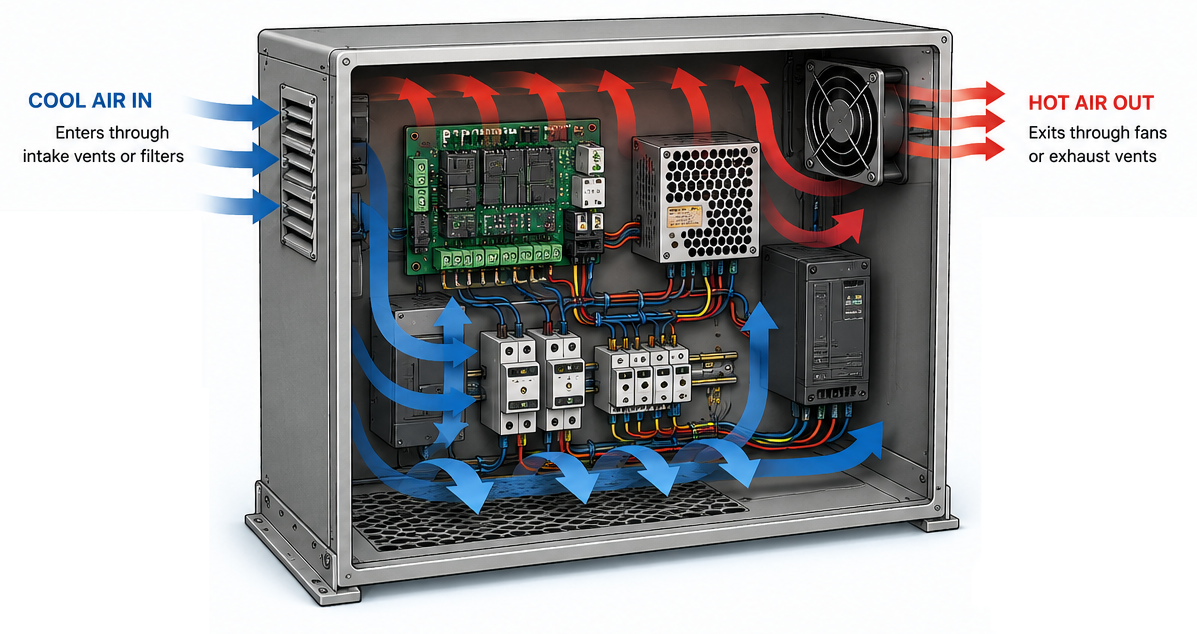
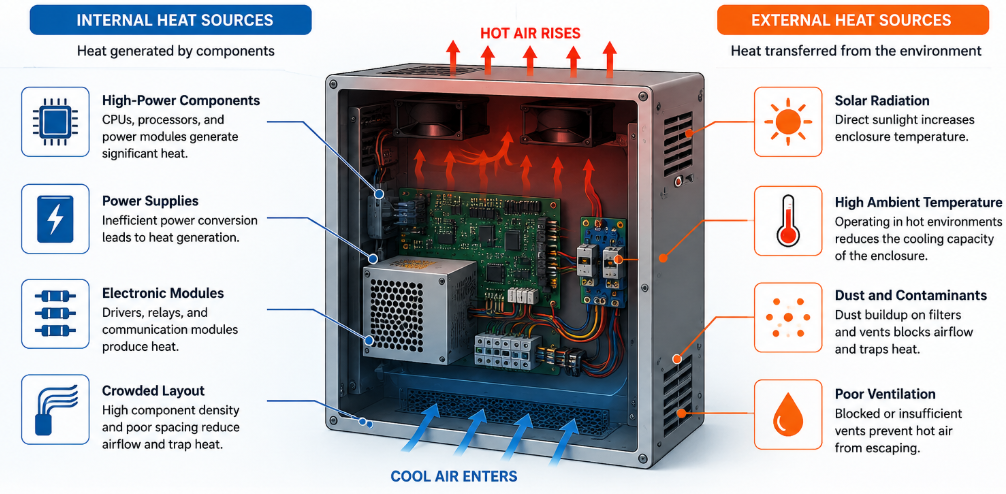
Cooling methods should be compatible with IP or NEMA protection requirements to avoid compromising enclosure sealing performance. At the same time, the cooling capacity must match the actual thermal load of the equipment.
It is recommended to reserve 15%–20% thermal headroom to accommodate workload fluctuations and future equipment expansion, helping reduce future redesign costs.
Thermal management solutions should prioritize low-maintenance, energy-efficient, and cost-effective designs while avoiding unnecessary overdesign.
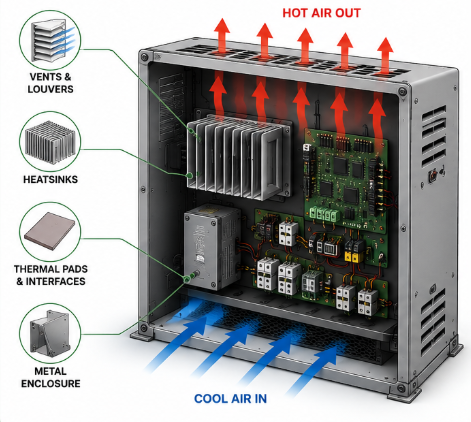
Passive cooling does not require additional power and is suitable for low thermal loads and ambient temperatures below 40°C. It offers advantages such as low cost, quiet operation, and simple maintenance.
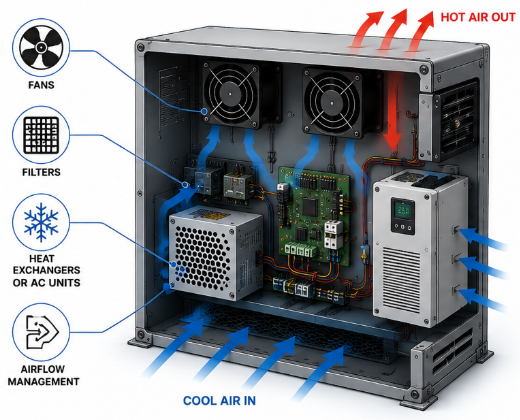
Active cooling uses mechanical devices to force heat exchange and is suitable for high thermal loads, high ambient temperatures, or sealed enclosure applications.
The heat load of an enclosure can usually be estimated based on the total power consumption of the internal electronic devices. In most cases, nearly all consumed electrical energy is eventually converted into heat.
A common conversion formula is: 1 W≈3.41 BTU/h1
For example, if the total equipment power consumption is 500W: 500×3.41=1705 BTU/h. The estimated enclosure heat load is approximately 1705 BTU/h.
In real-world enclosure design, factors such as ambient temperature, solar radiation, equipment density, and future expansion requirements should also be considered.
Choosing the right thermal management solution depends on several factors, including thermal load, protection rating, environmental conditions, and maintenance requirements.
In practical applications, enclosure thermal management should always be evaluated together with total system power, ambient conditions, and IP/NEMA protection requirements.
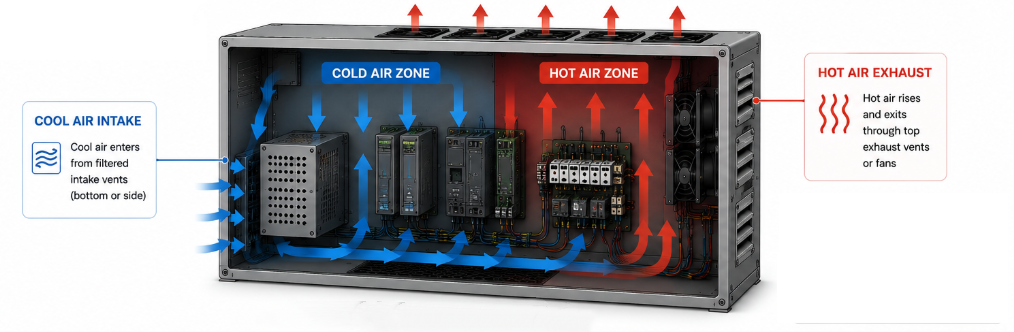
The following airflow issues are common in enclosure thermal management:
Many cooling problems are not caused by insufficient cooling hardware, but by poor airflow planning during the early enclosure design stage. Adding fans or air conditioners later often cannot fully solve heat accumulation issues.
✅️Ensure unobstructed airflow paths
✅️Separate hot and cold airflow zones
✅️Leave sufficient fan installation clearance
✅️Consider ambient temperature and solar radiation
✅️Prevent condensation buildup
✅️Avoid cables blocking ventilation paths
✅️Reserve thermal headroom for future expansion
✅️Ensure cooling methods comply with IP/NEMA requirements
As electronic devices continue to become more compact, higher powered, and increasingly deployed outdoors, enclosure thermal management is becoming more important than ever. Proper thermal management of electronic devices can improve system reliability, extend equipment lifespan, and reduce long-term maintenance costs.
PCBWay enclosure design service helps optimize enclosure structure, airflow paths, thermal management solutions, and manufacturability, enabling industrial and commercial projects to move more efficiently from concept to production.
Thermal performance is closely tied to the overall electronic enclosure design, including material selection, IP/NEMA protection level, and structural configuration. For a deeper understanding of enclosure structures, materials, and IP rating considerations, refer to this guide:
PCB Enclosure Design Guide: Materials, IP Ratings, and Structural Best Practices



