1. Blog>
  2. EMI Shielded Enclosure Design Guide: Principles, Materials, and Best Practices

EMI Shielded Enclosure Design Guide: Principles, Materials, and Best Practices

by: May 14,2026 130 Views 0 Comments Posted in PCB Design & Layout

enclosure design enclosure in design EMI enclosure design EMI shielded enclosure

EMI (Electromagnetic Interference) has become a major challenge in modern electronic systems. In many projects, EMI-related issues do not appear during early development, but instead emerge during EMC testing, product certification, or field deployment, often resulting in redesigns, structural modifications, delayed product launches, and additional compliance costs.

With experience across PCB layout, enclosure engineering, and manufacturability optimization, PCBWay enclosure design service has supported a wide range of projects involving EMI shielded enclosure design, EMC optimization, and high-speed electronic systems.


EMI Shielding Fundamentals and Design Requirements

1. What Is EMI Shielding?

EMI (Electromagnetic Interference) involves two core issues: unwanted emissions from electronic devices and susceptibility to external interference. These problems can cause data errors, communication instability, intermittent failures, and EMC compliance issues.

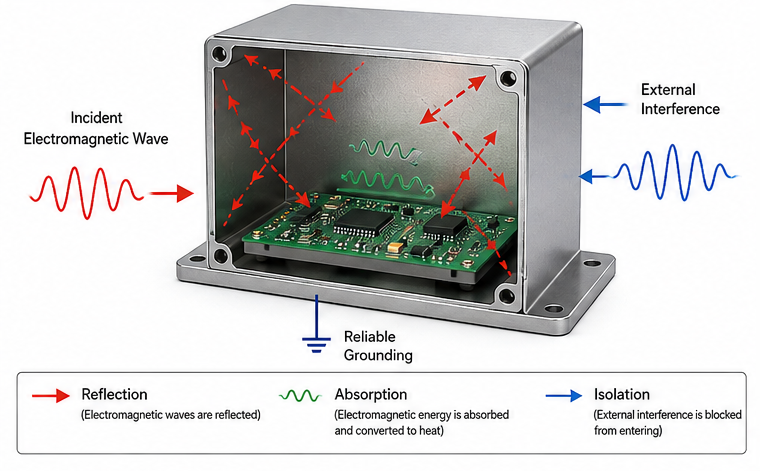
An EMI shielded enclosure is based on the Faraday Cage principle. It uses conductive or magnetic materials to form a continuous shielding structure, containing internal radiation while blocking external interference.

For this reason, EMI enclosure design is widely used in high-speed electronics, industrial systems, medical devices, and communication equipment.

Shielding performance is measured using Shielding Effectiveness (SE), expressed in dB. Typical requirements vary by application:

  • Consumer electronics: 30–60 dB
  • Industrial systems: 60–80 dB
  • Medical: 80–100 dB or higher

EMI shielding is achieved through three main mechanisms: reflection (reducing electric-field interference), absorption (converting energy into heat), and multiple reflection (further attenuation inside the material).

2. Applications That Require EMI Shielded Enclosures

EMI risks are often underestimated during early product development. However, the following scenarios typically require EMI shielding design from the beginning of the project:

  • High-speed digital systems: DDR memory, USB 3.0, HDMI, and circuits operating above 100 MHz generate significant electromagnetic radiation
  • Power electronics: power supplies, inverters, motor drives, and high-frequency transformers are major EMI sources
  • Sensitive equipment: RF receivers, medical devices, precision instruments, and sensor arrays are highly vulnerable to external interference
  • Compact and high-density PCB layouts: closely spaced components increase electromagnetic coupling risks
  • Harsh electromagnetic environments: systems located near wireless base stations, avionics equipment, or medical systems face stronger EMI exposure
  • Regulatory compliance products: devices requiring FCC, CE, or MIL-STD-461 certification usually require properly designed EMI shielded enclosures


Key Design Considerations for EMI Shielded Enclosures

1. EMI Enclosure Structural Design

Many EMI shielding failures are caused by structural leakage rather than shielding material limitations. Seams, openings, and fastening areas are among the most common EMI leakage paths.

As a result, structural details are often more important than simply using higher-grade shielding materials.


(1) Seam Design and Electrical Continuity

Enclosure seams are one of the largest sources of high-frequency EMI leakage. Even microscopic gaps can significantly reduce shielding effectiveness.

Key design considerations include:
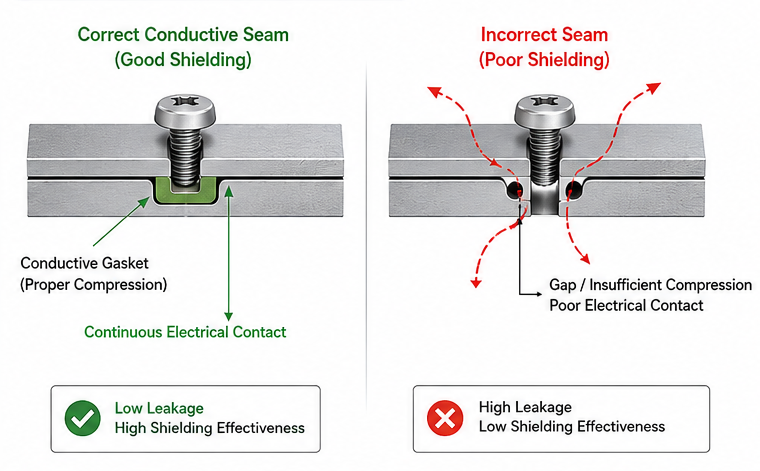
  • Maintain mating surface flatness within approximately 0.1 mm
  • Use conductive gaskets or conductive foam with compression ratios typically between 30% and 50%
  • For complex geometries, Form-In-Place (FIP) conductive gaskets can improve electrical continuity
  • Keep fastener spacing consistent, typically between 50–80 mm
  • Snap-fit structures should be tested for long-term mechanical stability to prevent loosening over time


(2) Ventilation and Opening Design

Electronic devices often require ventilation holes, cable exits, or display openings. However, these features can also become major EMI leakage paths.

Opening dimensions should generally follow the waveguide cutoff principle, meaning the opening size should remain below approximately 1/20 of the interference wavelength.

Practical design recommendations include:
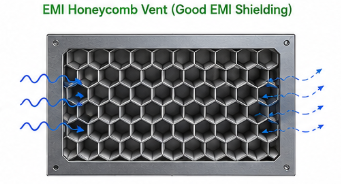
  • Use honeycomb waveguide ventilation panels whenever possible
  • Honeycomb depth should typically exceed three times the opening diameter
  • Avoid large unshielded openings
  • Add conductive gaskets, shielded connectors, or EMI shielding windows around interfaces and displays
  • Use shielded feedthrough filters for cable exits and ensure proper grounding of cable shields


(3) Internal Partitioning and Grounding Design

Proper internal partitioning and grounding can significantly reduce electromagnetic coupling between different circuits.

Common practices include:

  • Separating power, digital, analog, and RF sections
  • Using metallic partitions between functional areas
  • Implementing layered grounding strategies to avoid ground loops
  • Separating power ground, signal ground, and shield ground before single-point grounding
  • Ensuring the EMI shielded enclosure itself is reliably grounded to prevent the enclosure from acting as an antenna


2. EMI Shielding Material Selection

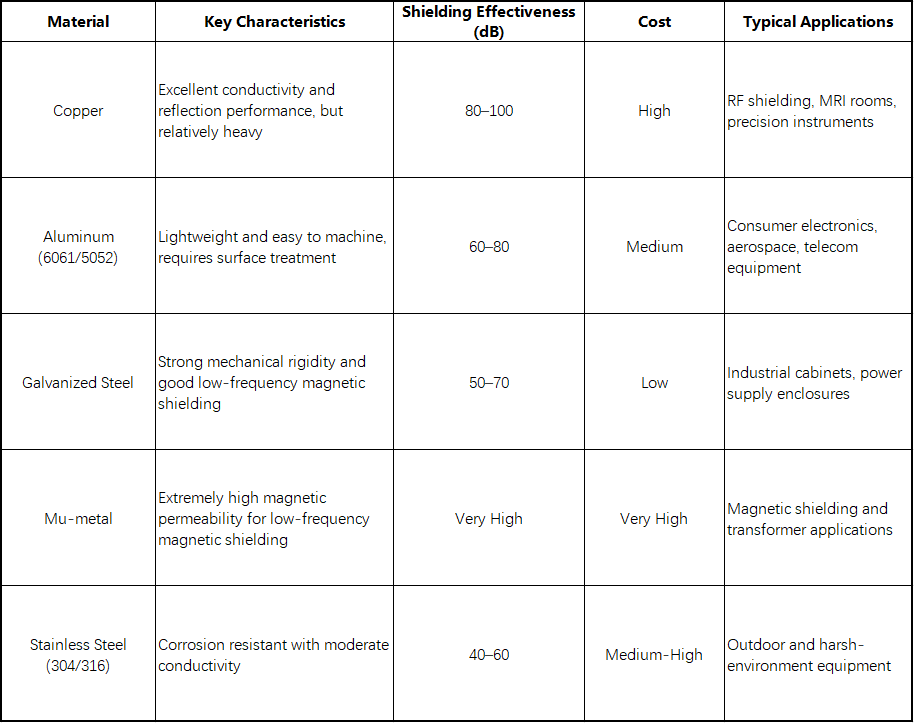
Shielding materials directly affect the upper limit of EMI shielding effectiveness. Material selection should consider interference frequency, shielding requirements, environmental conditions, weight, manufacturing processes, and overall cost.


(1) Metal Materials for EMI Shielded Enclosures


(2) Plastic EMI Shielding Solutions

Plastic enclosures do not inherently provide EMI shielding and therefore require additional conductive treatment.

Common solutions include:

  • Conductive coatings: applying copper, nickel, or silver conductive paint to ABS, PC, or PC/ABS enclosures
  • Conductive-filled plastics: adding carbon fiber, graphite, or metal particles into resin before injection molding

These approaches are suitable for lightweight and complex enclosure designs, although their shielding performance is typically lower than fully metallic EMI shielded enclosures.


(3) Material Selection Challenges

  • Avoid galvanic corrosion caused by dissimilar metal contact in humid environments
  • High-frequency applications generally benefit from highly conductive materials such as copper or aluminum
  • Low-frequency magnetic shielding applications benefit from high-permeability materials such as steel or mu-metal
  • Material consistency must be controlled during mass production to maintain stable shielding performance


EMI Compliance Standards for EMI Shielded Enclosures

EMC compliance is mandatory for most electronic products entering commercial markets. Different industries and regions require different EMI shielding standards.

Common standards include:

  • FCC (United States): regulates electromagnetic emissions from electronic devices
  • CE EMC Directive (Europe): controls both emissions and immunity performance
  • MIL-STD-461 (Military): strict military EMC requirements covering wide frequency ranges
  • IEC 60601 (Medical): focuses on EMC safety for medical equipment
  • IEC 61000 (Industrial): covers industrial electromagnetic environments


Common EMI Shielding Design Mistakes

Many EMI shielding failures are caused by overlooked engineering details rather than theoretical errors.

Common mistakes include:

  • Adding shielding only after EMC test failures
  • Focusing solely on material specifications while ignoring structural leakage
  • Ignoring galvanic corrosion between different metals
  • Improper enclosure grounding
  • Excessive shielding that unnecessarily increases weight and cost
  • Poor assembly consistency during mass production


EMI Shielded Enclosure Design Workflow and Manufacturing Considerations

Successful EMI enclosure design should be integrated into the entire product development process rather than treated as a late-stage correction.

A typical workflow includes:

  • Defining interference frequencies, SE targets, environmental conditions, and certification requirements
  • Planning enclosure materials, grounding methods, and internal partitions
  • Optimizing seams, ventilation openings, shielding structures, and DFM considerations
  • Building prototypes for EMI, thermal, and assembly validation
  • Controlling material consistency, tolerances, and assembly quality during mass production


Conclusion

As electronic systems continue moving toward higher speeds, smaller form factors, and greater power density, EMI shielded enclosure design is becoming an essential engineering capability rather than an optional optimization step.

For projects requiring enclosure engineering, EMC optimization, PCB layout, or manufacturability support, PCBWay enclosure design service can help streamline development, reduce redesign risks, and improve overall product reliability from prototype to production.


👉Get Free Enclosure Design Quote👈

Join us
Wanna be a dedicated PCBWay writer? We definately look forward to having you with us.
  • Comments(0)
Upload photo
You can only upload 5 files in total. Each file cannot exceed 2MB. Supports JPG, JPEG, GIF, PNG, BMP
0 / 10000
    Back to top