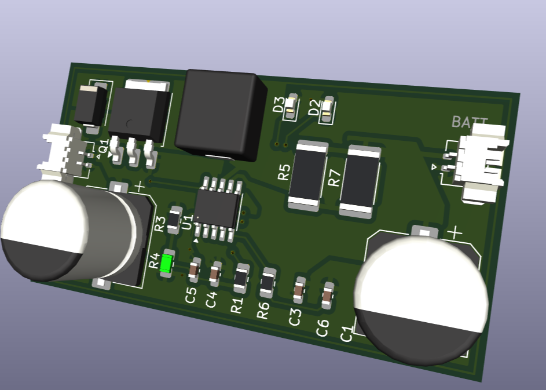
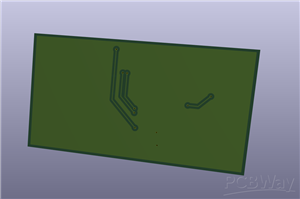
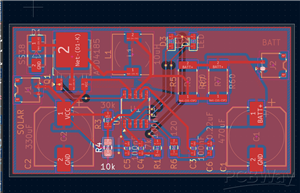
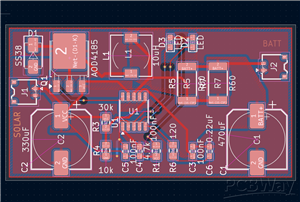
The CD3791 Solar MPPT Charger
CN3791-Based Solar MPPT Lithium Battery Charger
Motivation
Solar-powered devices often operate under changing environmental conditions where sunlight intensity varies throughout the day. Traditional charging circuits cannot continuously extract the maximum available power from a solar panel, resulting in reduced charging efficiency and wasted energy.
I decided to develop this project to explore practical renewable energy electronics and create a charging solution that can efficiently utilize available solar power while maintaining battery safety. The design also serves as a learning platform for power electronics, PCB design, thermal management, and energy harvesting techniques.
How It Works
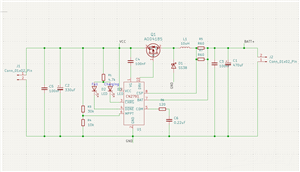
The solar panel serves as the primary energy source. The CN3791 charger continuously monitors the input voltage and regulates the charging process using a buck-converter architecture.
The Maximum Power Point Tracking (MPPT) function ensures that the solar panel operates near its optimum power-producing voltage. By maintaining the panel voltage at a predetermined percentage of its open-circuit voltage, the charger can extract more energy compared to conventional charging methods.
The charging process follows a constant-current and constant-voltage algorithm:
Constant Current Mode
When the battery voltage is low, the charger delivers a controlled charging current.
Charge current is determined by the current-sense resistor:
Vmppt = 1.205 * (1+ R1/R3) For
I_CHG = 0.12/ R_CS
where:
I_CHG = charging current (A)
R_CS = current sense resistor (Ω)
Constant Voltage Mode
As the battery approaches full charge, the charger transitions to voltage regulation mode and maintains:
V_BAT = 4.2 V
for a standard lithium-ion cell.
Charging current gradually decreases until the battery reaches full charge.
Solar Power Relationship
The power available from the solar panel can be expressed as:
where:
P = power (W)
V = panel voltage (V)
I = panel current (A)
The MPPT system attempts to keep the operating point near the maximum power point, allowing the charger to harvest the highest possible power under changing sunlight conditions.
PCB Design Considerations
Special attention was given to:
Wide copper traces for high-current paths
Short switching loops to reduce EMI
Adequate copper area for thermal dissipation
Proper placement of input and output capacitors
Ground plane optimization for improved stability
Manufacturable two-layer PCB layout
Applications
Solar-powered IoT devices
Portable battery charging systems
Remote environmental monitoring stations
Educational renewable-energy projects
Backup power systems
Off-grid electronics
Conclusion
This project demonstrates an efficient solar charging solution that combines renewable energy harvesting with safe lithium battery charging. By utilizing MPPT technology and careful PCB design techniques, the system improves charging efficiency, enhances battery reliability, and provides a practical platform for sustainable energy applications.
The CD3791 Solar MPPT Charger
Project images are for reference only. Actual production is based on the manufacturing files on the project page.
Please review the designer's notes (e.g., PCB thickness) and select the appropriate options.
PCBWay is not responsible
for issues caused by unsuitable parameter selections.
For more important ordering information, please refer to
Read More


Raspberry Pi 5 7 Inch Touch Screen IPS 1024x600 HD LCD HDMI-compatible Display for RPI 4B 3B+ OPI 5 AIDA64 PC Secondary Screen(Without Speaker)
BUY NOW


- Comments(0)
- Likes(1)
 More by DIY volt
-
SmallOLED - Live PC Stats, Animated Clocks & Audio Visualizer
771 0 3 -
"Talking Multimeter": Arduino-Based Speech Add-on for Multimeters with SCPI Protocol
437 0 1 -
Programmable Mist Maker - XIAO / QT PY Extension
2889 2 3 -
RadioHAT - Raspberry Pi radio development platform
2468 0 4 -
-
-
-
ARPS-2 – Arduino-Compatible Robot Project Shield for Arduino UNO
4550 0 6