

PCB Board Home Automation with ESP8266
Introduction
The incorporation of the ESP8266 module into home automation represents a significant advancement in the field of smart home technology.
The ESP8266, a microcontroller with built-in Wi-Fi connectivity, offers a powerful and affordable platform for creating highly customized home automation systems. With the ability to communicate with devices and sensors via a wireless network, the ESP8266 allows homeowners to remotely control a wide range of functionality in their home, such as lighting, temperature, security and more, transforming conventional homes into living spaces. efficient, secure and highly customizable.
Integrating the ESP8266 module with relays offers a highly versatile approach to creating home automation systems and controlling devices on the power grid via the internet.
The ESP8266, a microcontroller with built-in Wi-Fi connectivity, is a popular choice due to its ease of use, affordability, and active developer community. When combined with relays, which act as remotely controlled switches, this set allows users to control electrical devices, such as lamps, appliances and security systems, from anywhere in the world, through a simple internet connection. This not only adds a level of convenience to everyday life, but also contributes to the energy efficiency, security and personalization of home systems, making home automation an accessible reality for a wide audience.
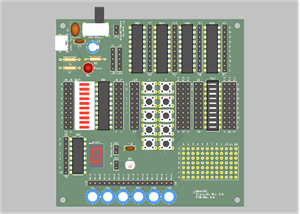
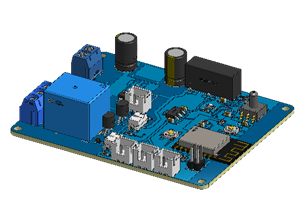
In this article you will learn how to create a circuit capable of activating various devices in your home via the internet. Below we have an image of the electronic board that we will make available for you to transform your home into a smart home.
_RLeG8I5fL7.png?auto=compress%2Cformat&w=740&h=555&fit=max)
Let's get started and learn how each circuit block on this electronic board works.
Electronic Schematic of the ESP8266 Home Automation Board
The electronic circuit of the circuit board is made up of several blocks and below we have presented the electronic circuit of the circuit board is made up of several blocks and below we have presented the complete electronic schematic.
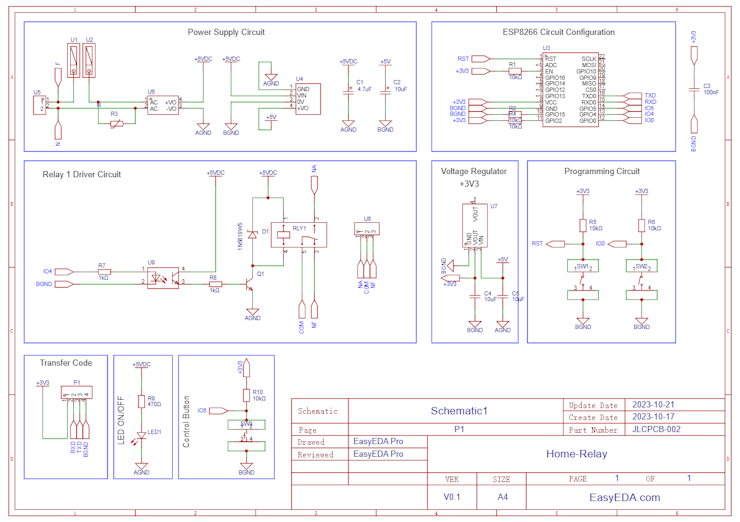
Next, we will explain the functionality of each circuit block.
Power Supply Circuit of ESP8266 Home Automation Board
The circuit below represents the power supply block of the electronic project. The first stage of the project consists of a screw connector that allows powering the circuit board directly from the 220VAC electrical network.
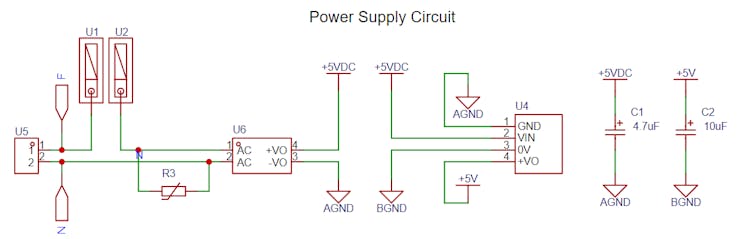
At the source input there is a circuit with fuse and varistor. Its purpose is to protect the circuit against overload or short circuit.
After that, this voltage passes through the HiLink AC-DC converter, which provides 5V at its output. Another element was used in this project, the isolated DC-DC converter B0505S. It was used with the aim of creating an isolated source to power the ESP8266 circuit and relay drive circuit using an optocoupler.
The objective is to create a source isolated from the main source and minimize possible interference from external noise in the ESP8266 circuit as much as possible.
As you can see, there are two 5V power supplies isolated from each other, each one has its own GND.
The +5V isolated voltage source is used at the input of the +3V3 voltage regulator circuit.
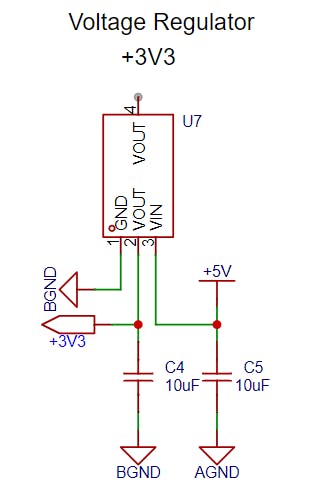
It is through this voltage regulator that the ESP8266 circuit is powered.
Electronic Circuit of the ESP8266
Below we have the basic operating circuit of the ESP8266. Upon connecting the ESP8266 to power and its basic components, the ESP8266 will execute its control firmware.
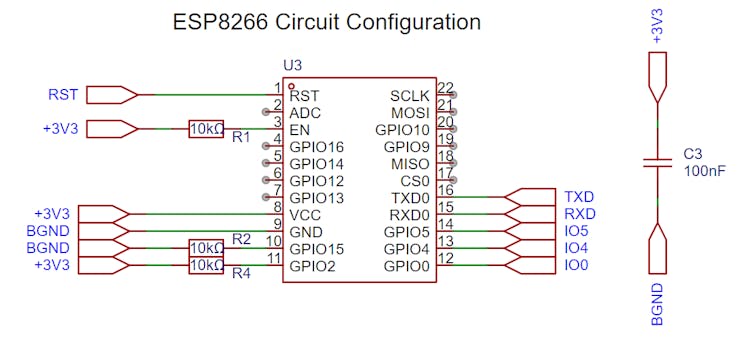
Associated with this circuit, we have the programming mode configuration block, which is made up of two buttons. These two buttons are responsible for putting the ESP8266 into programming mode.
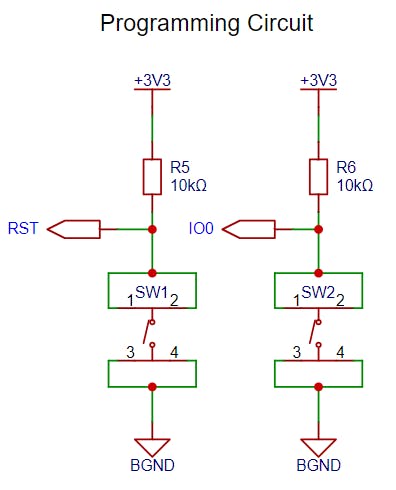
This way, you will be able to transfer code to your ESP8266. Code transfer is carried out through the pins of the circuit block below.
Your code will be stored in the ESP8266's memory and will be ready to control the relay to activate the load you desire.
After all, how does the relay activation circuit work?
Relay Drive Circuit with ESP8266
The relay activation circuit with ESP8266 can be activated in 2 ways. The first is through the button below. It is a general purpose button and can be used in programming for manual activation or for any other task you want.
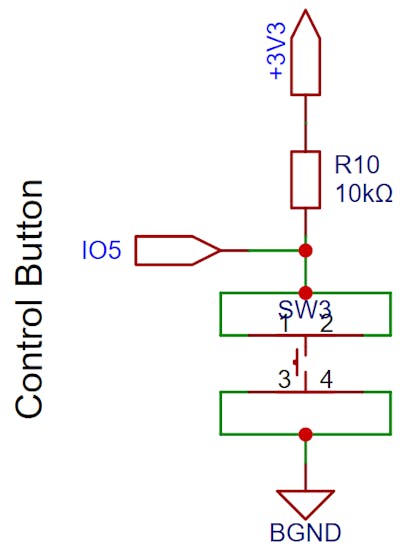
The other way to control the relay is through commands sent via a website. The command will be sent over the internet and will activate the relay. The electronic circuit of the relay is shown below.
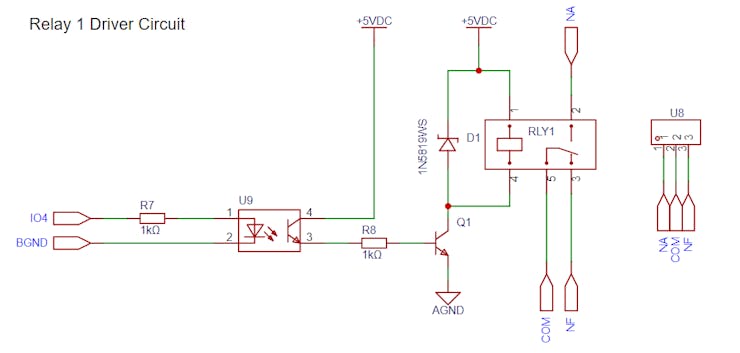
In the circuit above we have the relay being activated through an optocoupler, which guarantees the isolation of the activation signal. Furthermore, it is possible to observe that the two sides are completely isolated through two 5V voltage sources.
In other words, we have a voltage source to drive the optocoupler and another to drive the relay coil.
The relay has normally open and normally closed contacts to control the connected load.
A partir desse circuito, foi desenvolvido o projeto eletrônico da placa de circuito impresso abaixo.
_5cgZ0mpqlX.png?auto=compress%2Cformat&w=740&h=555&fit=max)
1 / 2
Using this electronic board, you can develop countless applications and connect your home to the internet.
Electronic Applications with ESP8266 Home Automation
Home automation with the ESP8266, driving relays to control devices over the internet, offers a diverse range of applications, making life more convenient and efficient. A classic example is lighting control. With the ESP8266 and relays, you can turn your home's light bulbs into smart devices that can be turned on, off, or programmed remotely.
This not only increases convenience, but also saves energy by allowing you to turn lights on or off in different rooms of your home, whether you're on the couch or on the other side of the world.
Additionally, the ESP8266 with relays can be used to automate blinds and curtains, allowing you to adjust the brightness and privacy of your home with a simple tap on your smartphone. If you are a gardening enthusiast, you can create a smart irrigation system that automatically adjusts the watering of your plants based on local weather conditions.
Additionally, controlling electrical appliances such as air conditioning and heaters allows you to optimize the comfort of your home, saving energy and money. These are just a few of the countless exciting applications that home automation with ESP8266 and relays offers, making your home smarter and more efficient than ever.
Next, you can have access to all printed circuit board files and receive free PCBWay units in your home.
Acknowledgments
We would like to thank PCBWAY for supportting the creation of this project and made some units available for you to earn for free and receive 5 units at your home. To receive them, access this link, create an account on the website and receive coupons for you to win right now.
PCB Board Home Automation with ESP8266
Project images are for reference only. Actual production is based on the manufacturing files on the project page.
Please review the designer's notes (e.g., PCB thickness) and select the appropriate options.
PCBWay is not responsible
for issues caused by unsuitable parameter selections.
For more important ordering information, please refer to
Read More


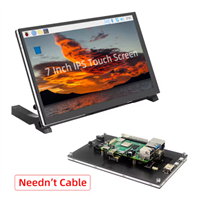
Raspberry Pi 5 7 Inch Touch Screen IPS 1024x600 HD LCD HDMI-compatible Display for RPI 4B 3B+ OPI 5 AIDA64 PC Secondary Screen(Without Speaker)
BUY NOW


- Comments(1)
- Likes(8)

More by Silícios Lab silicioslab
-
 How to measure weight with Load Cell and HX711
IntroductionThe purpose of this project is to develop a printed circuit board (PCB) that allows weig...
How to measure weight with Load Cell and HX711
IntroductionThe purpose of this project is to develop a printed circuit board (PCB) that allows weig...
-
 Electronic Enclosure applied for electronic projects
IntroductionWhen designing electronics, the enclosure plays a crucial role that is often overlooked....
Electronic Enclosure applied for electronic projects
IntroductionWhen designing electronics, the enclosure plays a crucial role that is often overlooked....
-
 IoT Indoor system with ESP32 to monitor Temperature, Humidity, Pressure, and Air Quality
IntroductionAir quality, temperature, humidity and pressure are essential elements to ensure healthy...
IoT Indoor system with ESP32 to monitor Temperature, Humidity, Pressure, and Air Quality
IntroductionAir quality, temperature, humidity and pressure are essential elements to ensure healthy...
-
 WS2812B RGB LED Controller with ESP8266 via WiFi
IntroductionWS2812b addressable RGB LEDs are devices widely used in lighting projects. They are foun...
WS2812B RGB LED Controller with ESP8266 via WiFi
IntroductionWS2812b addressable RGB LEDs are devices widely used in lighting projects. They are foun...
-
 Electronic Board for Cutting Electrical Power to Devices and Machines
IntroductionAn energy saving system for cutting electrical energy in machines is a fundamental piece...
Electronic Board for Cutting Electrical Power to Devices and Machines
IntroductionAn energy saving system for cutting electrical energy in machines is a fundamental piece...
-
 PCB Board Home Automation with ESP8266
IntroductionThe incorporation of the ESP8266 module into home automation represents a significant ad...
PCB Board Home Automation with ESP8266
IntroductionThe incorporation of the ESP8266 module into home automation represents a significant ad...
-
 Dedicated Control Board for Mobile Robots with Wheels
IntroductionFor a long time we developed several prototypes and teaching kits of mobile robots and w...
Dedicated Control Board for Mobile Robots with Wheels
IntroductionFor a long time we developed several prototypes and teaching kits of mobile robots and w...
-
 Traffic turn signal for bicycles
IntroductionDoes every project with electronic logic need a Microcontroller or Arduino to be develop...
Traffic turn signal for bicycles
IntroductionDoes every project with electronic logic need a Microcontroller or Arduino to be develop...
-
 Mini Arduino with ATTINY85
Do you know the ATTINY85 microcontroller? This article has news and a gift for you. Many people deve...
Mini Arduino with ATTINY85
Do you know the ATTINY85 microcontroller? This article has news and a gift for you. Many people deve...
-
 Christmas Tree
The tree used to signal light of Christmas.
Christmas Tree
The tree used to signal light of Christmas.
-
 Electronic Fish Feeder
Never forget to feed your fish again and with the right amount, at the right time.Regular feeding is...
Electronic Fish Feeder
Never forget to feed your fish again and with the right amount, at the right time.Regular feeding is...
-
 ESP32 BMP280 Pressure Monitor
IntroductionMonitoring environmental variables is crucial for the efficiency and safety of numerous ...
ESP32 BMP280 Pressure Monitor
IntroductionMonitoring environmental variables is crucial for the efficiency and safety of numerous ...
-
 Smart Pressure Control: The IoT Pressure Monitor
Introduction and ObjectiveThe ProblemIn the development of electronic monitoring systems, we often e...
Smart Pressure Control: The IoT Pressure Monitor
Introduction and ObjectiveThe ProblemIn the development of electronic monitoring systems, we often e...
-
 IoT Access control and communication system with Raspberry Pi/PC using ESP32
IntroductionIn the world of automation and the Internet of Things (IoT), access control systems have...
IoT Access control and communication system with Raspberry Pi/PC using ESP32
IntroductionIn the world of automation and the Internet of Things (IoT), access control systems have...
-
 Electronic Enclosure applied for electronic devices
IntroductionWhen designing electronics, the enclosure plays a crucial role that is often overlooked....
Electronic Enclosure applied for electronic devices
IntroductionWhen designing electronics, the enclosure plays a crucial role that is often overlooked....
-
 Electronic Enclosure for Programmable Logic Controller
The housing developed for programmable logic controllers is a practical and efficient solution for t...
Electronic Enclosure for Programmable Logic Controller
The housing developed for programmable logic controllers is a practical and efficient solution for t...
-
 Payment PCB for machines and services
IntroductionIn many commercial establishments, hospitals and other places, there are video game equi...
Payment PCB for machines and services
IntroductionIn many commercial establishments, hospitals and other places, there are video game equi...
-
 Relay High Power Printed Circuit Board
IntroductionEfficient management of electrical loads is essential for optimizing performance and saf...
Relay High Power Printed Circuit Board
IntroductionEfficient management of electrical loads is essential for optimizing performance and saf...
-
Émetteur Récepteur Optique Expérimental (communication UART ATtiny + fibre optique)
153 0 1 -
SmallOLED - Live PC Stats, Animated Clocks & Audio Visualizer
1006 0 3 -
"Talking Multimeter": Arduino-Based Speech Add-on for Multimeters with SCPI Protocol
575 0 1 -
Programmable Mist Maker - XIAO / QT PY Extension
3045 2 3 -
RadioHAT - Raspberry Pi radio development platform
2592 0 4 -
-
-