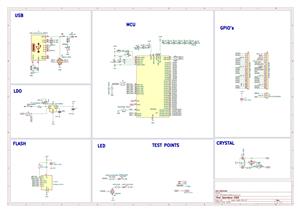
|
|
RP2350BRaspberry Pi
|
x 1 | |
|
|
SMD RESISTOR |
x 1 | |
|
|
SMD CAPACITOR |
x 1 | |
|
|
USB C |
x 1 | |
|
|
LED 's |
x 1 | |
|
|
PUSH SWITCH |
x 1 | |
|
|
LDO |
x 1 | |
|
|
FLASH |
x 1 |

|
KiCad 9.0 |
OPENWAVE 2350
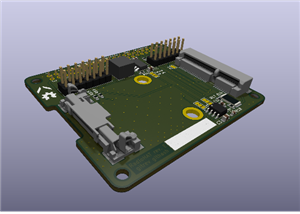
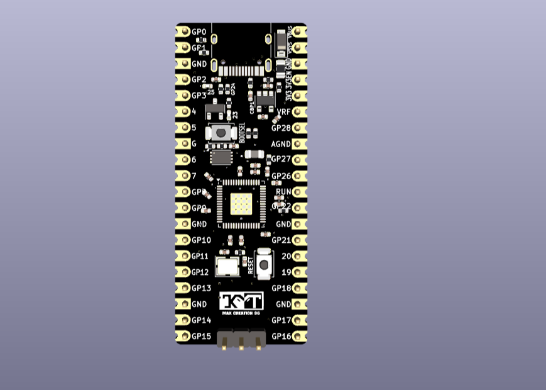
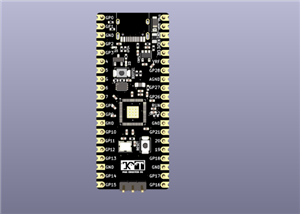
OPENWAVE 2350 is an open-source embedded development platform built around the RP2350 microcontroller and designed to provide an improved experience for makers, students, engineers, researchers, and hardware developers working on modern embedded systems. The purpose behind OPENWAVE 2350 is not only to create another RP2350 development board, but to provide a hardware platform that improves accessibility, usability, customization, and learning while maintaining compatibility with the growing RP2350 ecosystem. The board is intended to support users ranging from complete beginners exploring microcontrollers for the first time to experienced developers building advanced robotics, IoT systems, automation devices, audio applications, and embedded products.
The motivation behind OPENWAVE 2350 originates from common limitations encountered during hardware development workflows. Traditional development boards often require external tools or repetitive processes for programming, debugging, and prototyping. Small improvements in hardware design, such as more convenient connectivity, improved power architecture, easier reset access, and better user interaction with the board, can significantly improve the overall development experience. OPENWAVE 2350 attempts to address these practical challenges by integrating enhancements that make embedded development more efficient and accessible.
At the core of OPENWAVE 2350 is the RP2350 microcontroller, a modern embedded processor designed for high-performance applications while maintaining flexibility for a broad range of use cases. The RP2350 architecture enables developers to implement real-time control systems, sensor processing, communication protocols, robotics algorithms, embedded user interfaces, and many other applications requiring efficient processing. The computational capabilities of the RP2350 make OPENWAVE 2350 suitable not only for educational experimentation but also for more demanding embedded projects and product prototypes.
One of the major hardware improvements introduced in OPENWAVE 2350 is the inclusion of USB Type-C connectivity. Modern embedded development increasingly benefits from USB-C due to its improved durability, reversible connector orientation, and widespread adoption across contemporary devices. By integrating USB-C, the development workflow becomes more convenient, reducing compatibility issues and improving ease of use during programming, debugging, and power delivery. This small but practical enhancement contributes to a smoother user experience for everyday development activities.
Another important feature incorporated into OPENWAVE 2350 is the dedicated reset button. During firmware development, debugging, testing, and iterative prototyping, developers often need to repeatedly reset or reboot the microcontroller. Having direct hardware access to reset functionality improves productivity and simplifies testing workflows. This becomes especially useful when experimenting with unstable firmware, communication protocols, low-level programming, or embedded operating systems.
Power architecture plays a critical role in embedded systems, particularly in applications involving analog sensors, signal acquisition, audio generation, and precision measurements. OPENWAVE 2350 incorporates a low-noise power design philosophy intended to reduce electrical interference commonly introduced through power regulation circuits. Cleaner power delivery may help improve performance in noise-sensitive applications such as PWM audio generation, sensor interfacing, analog-to-digital conversion, and other precision embedded operations. This design consideration increases the versatility of the board for both digital and analog applications.
OPENWAVE 2350 is designed to support multiple programming environments, allowing users to choose development tools according to their experience level and project requirements. Developers may use traditional C or C++ for low-level optimization, Arduino IDE for rapid prototyping, Raspberry Pi Pico SDK for native RP2350 development, MicroPython and CircuitPython for simplified scripting, or Embedded Rust for safety-oriented systems programming. This flexibility enables users from different backgrounds to adopt the platform without significant learning barriers.
The board is intended to support a wide variety of embedded applications. In robotics projects, OPENWAVE 2350 may be used for motor control, sensor fusion, autonomous systems, and communication interfaces. For Internet of Things applications, it can serve as the computational core for monitoring systems, wireless communication nodes, and environmental sensing devices. In educational environments, students can use the platform to explore microcontroller fundamentals, embedded programming, PCB design, and hardware interfacing. Researchers and product developers may utilize the board for rapid prototyping and proof-of-concept validation.
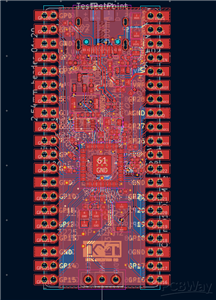
OPENWAVE 2350 is also intended to encourage hardware learning beyond firmware development. Since the project follows an open-source philosophy, users can inspect PCB layouts, schematics, component selection decisions, and design architecture. This transparency allows learners to understand practical hardware engineering considerations such as power management, signal routing, component placement, and manufacturability. Instead of treating development boards as black-box systems, OPENWAVE 2350 encourages deeper understanding and customization.
The open-source nature of the project enables community-driven development and continuous improvement. Users may contribute modifications, optimize layouts, propose new features, create custom variants, or adapt the design for specialized applications. Such collaborative development can accelerate innovation and allow OPENWAVE 2350 to evolve based on real-world usage and community feedback. Open hardware also provides opportunities for educational institutions, hobbyists, and startups to build upon existing designs rather than beginning entirely from scratch.
Beyond serving as a standalone development board, OPENWAVE 2350 aims to act as a bridge between experimentation and product development. Many developers begin with educational projects but face challenges transitioning toward professional hardware design and commercialization. By exposing users to practical hardware structures, design files, and embedded workflows, the platform seeks to reduce that gap and support the progression from prototypes to deployable systems.
The name "OPENWAVE" reflects the underlying philosophy of the project. The term "OPEN" represents accessibility, transparency, knowledge sharing, and collaborative hardware development. The term "WAVE" symbolizes electrical signals, communication systems, continuous innovation, and the dynamic nature of technology. Combined together, OPENWAVE represents a platform intended to empower creators to learn openly, build efficiently, and innovate without unnecessary limitations.
OPENWAVE 2350 is therefore more than a microcontroller development board. It represents an educational resource, a prototyping platform, an open hardware initiative, and a community-driven ecosystem intended to support the next generation of embedded developers and innovators. Through practical improvements, open accessibility, and extensibility, OPENWAVE 2350 aims to provide a foundation where ideas can move from concepts into functioning embedded systems and eventually into real-world products.
OPENWAVE 2350 is built with the belief that embedded development should not only be powerful but also understandable, modifiable, and accessible to anyone willing to learn, experiment, and create. 🌊⚡
OPENWAVE 2350
Project images are for reference only. Actual production is based on the manufacturing files on the project page.
Please review the designer's notes (e.g., PCB thickness) and select the appropriate options.
PCBWay is not responsible
for issues caused by unsuitable parameter selections.
For more important ordering information, please refer to
Read More


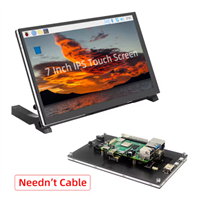
Raspberry Pi 5 7 Inch Touch Screen IPS 1024x600 HD LCD HDMI-compatible Display for RPI 4B 3B+ OPI 5 AIDA64 PC Secondary Screen(Without Speaker)
BUY NOW


- Comments(0)
- Likes(0)
More by Mahesh Thilak K
-
 EmbedMatrix
 is a modular embedded development platform designed to accelerate hardware innovation by...
EmbedMatrix
EmbedMatrix is a modular embedded development platform designed to accelerate hardware innovation by...
-
 NanoControl F031 Platform
 is a compact, energy-efficient embedded development platform built around ...
NanoControl F031 Platform
NanoControl F031 Platform is a compact, energy-efficient embedded development platform built around ...
-
 PicoCore One
 is a compact, high-performance embedded development platform designed to simplify the d...
PicoCore One
PicoCore One is a compact, high-performance embedded development platform designed to simplify the d...
-
 impactcontrol h7
ImpactControl H7 is a high-performance embedded control platform built around the STM32H7 microcontr...
impactcontrol h7
ImpactControl H7 is a high-performance embedded control platform built around the STM32H7 microcontr...
-
 ForceSync H7
AbstractForceSync H7 is a high-performance PCB-based embedded computing platform built around the ST...
ForceSync H7
AbstractForceSync H7 is a high-performance PCB-based embedded computing platform built around the ST...
-
 Cap Probe TESTER
CapProbe is a compact PCB-based capacitive sensing platform designed for precise detection, measurem...
Cap Probe TESTER
CapProbe is a compact PCB-based capacitive sensing platform designed for precise detection, measurem...
-
 AirLink STM8
 is a compact, low-power embedded PCB platform built around the STM8 microcontroller to ...
AirLink STM8
AirLink STM8 is a compact, low-power embedded PCB platform built around the STM8 microcontroller to ...
-
 ZynqFusion Compute SoM#
ZynqFusion Compute SoM is a high-performance System-on-Module (SoM) designed to deliver advanced emb...
ZynqFusion Compute SoM#
ZynqFusion Compute SoM is a high-performance System-on-Module (SoM) designed to deliver advanced emb...
-
 TokayEdge Lite Platform
 is a compact PCB-based edge computing platform designed to deliver real-time...
TokayEdge Lite Platform
TokayEdge Lite Platform is a compact PCB-based edge computing platform designed to deliver real-time...
-
 smart-sensor-battery-pack
Smart Sensor Battery Pack is an intelligent PCB-based battery monitoring and management system desig...
smart-sensor-battery-pack
Smart Sensor Battery Pack is an intelligent PCB-based battery monitoring and management system desig...
-
 MosaicCore HAT
 is a modular PCB expansion board designed to enhance embedded computing platforms wit...
MosaicCore HAT
MosaicCore HAT is a modular PCB expansion board designed to enhance embedded computing platforms wit...
-
 LoRaFlux RF HAT#
LoRaFlux RF HAT is a high-performance PCB-based wireless communication module designed to provide lo...
LoRaFlux RF HAT#
LoRaFlux RF HAT is a high-performance PCB-based wireless communication module designed to provide lo...
-
 BlueRetroHW
 is a compact PCB-based wireless controller adapter designed to modernize classic gaming ...
BlueRetroHW
BlueRetroHW is a compact PCB-based wireless controller adapter designed to modernize classic gaming ...
-
 AetherSync NeuralNode
 Abstract: AetherSync NeuralNode is a next-generation intelligent PCB platform...
AetherSync NeuralNode
AetherSync NeuralNode Abstract: AetherSync NeuralNode is a next-generation intelligent PCB platform...
-
 BluePulse VectorX
 Abstract: BluePulse VectorX is an advanced PCB-based wireless communication and i...
BluePulse VectorX
BluePulse VectorX Abstract: BluePulse VectorX is an advanced PCB-based wireless communication and i...
-
 NanoFlux EdgeCore
 Project Overview: NanoFlux EdgeCore is a next-generation PCB-based edge computin...
NanoFlux EdgeCore
NanoFlux EdgeCore Project Overview: NanoFlux EdgeCore is a next-generation PCB-based edge computin...
-
 PicoForge QuantumLite
 PicoForge QuantumLite is a compact and innovative PCB-based embedded computing...
PicoForge QuantumLite
PicoForge QuantumLite PicoForge QuantumLite is a compact and innovative PCB-based embedded computing...
-
 Innevitable_Pico
Innevitable PicoInnevitable Pico is a custom RP2040-based handheld gaming console designed to integr...
Innevitable_Pico
Innevitable PicoInnevitable Pico is a custom RP2040-based handheld gaming console designed to integr...
-
SmallOLED - Live PC Stats, Animated Clocks & Audio Visualizer
771 0 3 -
"Talking Multimeter": Arduino-Based Speech Add-on for Multimeters with SCPI Protocol
437 0 1 -
Programmable Mist Maker - XIAO / QT PY Extension
2889 2 3 -
RadioHAT - Raspberry Pi radio development platform
2468 0 4 -
-
-
-
ARPS-2 – Arduino-Compatible Robot Project Shield for Arduino UNO
4550 0 6