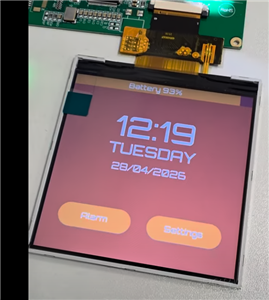
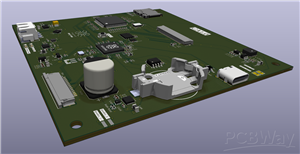
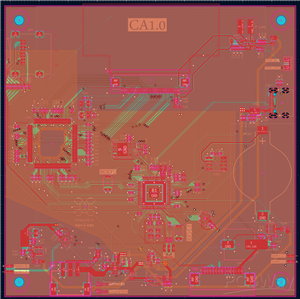
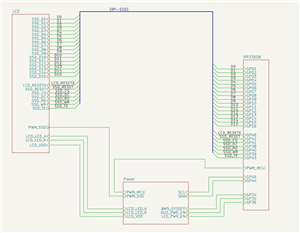
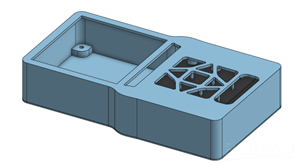
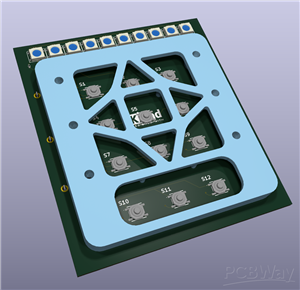
Camille Alarm 1.0 (CA1.0)
Camille Alarm 1.0 (CA1.0)
1. System Overview
CA1.0 is a high-performance, dual-PCB device built around the Raspberry Pi RP2350B microcontroller. The system features a modern graphical user interface powered by the LVGL library, high-fidelity digital audio, programmable accent lighting, and a robust power management system designed for long-term battery-powered or wall-tethered operation.
2. Hardware Architecture & PCB Division
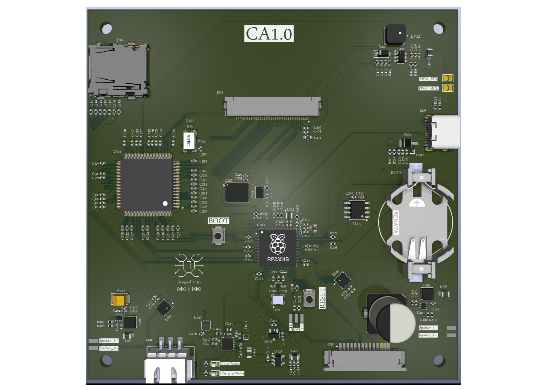
To optimize signal integrity, thermal performance, and mechanical layout, the system is split into two specialized printed circuit boards:
Main Board (Control & Processing)
- Microcontroller: Raspberry Pi RP2350B (ARM Cortex-M33 / Hazard3 RISC-V).
- External Memory: 16MB QSPI Flash (Firmware storage) + 8MB QSPI PSRAM (Extended memory map for heavy graphics/assets).
- Display Pipeline: Dedicated Solomon Systech SSD1963 graphics controller driving a 4.0" square 480x480 TFT LCD panel.
- Audio Subsystem: Dual MAX98357A 3W Class-D I2S amplifiers driving dual 8 Ohm passive speakers.
- Connectivity & Power: USB-C port for flashing/debugging and main power ingestion, integrated Battery Management System (BMS) with built-in charging circuitry, and a dedicated hardware debugging pin header.
- Timekeeping: Dedicated Real-Time Clock (RTC) chip backed by a CR2032 coin cell holder for persistent time tracking.
Peripheral Board (Interface & Power Delivery)
- Energy Storage: High-capacity battery matrix utilizing three 18650 Li-ion cells wired in parallel, delivering a total capacity of 10,500 mAh.
- User Input: Custom-engineered physical hardware keypad configured to function seamlessly as both a system navigator (UI focus/select) and a numeric input pad.
- Visual Accents: Integrated addressable WS2812B (NeoPixel) LED strips for dynamic ambient illumination and alarms.
3. Key Technical Specifications
Display & Graphics Pipeline:
The UI architecture utilizes a dual-bus system to bridge the microcontroller to the raw glass driver, maximizing throughput while preserving processing cycles:
- Host-to-Controller Interface: A high-speed 16-bit 8080 parallel bus connects the RP2350B to the SSD1963. This effectively halves the write cycles required for RGB565 pixel pushing compared to traditional 8-bit interfaces.
- Controller-to-Panel Interface: The SSD1963 internally expands/dithers the frame data to output a full 24-bit true-color RGB parallel interface directly to the ST7701S LCD controller embedded in the 480x480 panel.
High-Speed Peripherals
- Storage: Integrated 4-bit SDIO MicroSD card slot bypassing slower SPI alternatives to allow rapid image asset loading and fluid audio streaming via direct memory access (DMA).
- Audio Jitter Control: The I2S audio stream is handled entirely by the RP2350B’s Programmable I/O (PIO) state machines, ensuring exact hardware timing without loading down the primary CPU cores.
4. Software Environment
Core GUI Framework: LVGL (Light and Versatile Graphics Library).
- Memory Optimization: The software takes advantage of the RP2350B’s XIP (Execute-in-Place) controller, allocating massive LVGL display buffers and heavy graphical assets directly into the fast external 8MB PSRAM memory region (0x11000000), preserving the internal 520 KB SRAM for critical OS and system tasks.
- Input Processing: Keypad matrix scanning loops translate physical key presses directly into native LVGL input group events (LV_KEY_NEXT, LV_KEY_ENTER, numeric entries), allowing full, pointer-free navigation of complex menus.
Camille Alarm 1.0 (CA1.0)
Project images are for reference only. Actual production is based on the manufacturing files on the project page.
Please review the designer's notes (e.g., PCB thickness) and select the appropriate options.
PCBWay is not responsible
for issues caused by unsuitable parameter selections.
For more important ordering information, please refer to
Read More








Raspberry Pi 5 7 Inch Touch Screen IPS 1024x600 HD LCD HDMI-compatible Display for RPI 4B 3B+ OPI 5 AIDA64 PC Secondary Screen(Without Speaker)
BUY NOW


- Comments(2)
- Likes(1)
More by Jacob Berk
-
SmallOLED - Live PC Stats, Animated Clocks & Audio Visualizer
771 0 3 -
"Talking Multimeter": Arduino-Based Speech Add-on for Multimeters with SCPI Protocol
437 0 1 -
Programmable Mist Maker - XIAO / QT PY Extension
2889 2 3 -
RadioHAT - Raspberry Pi radio development platform
2468 0 4 -
-
-
-
ARPS-2 – Arduino-Compatible Robot Project Shield for Arduino UNO
4550 0 6