Placa Traseira (Rear Board) – Data Acquisition FSAE EV
Founded in 2011, our team took on the challenge of building one of Brazil's first Formula SAE electric vehicles. Since the electric category's official debut in 2012, we’ve stood out as the largest Formula SAE Electric team in the country.
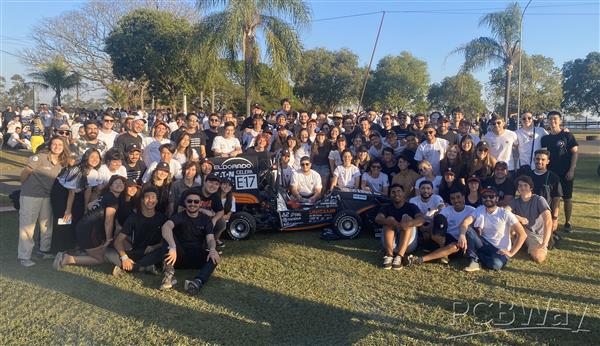
Team picture at 2023 competition
Since then, we have designed and manufactured our prototypes every year with the goal of competing annually, both in Brazil and internationally. By building our vehicle, we take part in competitions organized by the Society of Automotive Engineers (SAE), which aim to promote technological development. In these competitions, participants must plan, raise funds, manage, and execute the design of a high-performance, low-cost electric vehicle, preparing themselves to meet the future demands of the automotive industry. We have had the opportunity to participate in 9 national championships and 5 international ones. After more than 10 years of history, we have achieved 7 victories in Brazilian competitions and 2 in American competitions, establishing ourselves as the Brazilian Formula SAE Electric team with the highest number of national and international titles.
Our electronics division is responsible for the vehicle’s safety systems, data acquisition boards, dashboard, and low-voltage wiring harness. The safety system manages pre-charge, discharge, and full-load control of the inverters through a finite state machine and real-time monitoring of critical systems like the BMS (Battery Management System), IMD (Insulation Monitoring Device), and BSPD (Brake System Plausibility Device).
Beyond safety, we develop sensor boards to collect data such as cooling system temperature and suspension travel. This supports fine-tuning the vehicle's setup. We also design the dashboard electronics, which provide visual feedback to the driver, helping adapt the car's response to driving conditions.
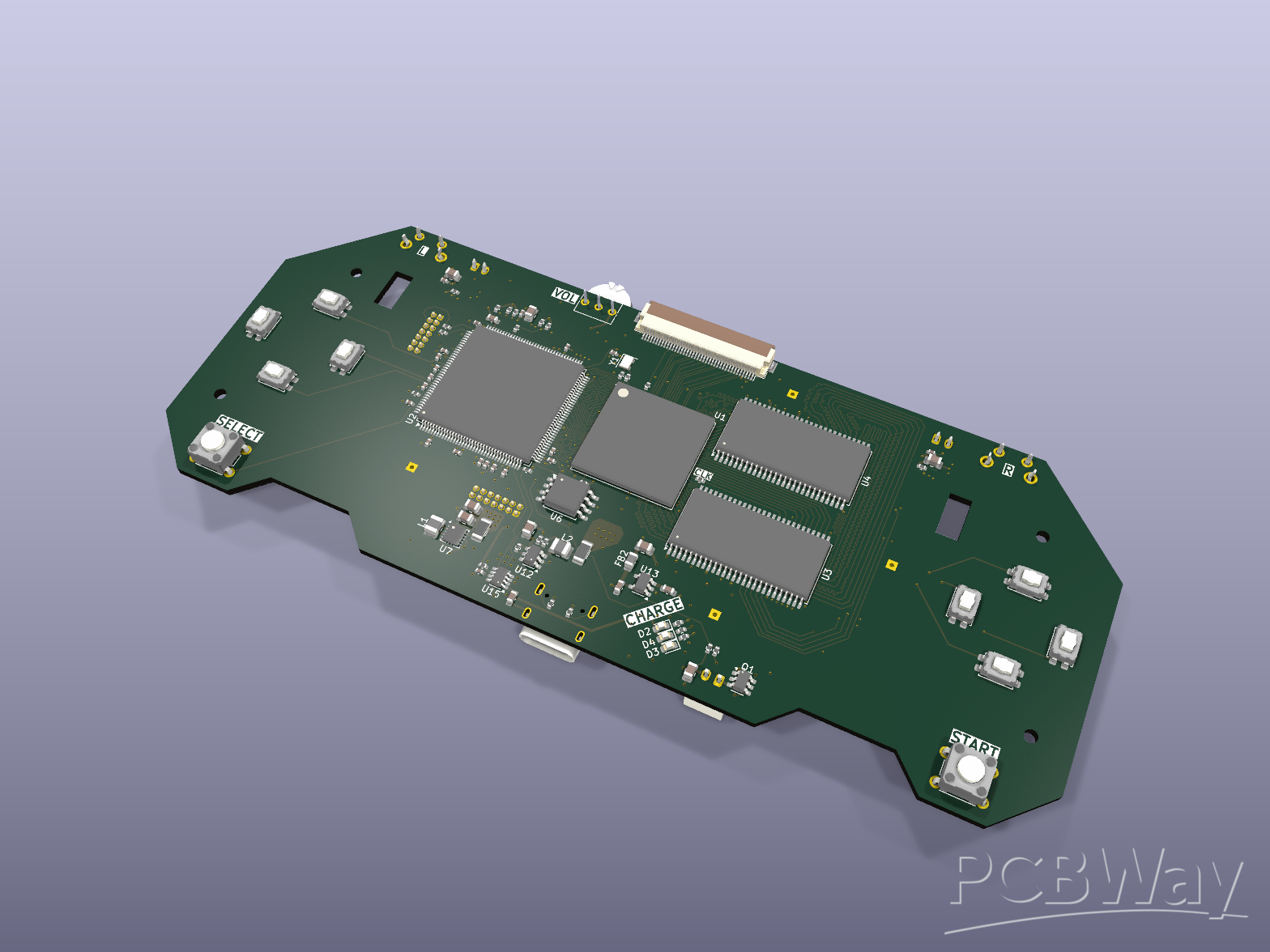
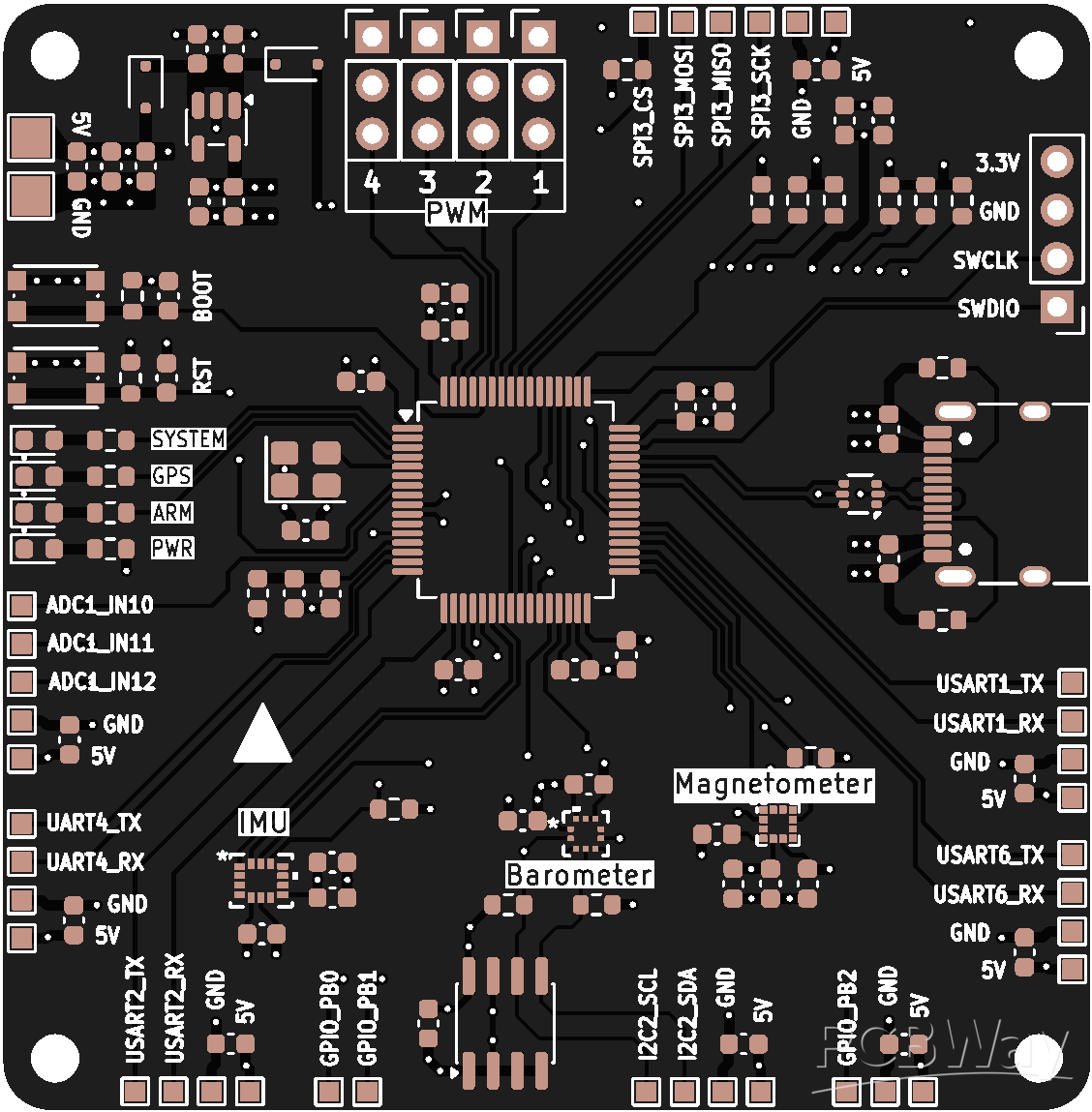
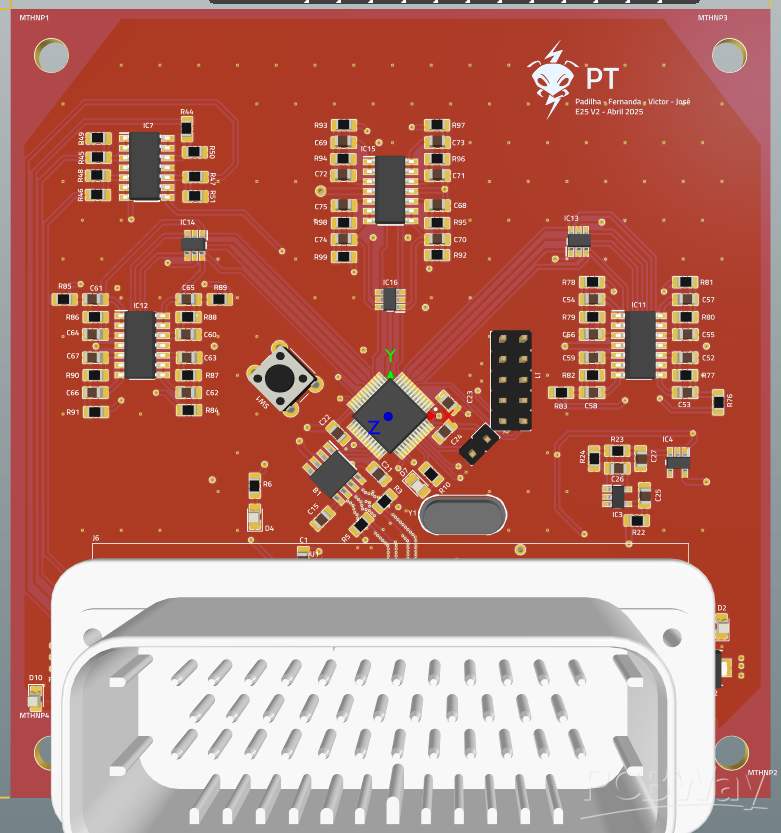
One of our key current projects is the PT (Rear Board) PCB, a four-layer mixed-signal board designed for acquiring and processing sensor data from the rear part of our electric race car. This board plays a crucial role in collecting and interpreting sensor inputs to support decision-making and optimize performance during the FSAE Electric competition.
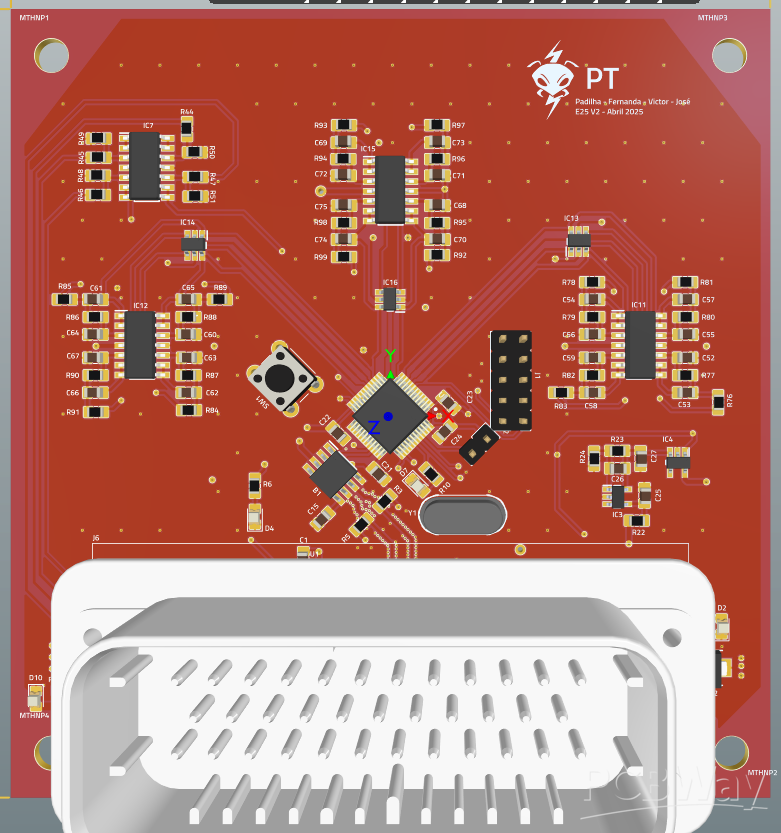
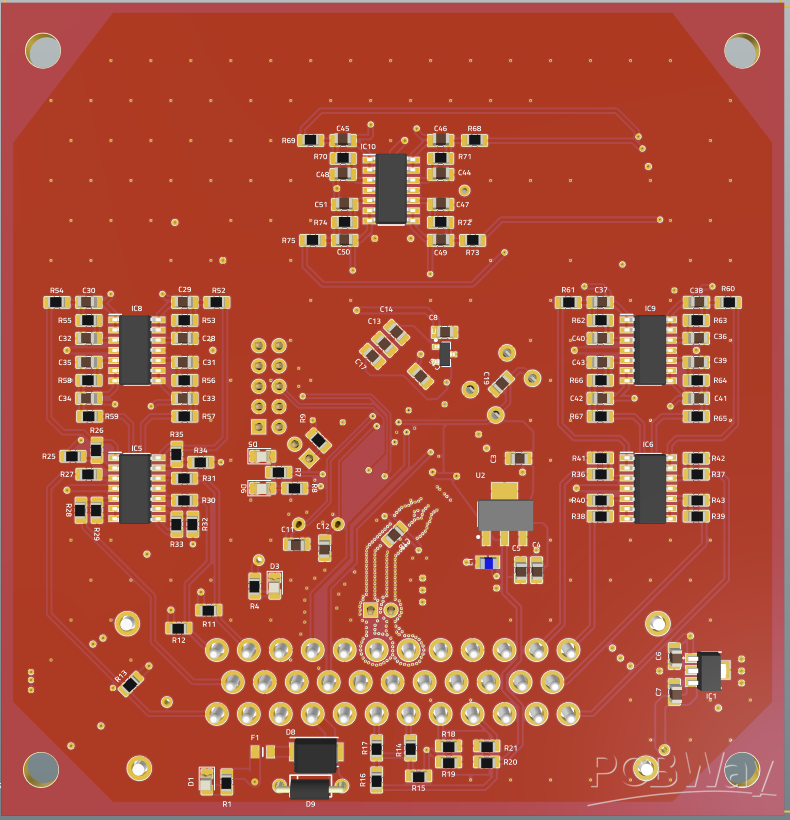
The PT board acquires both analog and digital signals from various sensors. Analog signals are processed through an analog-to-digital conversion, while digital signals are handled individually. All signals undergo a three-stage treatment process to ensure data quality: signal conditioning using operational amplifiers, a low-pass Sallen-Key filter to remove high-frequency noise, and an anti-aliasing filter to prevent sampling errors. These signals are then transmitted via the CAN protocol to the Jetson module, ensuring real-time data monitoring.
The PCB features a layer configuration of Signal - VCC - GND - GND - Signal to preserve signal integrity and minimize return current issues. To power the board, multiple regulators are used to separate analog and digital domains, ensuring better electromagnetic compatibility.
Below is a brief overview of the sensors used and their importance:
- R300 (PT100 Temperature Sensor): This resistive sensor varies its resistance with temperature. A voltage divider is used to measure the voltage across the sensor, which is converted into temperature using a quadratic fit, improving accuracy over an initial linear assumption.
- YF-S201 (Flow Sensor): A digital sensor that outputs a pulse signal whose frequency is proportional to flow. We use input capture to read the frequency and derive the flow rate using a linear conversion.
- Suspension Potentiometer: A variable resistor that outputs voltage linearly according to the extension. A linear function maps voltage to height values, read via ADC.
- DS18B20 (Digital Temperature Sensor): Uses a one-wire digital protocol to send temperature data. It operates from -55°C to 125°C and is used in planetary gear assemblies.
- MHPS-100 (Brake Line Pressure Sensor): Outputs an analog voltage from 0.5V to 4.5V corresponding to 0–102 bar. A voltage divider is used, and pressure is inferred linearly.
We use the STM32G473CET6, chosen for its expanded ADC capabilities and support for FDCAN. The board is powered via a dedicated 3.3V regulator. Decoupling capacitors and reset circuitry help ensure stable operation.
Signal Conditioning and Filtering: We use voltage followers to replicate voltages without affecting the signal. For the R300 sensor, a differential amplifier setup is used. Filters are implemented using the Sallen-Key topology, designed and simulated using Python and LTspice. Typical low-pass filters have a cutoff frequency of 10 Hz and Q=0.45, with variations for specific sensors.
Anti-Aliasing Filters: To prevent aliasing, we use analog low-pass filters with cutoffs well below half the sampling frequency. This enables oversampling and improves ADC resolution and signal stability.
PCBWay's support plays a key role in helping us develop more reliable and efficient systems. With their help, we can push our project further, improve performance, and gain valuable experience in PCB design and manufacturing. We're excited about the opportunity to work alongside PCBWay and bring our goals to life through this partnership.
Apply for sponsorship >>- Comments(0)
- Likes(0)
 More by Engineer
-
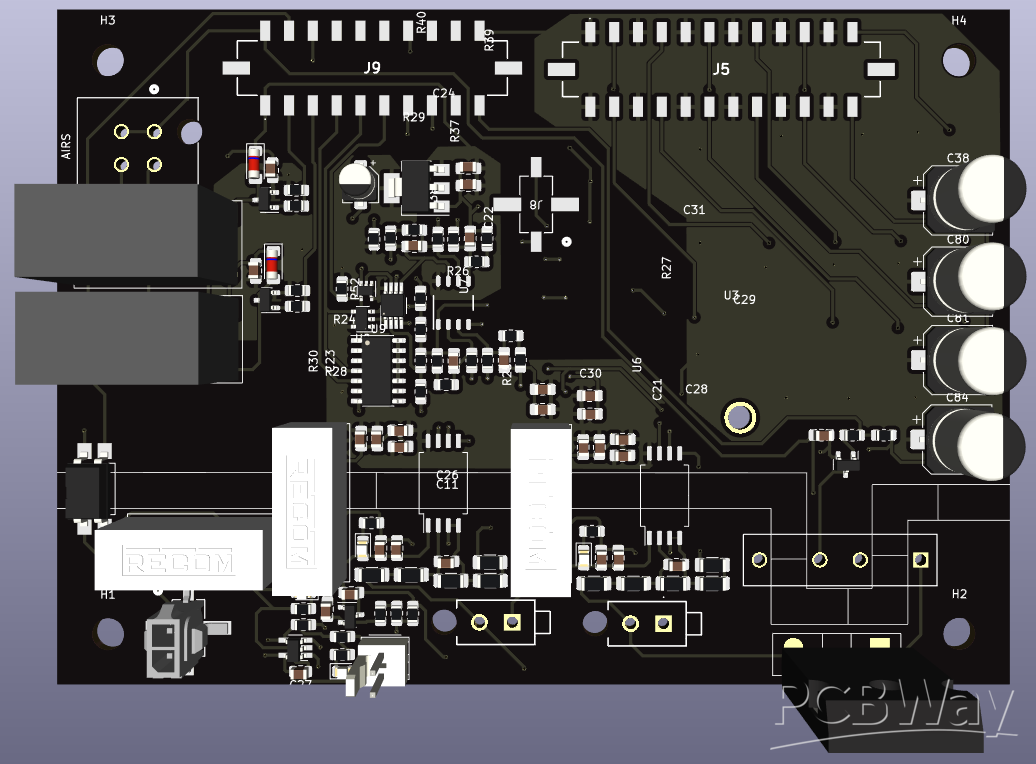 PDP - Placa do Pack - Accumulator Sensing Board
Since then, we have designed and manufactured our prototypes every year with the goal of competing a...
PDP - Placa do Pack - Accumulator Sensing Board
Since then, we have designed and manufactured our prototypes every year with the goal of competing a...
-
 Placa Traseira (Rear Board) – Data Acquisition FSAE EV
Founded in 2011, our team took on the challenge of building one of Brazil's first Formula SAE electr...
Placa Traseira (Rear Board) – Data Acquisition FSAE EV
Founded in 2011, our team took on the challenge of building one of Brazil's first Formula SAE electr...
-
 ACD - Accumulator Control Device for EV FSAE
Since then, we have designed and manufactured our prototypes every year with the goal of competing a...
ACD - Accumulator Control Device for EV FSAE
Since then, we have designed and manufactured our prototypes every year with the goal of competing a...