



|
KiCad 9.0 |
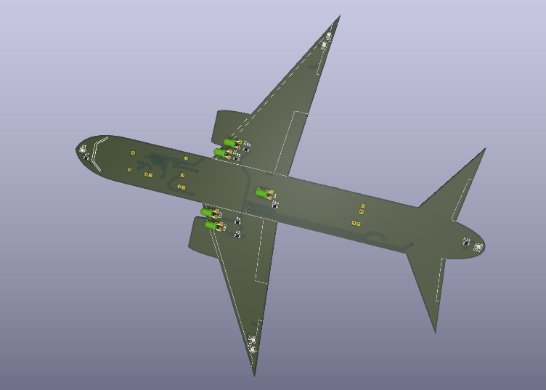
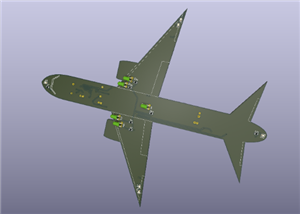
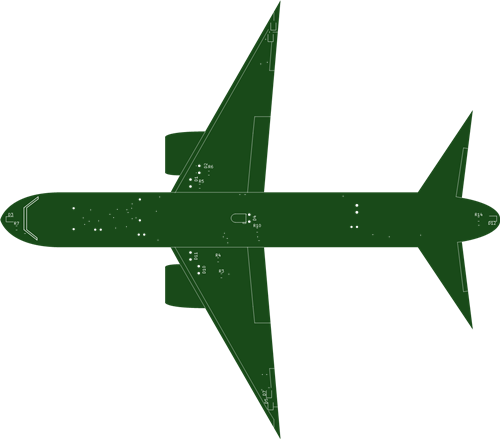
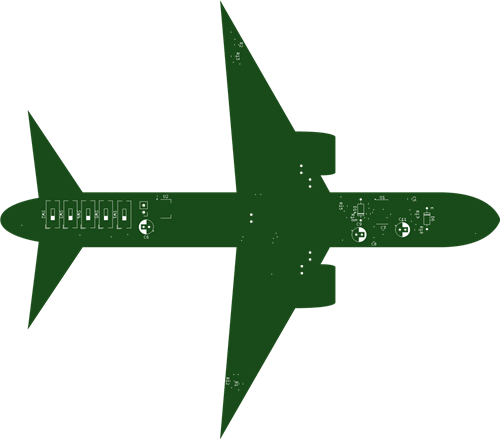
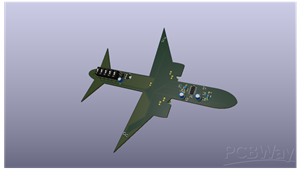
Fully analog LED Aircraft Lighting Simulator based on NE556
The goal of the project was to show that no microcontroller is needed to control the timing between LEDs. Instead, this project uses purely analog NE556 Dual Timer modules, in which pulse timings depend on the resistor's value and the capacitors' capacitance.
By adjusting these component values, it is possible to precisely control the intervals between flashes and the duration of each blink. In this design, the timings are calibrated to accurately replicate a real-world commercial aircraft lighting system.
Lights included:
NAV (Navigation Lights): Constant Red light on the port (left) wingtip and constant Green light on the starboard (right) wingtip.
Strobe Lights: High-intensity flashing White lights on the wingtips to maximize aircraft visibility.
Beacon Lights: Flashing Red anti-collision lights located on the top.
Taxi Light: Constant White light mounted near the nose gear area for ground operations.
Landing Lights: High-intensity, constant White lights positioned for takeoff and landing simulation.
Power supply:
The board includes a built- in voltage regulator which supplies 5V to the system. Every lighting system is routed through individual mechanical slide switches, allowing the user to independently toggle each system ON or OFF.
Input voltage: 6.3V-12V
Warning: Exceeding 12V might cause the regulator to overheat
Practical impact of the project:
The project shows that no microcontrollers are needed to create even more advanced systems.
It encourages students and makers to explore pure physics, hardware design, and analog circuit behavior.
Furthermore, the board serves as an educational tool for aviation enthusiasts, teaching the layout, functionality, and critical importance of commercial aircraft lighting systems.
From an engineering standpoint, an analog approach offers outstanding hardware reliability and instant boot time.
Technical calculations:
The flashing effects are achieved using the NE556. To achieve a duty cycle below 50% (short blink, long pause), a steering diode is placed in parallel with resistor Rb. This isolates the charging and discharging paths of the timing capacitor. The time durations for the pulse width and intervals are mathematically determined using the following formulas:
LED on time
t1 = 0.693*Ra*C
LED off time
t2 = 0.693*Rb*C
frequency:
f = 1.44/((Ra+Rb)*C)
Beacon lights:
blink: 200ms resistor a 30K
gap 1000ms resistor b 150K
Strobe lights:
blink 30ms resistor a 4.7K
gap 1000ms resistor b 150K
Engineering process:
Conceptualization: The project originated from the idea of merging an artistic aerospace layout with educational electronics. The core constraint was to eliminate software entirely.
Schematic Design: Setting up the NE556 astable configurations, followed by mathematical verification of the flashing frequencies to match actual aviation standards.
The PCB layout represented the most challenging stage of the project. The aircraft outline was drawn directly on the Edge.Cuts layer in KiCad to create a recognizable airplane shape. Additional visual details, such as control surfaces and structural markings, were implemented using the silkscreen layer.
Verification and Documentation: Electrical and design-rule checks were performed to validate the design, followed by preparation of the project documentation.
Fully analog LED Aircraft Lighting Simulator based on NE556
Project images are for reference only. Actual production is based on the manufacturing files on the project page.
Please review the designer's notes (e.g., PCB thickness) and select the appropriate options.
PCBWay is not responsible
for issues caused by unsuitable parameter selections.
For more important ordering information, please refer to
Read More


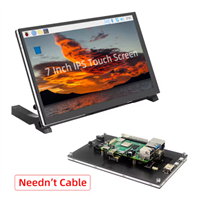
Raspberry Pi 5 7 Inch Touch Screen IPS 1024x600 HD LCD HDMI-compatible Display for RPI 4B 3B+ OPI 5 AIDA64 PC Secondary Screen(Without Speaker)
BUY NOW


- Comments(0)
- Likes(2)
More by Wojciech Lacheta
-
Programmable Mist Maker - XIAO / QT PY Extension
2056 2 2 -
RadioHAT - Raspberry Pi radio development platform
1752 0 4 -
-
-
-
ARPS-2 – Arduino-Compatible Robot Project Shield for Arduino UNO
3980 0 6 -
A Compact Charging Breakout Board For Waveshare ESP32-C3
4714 3 8 -
AI-driven LoRa & LLM-enabled Kiosk & Food Delivery System
5520 2 2 -