|
|
ESP32-DEVKIT-V1Espressif / Generic
|
x 1 |

|
KiCad 9.0 |
|

|
arduino IDEArduino
|
|

|
Blynk App |
|

|
VS Code |
ESP32-Based 8×16 LED Matrix Display Board
ESP32-Based 8×16 LED Matrix Display Board
Introduction
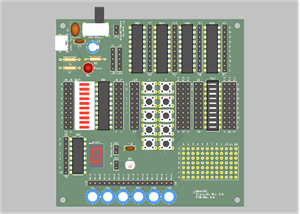
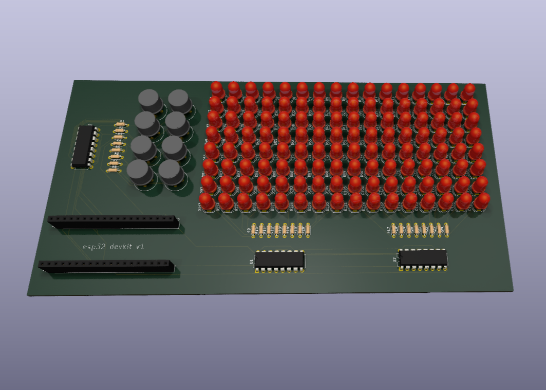
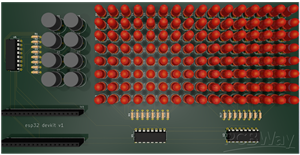
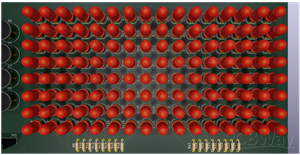
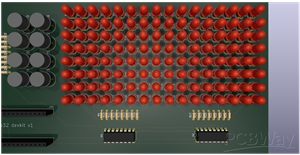
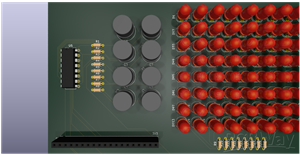
The ESP32-Based 8×16 LED Matrix Display Board is a custom PCB designed in KiCad for displaying text, symbols, and simple animations using a multiplexed LED matrix. The project combines an ESP32 development board, 74HC595 shift registers, transistor driver circuits, and 128 LEDs to create a scalable and efficient display system.To enhance usability, the project utilizes the Blynk IoT platform, enabling users to control display functions and update content remotely using a mobile application connected to the ESP32 via Wi-Fi.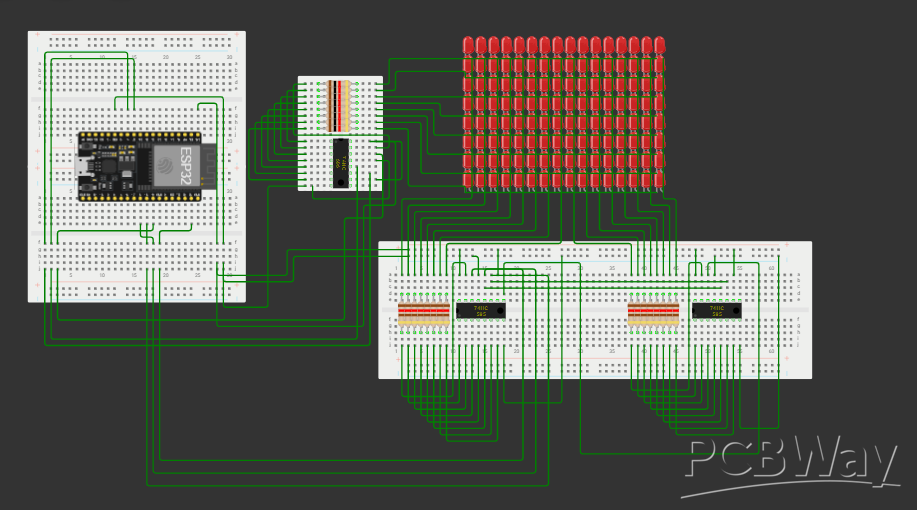
The goal of this project was to learn PCB design, LED matrix multiplexing, and microcontroller interfacing while creating a practical display platform that can be expanded for educational, IoT, and embedded applications.
Motivation
LED matrix displays are widely used in information boards, digital signage, scoreboards, and embedded display systems. Instead of using a prebuilt display module, I wanted to understand the underlying hardware by designing the complete driving circuitry from scratch.
This project provided an opportunity to:
- Design a complete PCB using KiCad.
- Learn LED matrix multiplexing techniques.
- Interface an ESP32 with shift registers.
- Optimize GPIO usage using serial-to-parallel expansion.
- Develop a reusable display platform for future projects.
Hardware Design
The system consists of:
- ESP32 DevKit V1
- 8×16 LED Matrix (128 LEDs)
- 74HC595 Shift Registers
- Transistor Driver Stage
- Current Limiting Resistors
- Custom KiCad PCB
The ESP32 acts as the main controller. Since directly controlling 128 LEDs would require a large number of GPIO pins, 74HC595 shift registers are used to expand the available outputs.
The transistor driver stage provides sufficient current handling capability for multiplexed operation and ensures reliable LED brightness.
Working Principle
The display operates using multiplexing.
The ESP32 sends serial data to the 74HC595 shift registers.
The shift registers convert the serial data into parallel outputs.
Row and column driver circuits select the LEDs that need to be illuminated.
The process repeats rapidly for all rows, creating the appearance of a continuously illuminated display.
By updating the LED patterns in software, the system can display:
- Scrolling text
- Static messages
- Symbols
- Basic animations
PCB Design
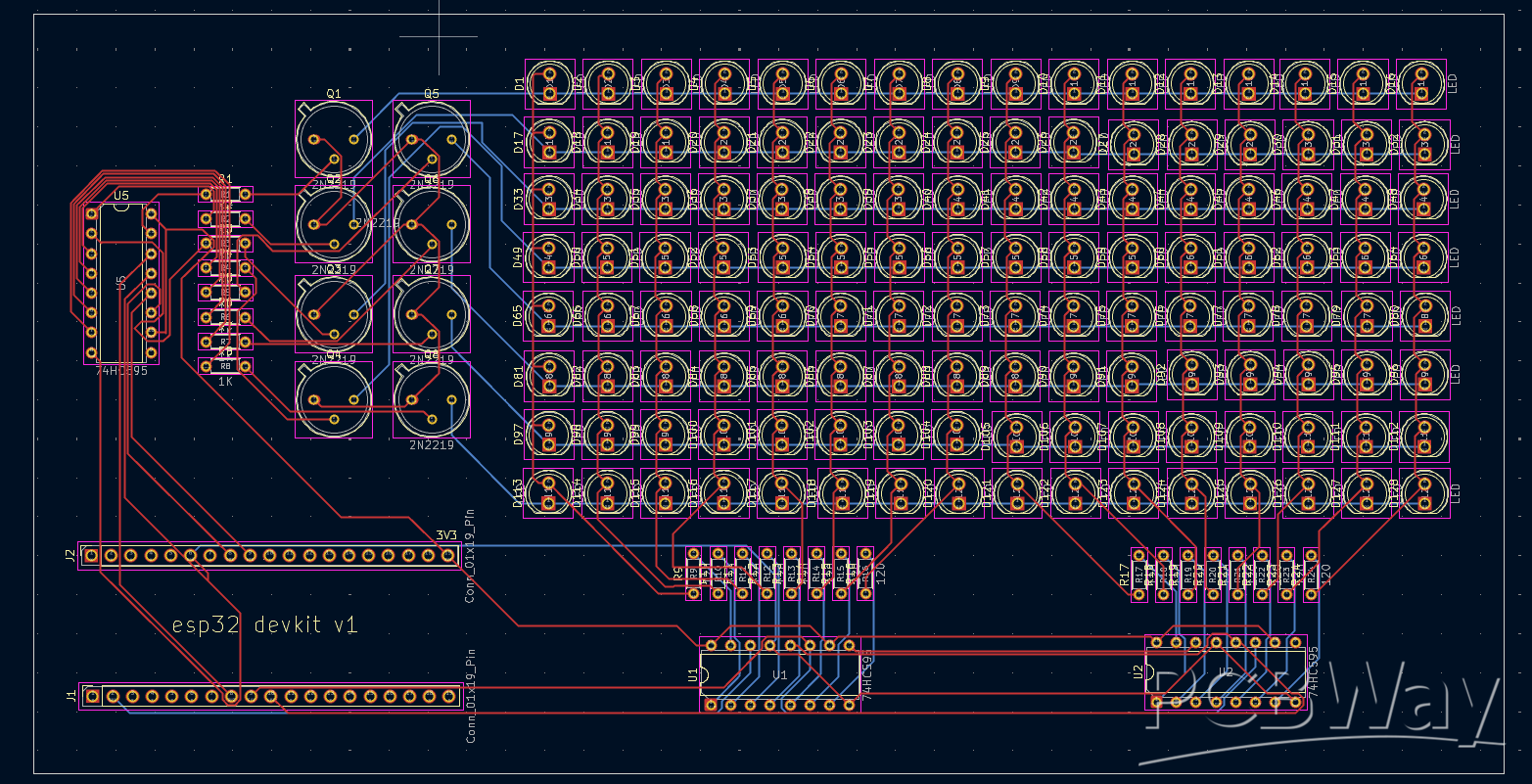
The schematic and PCB were designed entirely in KiCad.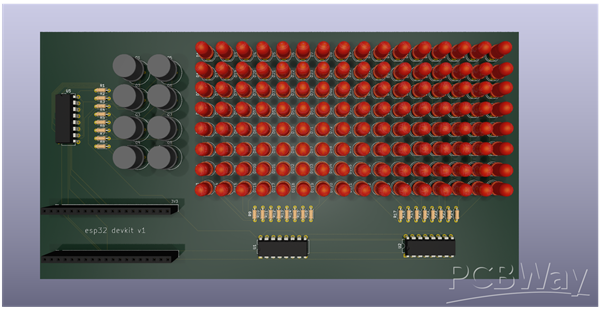
Applications
- Educational demonstrations
- Information display systems
- IoT status displays
- Embedded user interfaces
- Message boards
- Prototype digital signage
Future Improvements
Future versions of the project may include:
- Wi-Fi based message updates
- Web interface for text input
- Bluetooth control
- RGB LED matrix support
- Real-time clock integration
Conclusion
This project demonstrates the design of a complete LED matrix display system using an ESP32 and custom KiCad PCB. It combines microcontroller programming, digital electronics, and PCB design into a practical embedded hardware project while providing a platform for future expansion and experimentation.
ESP32-Based 8×16 LED Matrix Display Board
Project images are for reference only. Actual production is based on the manufacturing files on the project page.
Please review the designer's notes (e.g., PCB thickness) and select the appropriate options.
PCBWay is not responsible
for issues caused by unsuitable parameter selections.
For more important ordering information, please refer to
Read More


Raspberry Pi 5 7 Inch Touch Screen IPS 1024x600 HD LCD HDMI-compatible Display for RPI 4B 3B+ OPI 5 AIDA64 PC Secondary Screen(Without Speaker)
BUY NOW


- Comments(0)
- Likes(2)
More by Jerin Thomas John
-
Programmable Mist Maker - XIAO / QT PY Extension
2204 2 2 -
RadioHAT - Raspberry Pi radio development platform
1894 0 4 -
-
-
-
ARPS-2 – Arduino-Compatible Robot Project Shield for Arduino UNO
4082 0 6 -
A Compact Charging Breakout Board For Waveshare ESP32-C3
4840 3 8 -
AI-driven LoRa & LLM-enabled Kiosk & Food Delivery System
5635 2 2 -