


BoostCore-Module
BoostCore-Module
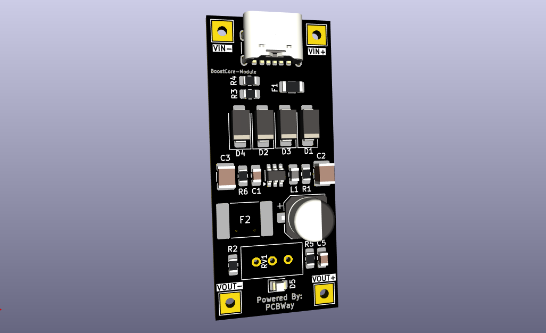
BoostCore-Module is a compact adjustable DC-DC step-up boost converter module built around the MT3608 regulator.
It supports USB-C 5V input, an optional external VIN input, Schottky OR-ing input selection, resettable fuse protection, TVS protection on USB VBUS, and a trimpot-adjustable output feedback network.
PCB manufacturing sponsor: This project is sponsored by PCBWay.
PCBWay support is mentioned in the documentation because the PCB is intended to be published as an open hardware project and manufactured as a compact prototype board.
Project Highlights
MT3608 based boost converter
USB-C power-only input
External VIN input
Input OR-ing with SS36 Schottky diodes
USB-C VBUS protection with 5V TVS diode
USB-C PTC fuse protection
Optional VIN_EXT PTC fuse protection
Adjustable output voltage using trimpot
0805 resistor/LED-friendly design choices
Test points for VIN, VOUT, FB, EN and GND
KiCad-ready hardware folder structure
GitHub documentation package with BOM, assembly, layout and testing guides
Sponsorship:
This project is sponsored by PCBWay.
PCBWay is mentioned here as the PCB manufacturing sponsor for the open hardware release of BoostCore-Module. The board was designed with prototype manufacturing in mind, including compact routing, silkscreen labels, test points, and an export-ready project structure.
Electrical Overview
ParameterValueController ICMT3608TopologyBoost / step-upUSB-C input5V onlyExternal VIN input2V-24V target rangeOutput voltageAdjustable by RV1 trimpotSwitching frequencyMT3608 typical 1.2MHzInductor4.7uH recommendedMain boost diodeSS36, 3A, 60VOutput adjustmentR1 + R2 + RV1 feedback networkOutput capacitor cautionUse 50V capacitors for high output voltage
Current Feedback Network
The adjustable output stage is:
VOUT -> R2 10k -> RV1 100k trimpot -> FB -> R1 2.2k -> GND
Recommended trimpot wiring:
RV1 pin 3 -> R2 side
RV1 pin 1 + pin 2 -> FB node
Formula:
VOUT = 0.6 x (1 + R_UPPER / R1)
Where:
R_UPPER = R2 + active RV1 resistance
R1 = 2.2k
Important:
Start with the trimpot at the lowest output setting.
Always adjust output using a multimeter.
Do not connect a sensitive load before confirming VOUT.
High output voltages require output capacitors rated above the selected voltage.
Images
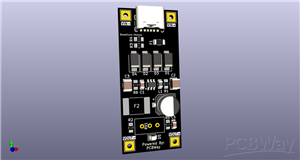
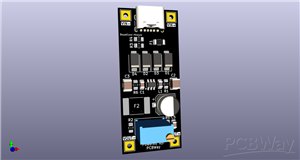
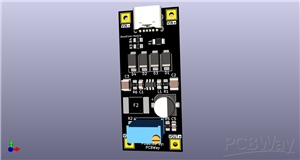
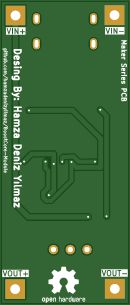
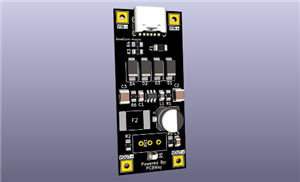
Layout preview


Important Hardware Notes
USB-C input
The USB-C connector is used as a 5V power-only input.
Required CC resistors:
CC1 -> 5.1k -> GND
CC2 -> 5.1k -> GND
USB-PD negotiation is not implemented. The USB-C input is therefore 5V only.
F1 USB fuse
Current selected part:
F1 = KLM3S300RY
PTC resettable fuse
1206 / 3A / 6V
USB-C 5V input only
Do not use this part on the 24V external input path.
F2 external VIN fuse
Compact option:
F2 = MF-MSMF110/24X-2
1812 / 1.1A / 24V
Higher-current but larger option:
F2_ALT = FSMD185-2920-R
2920 / 1.85A / 33V
D2 USB TVS
D2 must be a 5V TVS diode, not a Schottky diode.
Recommended:
D2 = P4SMAJ5.0_R1_00001
D1 / D3 / D4
The board uses SS36 diodes:
D1 = SS36
D3 = SS36
D4 = SS36
D3 and D4 are used for input OR-ing.
C4 polarity
If using the compact electrolytic output capacitor:
C4 (+) -> VOUT
C4 (-) -> GND
Mark polarity clearly on silkscreen.
PCB Layout Rules
Boost converters are layout-sensitive. Follow these rules:
Keep the SW node as short and small as possible.
The SW node is:U1 pin 1 SW + L1 right side + D1 anode
Do not place copper pour under the SW node area.
Keep FB trace away from SW node, diode switching node and inductor.
Place C1 close to U1 IN and GND.
Place output capacitors close to D1 cathode and GND.
Use a solid GND plane on the bottom layer.
Add via stitching near high-current GND return paths.
Do not route feedback under the inductor.
Make VIN_SYS and VOUT traces wide.
Assembly Order
Recommended assembly sequence:
Inspect PCB visually.
Solder USB-C connector.
Solder protection parts: F1, D2, D3, D4.
Solder MT3608.
Solder inductor L1 and diode D1.
Solder resistors and small capacitors.
Solder RV1 trimpot.
Solder output capacitors.
Solder connectors.
Inspect polarity of C4.
Check shorts between VIN, VOUT and GND.
Power on without load.
Adjust output voltage with a multimeter.
Test with a dummy load.
First Power-Up Checklist
Before applying power:
Check USB-C VBUS is not shorted to GND.
Check VIN_SYS is not shorted to GND.
Check VOUT is not shorted to GND.
Confirm D1 cathode points to VOUT.
Confirm C4 polarity.
Confirm RV1 pin 1+2 go to FB.
Confirm RV1 pin 3 goes to R2.
Confirm EN is pulled to VIN_SYS through R6.
Initial test:
1. Apply input power.
2. Measure VIN_SYS.
3. Measure VOUT.
4. Adjust RV1 slowly.
5. Verify output under light load.
6. Check temperature of MT3608, L1 and D1.
This is an open hardware project. Use at your own risk. Verify all footprints, ratings, clearances, capacitor voltage ratings and component stock before fabrication or ordering.
BoostCore-Module
Project images are for reference only. Actual production is based on the manufacturing files on the project page.
Please review the designer's notes (e.g., PCB thickness) and select the appropriate options.
PCBWay is not responsible
for issues caused by unsuitable parameter selections.
For more important ordering information, please refer to
Read More


Raspberry Pi 5 7 Inch Touch Screen IPS 1024x600 HD LCD HDMI-compatible Display for RPI 4B 3B+ OPI 5 AIDA64 PC Secondary Screen(Without Speaker)
BUY NOW


- Comments(0)
- Likes(0)
More by Hamza Deniz Yılmaz
-
 L298N Borad
L298N is a widely used motor driver IC. This integrated is a solution for controlling DC motors or s...
L298N Borad
L298N is a widely used motor driver IC. This integrated is a solution for controlling DC motors or s...
-
 BoostCore-Module
BoostCore-Module is a compact adjustable DC-DC step-up boost converter module built ...
BoostCore-Module
BoostCore-ModuleBoostCore-Module is a compact adjustable DC-DC step-up boost converter module built ...
-
 STM32F4xx Maker PCB MakerST-1
Getting Started with the Maker PCB MakerST-1: Your STM32F4 Adventure Begins!Hey there, makers and te...
STM32F4xx Maker PCB MakerST-1
Getting Started with the Maker PCB MakerST-1: Your STM32F4 Adventure Begins!Hey there, makers and te...
-
 Discover the Next Generation Development Platform with ATmega32U4 Based Uptimes Developers Board
IntroductionFor engineers developing electronic projects, hobbyists, enthusiasts and prototypers, fi...
Discover the Next Generation Development Platform with ATmega32U4 Based Uptimes Developers Board
IntroductionFor engineers developing electronic projects, hobbyists, enthusiasts and prototypers, fi...
-
 ESP32-C3-MINI-1 MacroPad
ESP32-C3-MINI-1 What is it ?ESP32-C3-MINI-1 is a microcontroller board developed by Espressif System...
ESP32-C3-MINI-1 MacroPad
ESP32-C3-MINI-1 What is it ?ESP32-C3-MINI-1 is a microcontroller board developed by Espressif System...
-
 ESP32-Controller-Board
Objectives of the Project:Building a simple relay control circuit using an ESP32 microcontroller. To...
ESP32-Controller-Board
Objectives of the Project:Building a simple relay control circuit using an ESP32 microcontroller. To...
-
 Multi-Controlled Robot Card_V1
For more information: https://www.hackster.io/hamzadenizyilmaz/multi-controlled-robot-card-v1-91f67c
Multi-Controlled Robot Card_V1
For more information: https://www.hackster.io/hamzadenizyilmaz/multi-controlled-robot-card-v1-91f67c
-
 Atmega32u4 Pro Micro PCB design
For more information:https://www.hackster.io/504629/atmega32u4-pro-micro-pcb-design-4e3baf
Atmega32u4 Pro Micro PCB design
For more information:https://www.hackster.io/504629/atmega32u4-pro-micro-pcb-design-4e3baf
-
 Esp32-S2-Wroom and Relay
For more, go to the link below:https://www.hackster.io/hamzadenizyilmaz/esp32-s2-wroom-and-relay-e0f...
Esp32-S2-Wroom and Relay
For more, go to the link below:https://www.hackster.io/hamzadenizyilmaz/esp32-s2-wroom-and-relay-e0f...
-
 ESP32-WROOM-32E-cart
FOR MORE INFORMATION:https://www.hackster.io/hamzadenizyilmaz/esp32-wroom-32e-cart-15601c
ESP32-WROOM-32E-cart
FOR MORE INFORMATION:https://www.hackster.io/hamzadenizyilmaz/esp32-wroom-32e-cart-15601c
-
 Wireless Communication with NRF24 and Arduino Pro Micro
FOR MORE INFORMATION:https://www.hackster.io/hamzadenizyilmaz/wireless-communication-with-nrf24-and-...
Wireless Communication with NRF24 and Arduino Pro Micro
FOR MORE INFORMATION:https://www.hackster.io/hamzadenizyilmaz/wireless-communication-with-nrf24-and-...
-
 Esp32-S2-Wroom borad
For more information about this project:https://www.hackster.io/hamzadenizyilmaz/esp32-s2-wroom-bora...
Esp32-S2-Wroom borad
For more information about this project:https://www.hackster.io/hamzadenizyilmaz/esp32-s2-wroom-bora...
-
 KeyboradPad
WARNING: The design of this project belongs to me, it can not be used without permission.WARNING: Th...
KeyboradPad
WARNING: The design of this project belongs to me, it can not be used without permission.WARNING: Th...
-
 MotorDuıno
For more information:https://www.hackster.io/hamzadenizyilmaz/motorduino-3c544d
MotorDuıno
For more information:https://www.hackster.io/hamzadenizyilmaz/motorduino-3c544d
-
 NumberPad V2
For more information:https://www.hackster.io/hamzadenizyilmaz/numberpad-v2-5acffeVideo:https://www.y...
NumberPad V2
For more information:https://www.hackster.io/hamzadenizyilmaz/numberpad-v2-5acffeVideo:https://www.y...
-
 Number Pad
For more information and codes:https://www.hackster.io/hamzadenizyilmaz/numberpad-41848e
Number Pad
For more information and codes:https://www.hackster.io/hamzadenizyilmaz/numberpad-41848e
-
 Making Macropad with Attiny85
For more information and codes:https://www.hackster.io/hamzadenizyilmaz14022008/making-macropad-with...
Making Macropad with Attiny85
For more information and codes:https://www.hackster.io/hamzadenizyilmaz14022008/making-macropad-with...
-
SmallOLED - Live PC Stats, Animated Clocks & Audio Visualizer
771 0 3 -
"Talking Multimeter": Arduino-Based Speech Add-on for Multimeters with SCPI Protocol
437 0 1 -
Programmable Mist Maker - XIAO / QT PY Extension
2889 2 3 -
RadioHAT - Raspberry Pi radio development platform
2468 0 4 -
-
-
-
ARPS-2 – Arduino-Compatible Robot Project Shield for Arduino UNO
4550 0 6