A resistor with color bands allows users to directly calculate the resistance value by identifying the color bands, without the need for measurement. Color band markings are mainly applied to cylindrical resistors, such as carbon film resistors, metal film resistors, metal oxide film resistors, fuse resistors, wire-wound resistors, etc. These markings indicate that the resistor has four, five, or six color bands to represent its resistance value.

A color-coded resistor is one of the most commonly used electronic components in electronic circuits. A color-coded resistor has different colored bands painted on the standard resistor packaging to distinguish its resistance value. The basic units of color-coded resistors include: ohms (Ω), kilo-ohms (KΩ), and mega-ohms (MΩ). 1 mega-ohm (MΩ) = 1000 kilo-ohms (KΩ) = 1,000,000 ohms (Ω).
The commonly used color-coded resistors can be divided into four-band and five-band types, with the four-band type being more commonly used. For a four-band resistor, the first two bands represent digits, the third band indicates the multiplier, and the last band represents the tolerance. In a five-band resistor, the first three bands represent digits, the fourth band indicates the multiplier, and the last band represents the tolerance. The tolerance is typically indicated by gold, silver, and brown colors, where gold represents a 5% tolerance, silver represents a 10% tolerance, and brown represents a 1% tolerance. Additionally, no color represents a 20% tolerance, and occasionally green is used to represent a 0.5% tolerance.
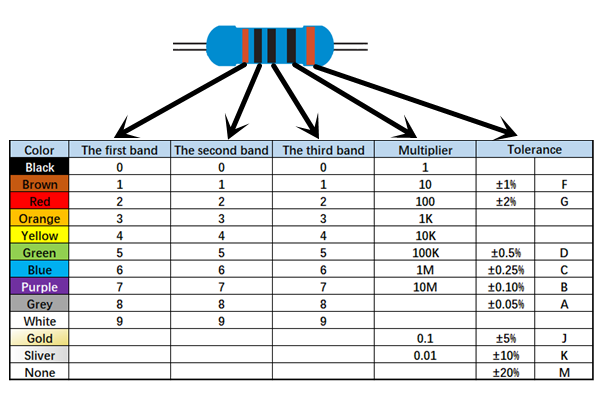
A four-band resistor refers to a resistor that uses four colored bands to indicate its resistance value. Counting from left to right, the first band represents the first significant digit, the second band represents the second significant digit, the third band indicates the multiplier, and the fourth band represents the tolerance (precision) of the resistor.
If it’s hard to distinguish the first band of the resistor, the simplest way is to check the "fourth band," which will either be gold or silver, cuz other colors will rarely appear as the fourth band. This method only applies to four-band resistors and is not applicable to five-band resistors.
Examples:
A five-band resistor refers to a resistor that uses five colored bands to indicate its resistance value. Counting from left to right, the first band represents the first significant digit, the second band represents the second significant digit, the third band represents the third significant digit, the fourth band indicates the multiplier, and the fifth band represents the tolerance range.
Example: Red, red, black, black, brown: 220 * 1 = 220Ω, tolerance is 1%.
A six-band resistor refers to a resistor that uses six colored bands to indicate its resistance value. The first five bands are interpreted the same way as in a five-band resistor, while the sixth band represents the temperature coefficient of the resistor. These resistors are only used in electronic products with specific requirements and are generally not very common.



