

UFABC Rocket Design - Projects Aracê and Caipora-Amanã
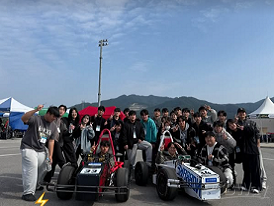
One of the oldest rocketry teams in Brazil, UFABC Rocket Design was founded in January 2010, having developed more than 20 projects since its origin. At the current time, we have more than 130 members from all over the university courses, which ends up generating a plurality of ideas and experiences for the improvement of the team every year
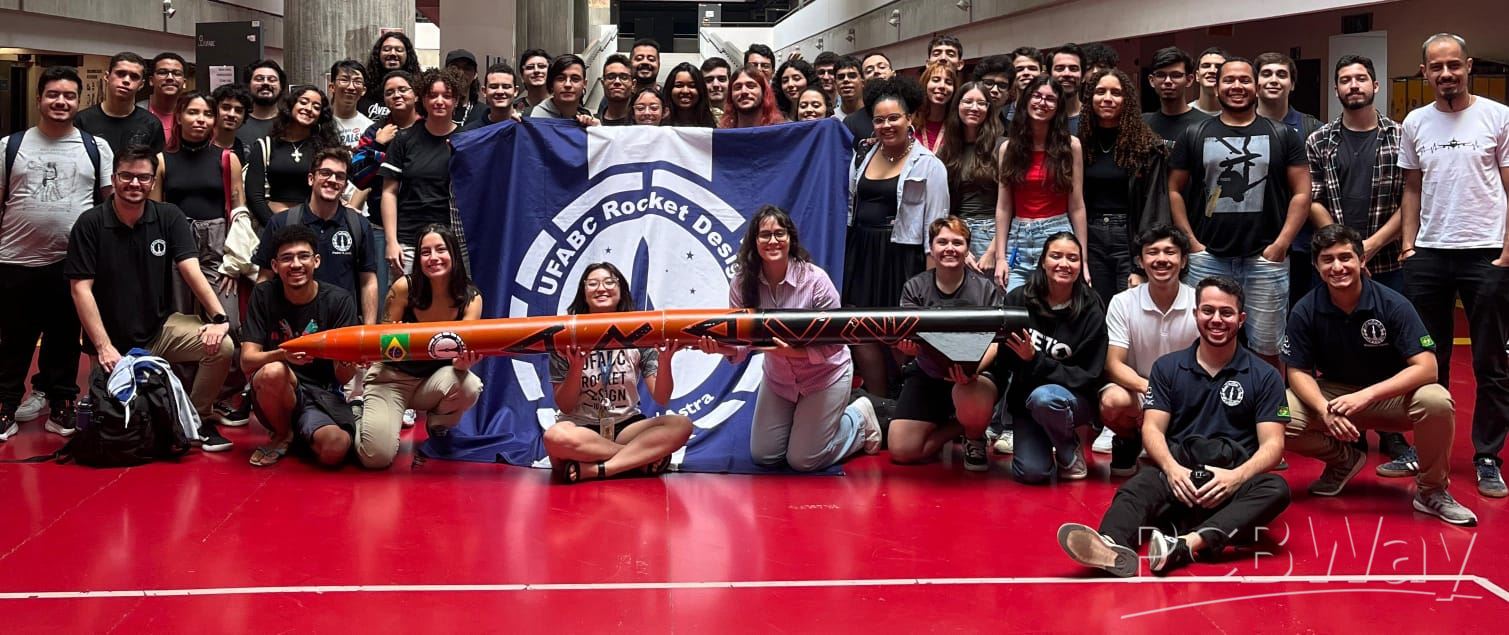
(Some of our team members after our reunion on 29/03/2025 with our current project Mockup)
Since the end of 2023, we have been developing two projecs in parallel for the 2025 International Rocket Engineering Competition (or IREC 2025) where we are returning after being part of the 2017 and 2019 editions, and for the 6th Latin America Space Challenge (or 6th LASC). These projects are Aracê, focused on developing a rocket for the 3KM (or 10.000ft) category and the Caipora-Amanã, the first satelite project of the team, focused on developing a 3U CubeSat with a experiment in partnership with the Brazilian Agricultural Research Corporation (or EMBRAPA) to analyze how plant seeds and seedlings will behave during the flight.
The following videos are the flights of the projects Tupã in the 2017 IREC/SAC 2017 and Angra in the 2019 IREC/SAC:
Both the satelite and the rocket contain PCBs developed by the Embedded Systems area, to gather and storage data during the flight, activate the parachute under certain conditions and ensure that is possible to track the rocket during and after the flight. We also develop PCBs for the static and hydrostatic motor tests, to ensure its operation parameters before any flight.
- The rocket's avionics is composed of two PCBs where each one is individualy powered by a pair of 18650 batteries. The main board is controlled by an Arduino Mega, with a GY-91 module to gather various flight parameters, a GPS module together with a LoRa RF 915MHz module to send this data to the ground station in real time and a SD card module to storage the data for post-flight analysis. In adition, this board also has the parachute deployment system for both parachutes of the rocket using 4 IRF640N MOSFETs together with a circuit developed so that each one of them has two triggers in case something goes wrong with the first one. The second board of the system is a Redundancy board, being controlled by an Arduino Nano and having only the GY-91 module and the SD card Module to gather and storage the flight data in case of any problems with the main board.
- On the satelite's avionics, the PCB is very similar to the redundancy board of the rocket, being powered by a pair of 18350 batteries. Controlled by an Arduino nano, a GY-91 module and a SD Card module and some conectors for the LED lights and Camera that will be stored inside the payload to film some of the samples of the experiment.
- For the ground safety procedures, the static and hydrostatic tests board is powered by a pair of 18650 batteries. It is controlled by an Arduino Mega with two different conectors, one of them is part of the Load Cell control that analyzes the motor strength together with an INA125 amplifier and a set of trimpots to allow different scales depending on the engine being tested and the other conector is used by a pressure tranducer coupled to the engine during the tests for pressure analysis.
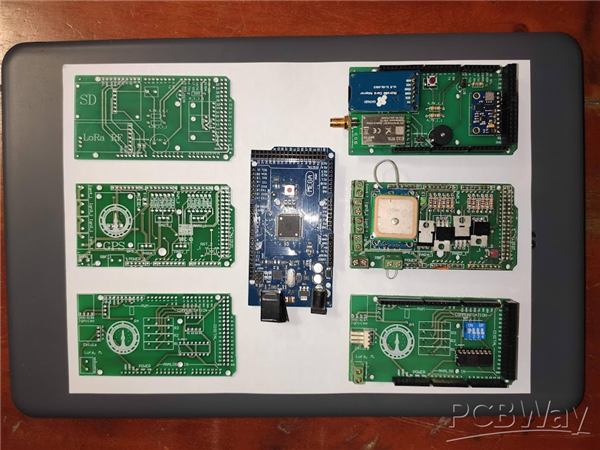
In the picture below, we have some of our old PCBs with and without the electronic components. The first two are the Main Boards, as the top row has the LoRa RF, the SD card and an old GY-81 Module and the middle one has the GPS and the IRF640N MOSFETs. These boards were used in the previous flights of the team. The last row is the old static test board, with the INA 125P, the trimpots and the conector for the Load Cell.
In this way, a good part of the rocket's design and its production goes through the PCBs developed by the team, and as we are a university team, we have few resources to meet all the material and equipment needs and thus, a sponsorship with PCBWay will provide high quality PCBs both for what we are developing today, allowing participation in all planned competitions, as for future team development.
Having the support of PCBWay allows new technologies to be applied, integrating new ideas for future projects while the team can continue researching increasingly complex systems with the security and confidence in the production of our PCBs
Apply for sponsorship >>- Comments(0)
- Likes(0)