IIT Kanpur Rocketry and Space Exploration Team
IITK RaSET
Our journey at IITK RaSET began in 2022 with a clear mission: to ignite a passion for space technology by building next-generation sounding rockets. Founded as a student project by Atharva Dehadraya, along with Nandan Madhuj and Shraman Das, our dedication led to our recognition as an official Science and Technology (SnT) Team at IIT Kanpur in 2024. We are driven by the ultimate goal of pioneering student-led advancements in rocket engineering.


Flight Computer : MAX-Q
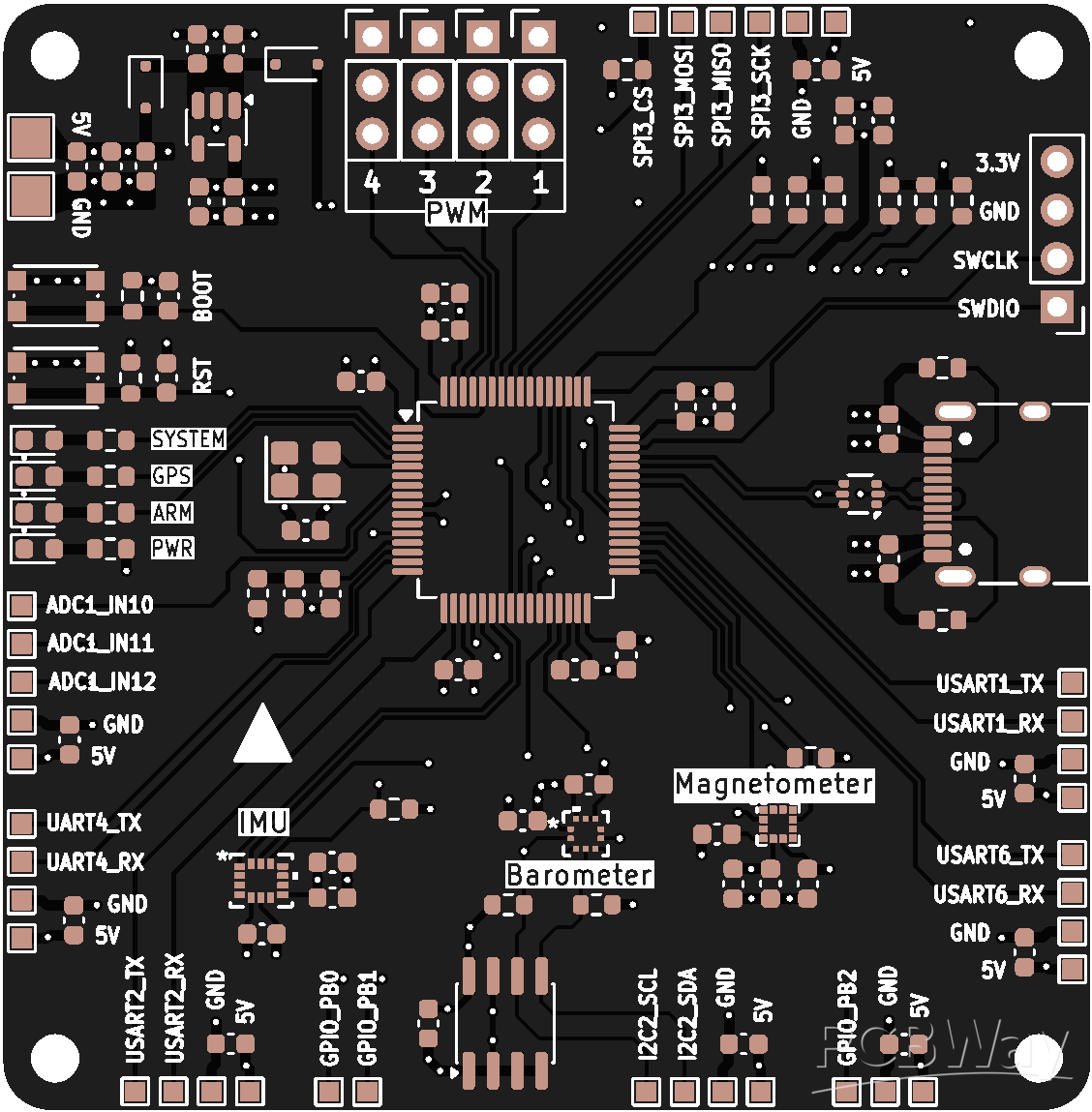
A core component of our rocketry platform is the MAX-Q Flight Computer, which we custom-developed over the past year. Crucial for rocket recovery and telemetry, it integrates high-accuracy sensors to measure altitude, orientation, and GPS location. The system logs all flight data to an SD card and can wirelessly transmit it over a range of 12 km with the help of an E22 Lora module. Having been successfully designed, manufactured, and tested, it can self-initiate recovery mechanisms, making it a comprehensive solution for our missions.

The MAX-Q features the BNO055 as the IMU, the BMP 390 as the altimeter, and a ZOE-M8Q for the GPS. Our MAX-Q Mk-1A has an onboard power management system that monitors power being used by the most crucial components. It also integrates backup sensors and a high-G IMU to get the best and most accurate data possible. We wish to make the design better by using dedicated MCUs for telemetry, navigation, and main processing, along with a system that has multiple fail-safe protections to ensure that the parachutes are deployed at apogee and accurate data is safely stored and transmitted.


The successful development of the MAX-Q serves as a foundational achievement and a critical stepping stone for our team. Each project provides invaluable experience that we carry forward, building upon our successes and learning from every challenge. We are now focused on leveraging this proven technology and knowledge to advance our capabilities, pushing us ever closer to our ultimate ambition: to design, build, and successfully launch a student-built rocket into space.


Moreover, having a reliable flight computer with multiple versions for different purposes helps us with rapid prototyping for our future plans. These include:
- Liquid Engine Sagarmatha: Our team is designing a bi-propellant liquid rocket engine using ethanol and nitrous oxide, which will be a rare accomplishment for a student rocketry project. It aims for 6-7 kN of thrust with a burn time of 10 seconds.
- Trajectory Prediction System: This project uses an LSTM-based machine learning model on a Raspberry Pi 4 to predict the payload’s position in real-time. It uses data from an IMU and a GNSS receiver and is optimized to stay accurate even during GPS signal loss.
The success of foundational projects like the MAX-Q is fueled by this collaborative spirit. To accelerate our development cycle and provide more students with hands-on prototyping experience, the support of partners like PCBWay would be instrumental in helping us engineer the future of student rocketry and achieve our goal of reaching space.
https://www.iitkraset.com/team - Team website
Apply for sponsorship >>- Comments(0)
- Likes(8)