


CanSat 2026 – The Launchables
Project Description
We are “The Launchables”, a student team from Zanneio Model Junior High School of Piraeus, Greece, participating in the CanSat 2026 competition under the ESA / ESERO Greece framework. CanSat is an international educational competition organized by the European Space Agency (ESA), in which student teams design, build, and launch a miniaturized satellite the size of a soda can. The CanSat is launched aboard a rocket, deployed at approximately 1 km altitude, and then descends under a parachute while performing scientific measurements.
Our project is a research-oriented CanSat mission inspired by planetary exploration and astrobiology. In addition to the mandatory primary mission, we are developing an advanced secondary mission that simulates the operation of a planetary lander.
During descent, the CanSat transmits telemetry data including atmospheric pressure, temperature, and GNSS position and velocity. After landing, it operates as a planetary lander, performing environmental, spectral, thermal, and geophysical measurements in order to assess the astrobiological potential of the environment.
The collected data are combined to compute a custom Astrobiological Potential Index (ABPI), defined by the team on a scale from 0 to 100. The mission concept and selected parameters are aligned with the NASA Astrobiology Roadmap, emphasizing multi-parameter habitability assessment.
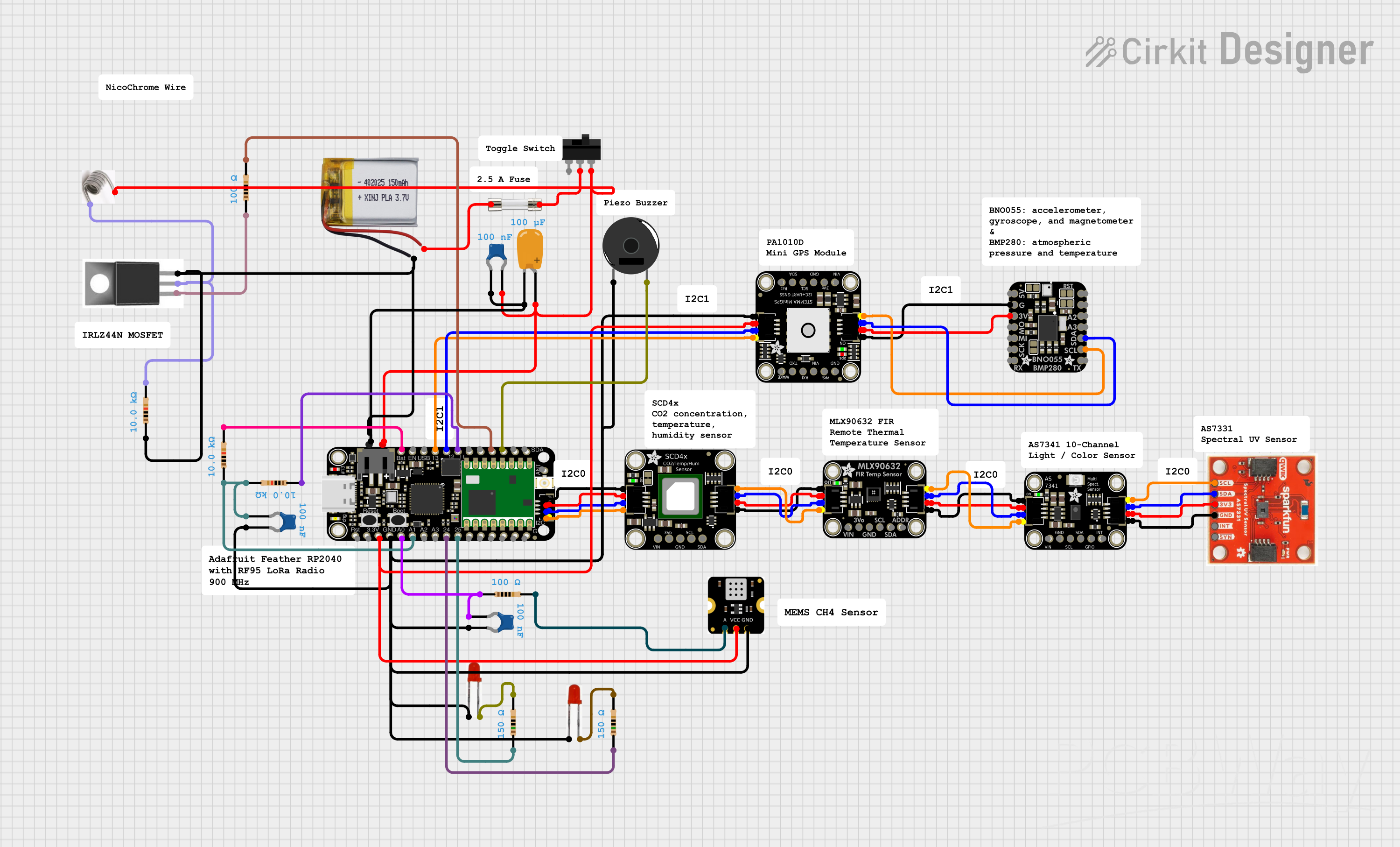
The CanSat electronics are based on the Adafruit Feather RP2040 RF95 microcontroller, integrating LoRa long-range communication, external Flash memory, and LiPo battery management.
The electronic schematic design has been completed, and breadboard-level tests of sensors, communication, and the burning-wire deployment mechanism have already been performed.
To complete system integration and validation, our team requires PCB fabrication support for multiple 2-layer PCB designs. These PCBs are strictly for educational and non-commercial use within the CanSat competition.
Technical Details / What We Are Building
The CanSat electronics are based on the Adafruit Feather RP2040 RF95 microcontroller, which integrates LoRa long-range communication, external Flash memory, and LiPo battery management.
Primary mission sensor:
- BMP280 (pressure and temperature, altitude calculation)
Secondary mission sensors:
- SCD41 (CO₂, temperature, humidity)
- CH₄ sensor (methane)
- AS7331 (UV spectrometer – UVA / UVB / UVC)
- AS7341 (VIS / NIR spectral reflectance)
- MLX90632 (infrared thermal sensor)
- BNO055 (IMU and magnetometer)
- GNSS module (descent dynamics and recovery)
Additional subsystems include a burning-wire mechanism for deployable landing legs and battery voltage monitoring for power management.
The electronic schematic design has been completed, and breadboard-level tests of sensors, communication, and the burning-wire mechanism have been successfully performed.
PCB Sponsorship Request
To complete system integration and validation, our team requires PCB fabrication support for:
- 4–5 different PCB designs
- Approximate size: 60 mm × 60 mm
- 2-layer PCBs (top and bottom copper)
- Multiple iterations (testing → revision → flight version)
- Fabrication only (PCBA optional at a later stage)
These PCBs are essential for reliable integration of multiple sensors and active subsystems. All PCBs are strictly for educational use within the CanSat competition.
Why We Request PCBWay Sponsorship
PCBWay’s strong support for student engineering teams and its experience with aerospace and CanSat-related projects make it an ideal manufacturing partner for our mission.
PCB fabrication sponsorship or PCBWay credit would directly enable our students to move from schematic-level design to fully integrated hardware and proper engineering validation.
Team / Contact Information
Team name: The Launchables
School: Zanneio Model Junior High School of Piraeus
Country: Greece
Mentor: Michael Kaskadamis
Website: http://gym-peir-zanneio.att.sch.gr/
Email: michaelkaskadamis@gmail.com
- Comments(0)
- Likes(3)