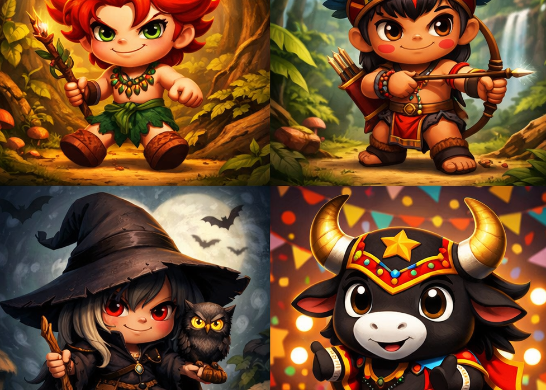
mini folklore
Official Manual - 3D Cultural Line v1
1️⃣ Vision of the project:
A modular, accessible, and scalable Brazilian cultural line that blends:
Folklore
Regional identity
Digital production
3D printing
Physical sales + STL
Replicable system
An original collection of Brazilian cultural characters in a modular chibi style, combining tradition, technology, and accessible digital production.
The project aims to:
To value Brazilian cultural identity.
Create collectible physical and digital characters.
Develop a modular system that allows for rapid variations.
Building a scalable and sustainable line
Transforming culture into a contemporary product.
In the long term:
To consolidate a Brazilian brand of original cultural characters produced using 3D technology.
2️⃣ Technical Standard
📏 Official Dimensions
Total height: 10 cm.
Proportion: 50% head / 50% body.
Stable base integrated into the body.
Reason:
10cm is:
Economical in materials
Quick to print
Easy to sell
Good for collecting.
🧱 Modular Structure
Model divided into:
Standard body base
Interchangeable head
Removable hair/accessories (when possible)
Objective:
To create variations without completely redesigning everything.
That's industrial efficiency applied to culture.
🧵Base Print Parameters (PLA)
Standard starting temperature: 205°C
Standard layer height: 0.16mm
Walls: 3
Infill: 15–20%
Top/Bottom: 4 layers
Reduced external speed
Brim when necessary
Technical reason:
0.16 = good balance between detail and timing
3 walls = sufficient strength
15–20% = lightweight and structural
Slow outer wall construction = better finish
🏗 Official Internal Structure
All models must:
To be hollow internally via infill
Have a standardized minimum wall thickness.
Avoid fragile micro-details
Designed for mass production.
No fragile parts that break during transport.
🧠 Technical Philosophy
First, validate the form.
Then optimize quality.
Then reduce the time.
Then reduce costs.
Only then should you look for a premium finish.
Order matters.
🗂 Versioning
Always record:
Character + Version + Healing Profile used.
Example:
Curupira v1 – Cura v1 Profile
Curupira v2 – Adjustment 205°C + Outer Wall -10%
3️⃣ Official Cure Profile
: This is the standard operational production protocol.
It exists to:
Ensure repeat quality.
Reduce error
Reduce improvisation
Accelerate production
🔹 Cura v1 Profile – Base Production
Material: PLA
Temperature: 205°C
Layer Height: 0.16mm
Walls: 3
Infill: 15–20%
Top/Bottom: 4
External Speed: Reduced
Brim: When necessary
Rule:
If you change something fixed → create a Cura v2 Profile.
Never overwrite a validated profile.
4️⃣ Notion Structure (explaining how it's organized)
Notion is the factory's control panel.
It should contain:
Database: Characters
Properties:
Character's name
Version
Height
Cura Profile (related to the Cura database)
Printing time
Weight
Technical result
Observations
Next action
Database: Cure Profiles
Profile name
Temperature
Layer Height
Walls
Infill
Top/Bottom
Speed
Technical observations
The relationship between the two bases is mandatory.
5️⃣ Drive folder structure
: Drive is the physical storage of the system.
Root Folder:
3D Cultural Line
Within:
📁 Characters
→ Curupira
→ Indigenous person
→ Alaursa
→ etc.
Each character must have:
STL v1
STL v2
Photos
Render
Technical observations
📁 Cura Profiles (backup .curaprofile if you want to export)
📁 Official Manual
Rule:
Never save the final STL file outside of the official Drive.
6️⃣ Official Pipeline
Character Selection
Visual definition
Basic low poly pattern making
Export STL
Apply Official Cure Profile
Test print
Register on Notion
Technical evaluation
Adjustment
Final version validated
Only after that will it go up for sale.
7️⃣ Commercial Strategy
Hybrid Model:
Physical sale:
Collectible cultural product
Affordable price
Production on demand
Digital sales:
Optimized STL
Personal license
Possible future commercial version
Initial objective:
Quick inflow of funds → validate interest → scale the line.
Strategic rule:
Don't stifle production by pursuing extreme perfection.
mini folklore
Project images are for reference only. Actual production is based on the manufacturing files on the project page.
Please review the designer's notes (e.g., PCB thickness) and select the appropriate options.
PCBWay is not responsible
for issues caused by unsuitable parameter selections.
For more important ordering information, please refer to
Read More


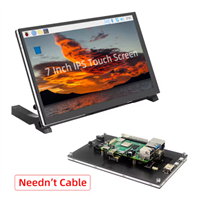
Raspberry Pi 5 7 Inch Touch Screen IPS 1024x600 HD LCD HDMI-compatible Display for RPI 4B 3B+ OPI 5 AIDA64 PC Secondary Screen(Without Speaker)
BUY NOW

- Comments(0)
- Likes(0)
 More by Engineer
-
Programmable Mist Maker - XIAO / QT PY Extension
2218 2 2 -
RadioHAT - Raspberry Pi radio development platform
1907 0 4 -
-
-
-
ARPS-2 – Arduino-Compatible Robot Project Shield for Arduino UNO
4086 0 6 -
A Compact Charging Breakout Board For Waveshare ESP32-C3
4846 3 8 -
AI-driven LoRa & LLM-enabled Kiosk & Food Delivery System
5641 2 2 -