NERVA-ONE Liquid Bipropellant Rocket Engine
NERVA-ONE Liquid Rocket Engine
Project Overview
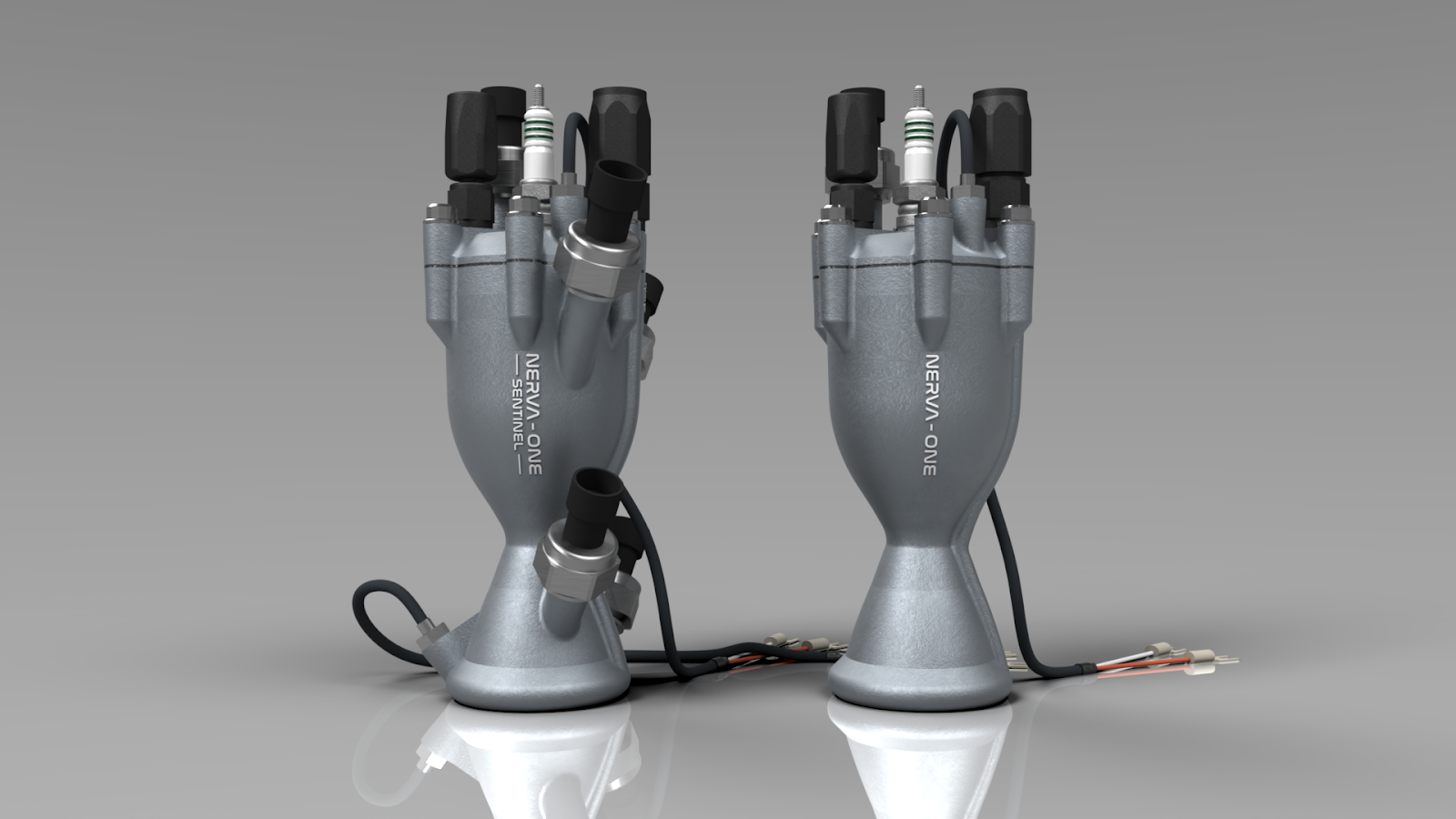
NERVA-ONE is a student led liquid rocket engine project focused on the design and development of a regeneratively cooled bipropellant engine. It represents one of the first fully university student led liquid bipropellant rocket engines in Australia, aiming to demonstrate that advanced propulsion systems can be designed and developed at an undergraduate level. The project incorporates novel design approaches, with additive manufacturing methods such as Selective Laser Melting (SLM) used to enable complex internal geometries. Through this work, NERVA-ONE aims to advance practical propulsion capability at Macquarie University and beyond while demonstrating the level of innovation and progress students are capable of achieving when their passion is supported.
Our Team
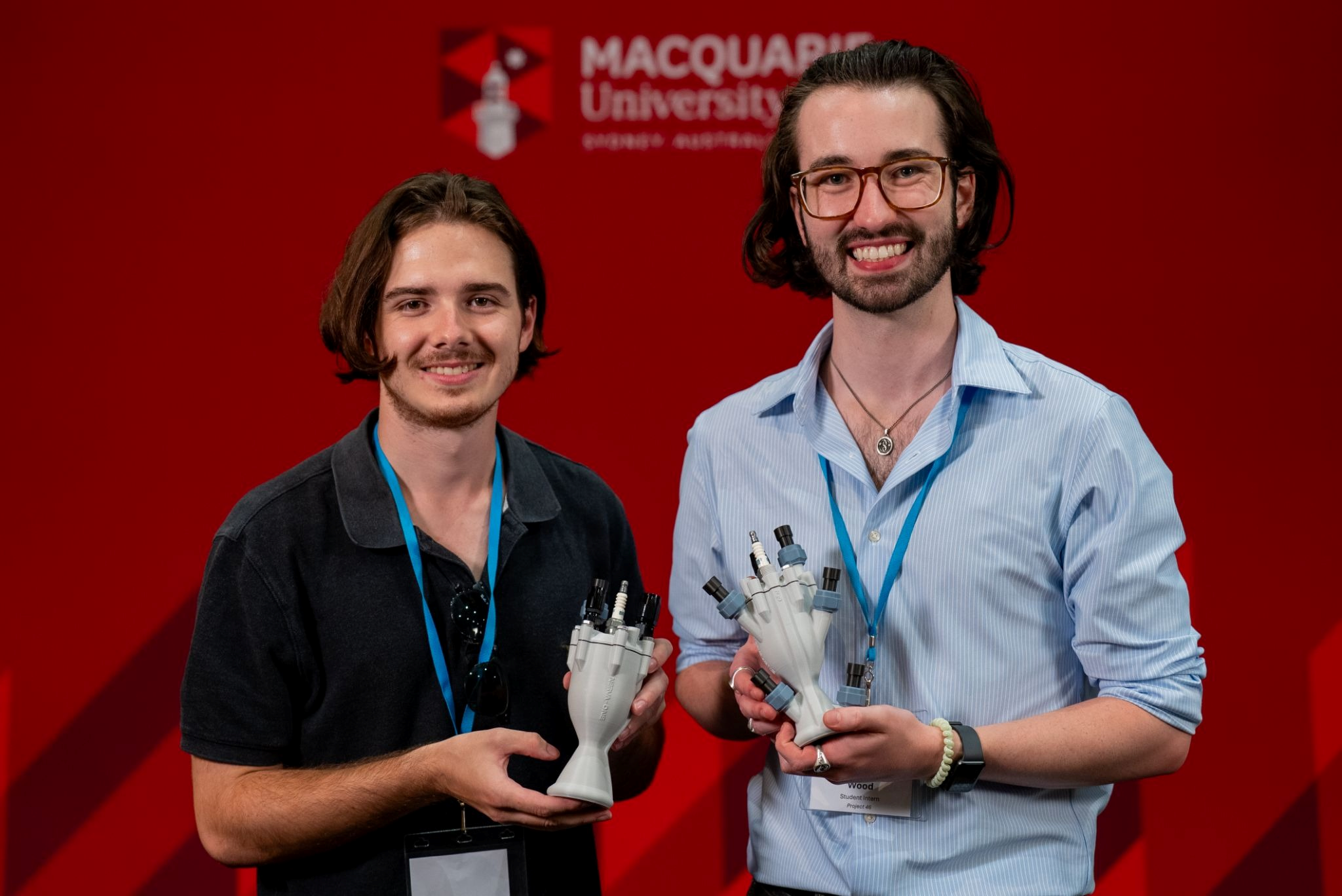
Our team consists of two undergraduate mechanical engineering students, Oliver Nicholson and Jake Mackenzie Wood, working under the guidance and support of our thesis supervisor, Fatemeh Salehi. We bring complementary technical strengths, engineering perspectives, and practical skill sets, including a strong emphasis on project management and structured documentation, allowing us to operate as an effective and balanced team throughout the project. Where one area presents a challenge, the other is often able to contribute experience or capability, enabling steady progress across a highly multidisciplinary program involving design, analysis, manufacturing, testing, and continual problem solving.
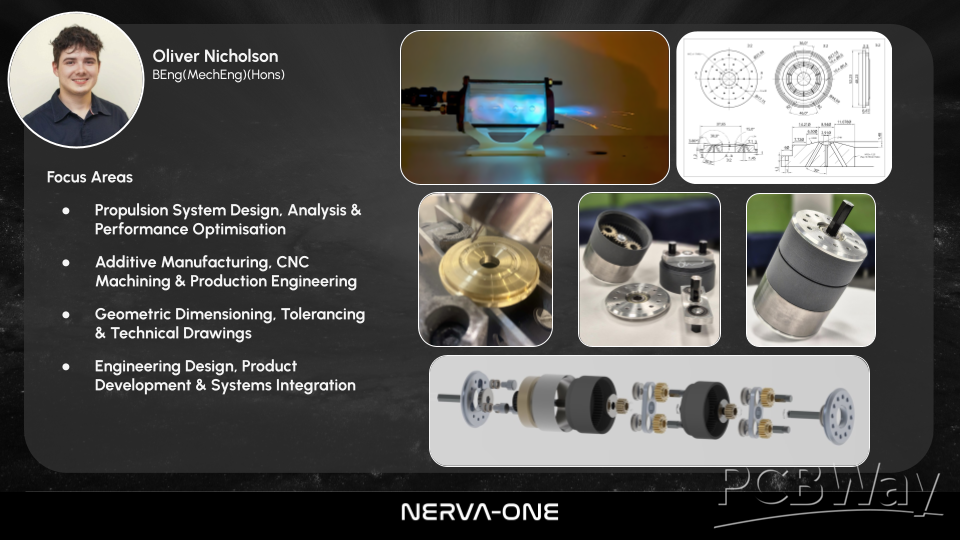
Oliver has a strong interest in propulsion system design, performance optimisation, and practical hardware development, with a particular focus on transforming theoretical engineering concepts into manufacturable, testable, and high performing real world systems. His interests span the full engineering process, from initial analysis and CAD design through to manufacturing, assembly, and experimental validation, with a strong appreciation for solving complex multidisciplinary challenges through practical execution.
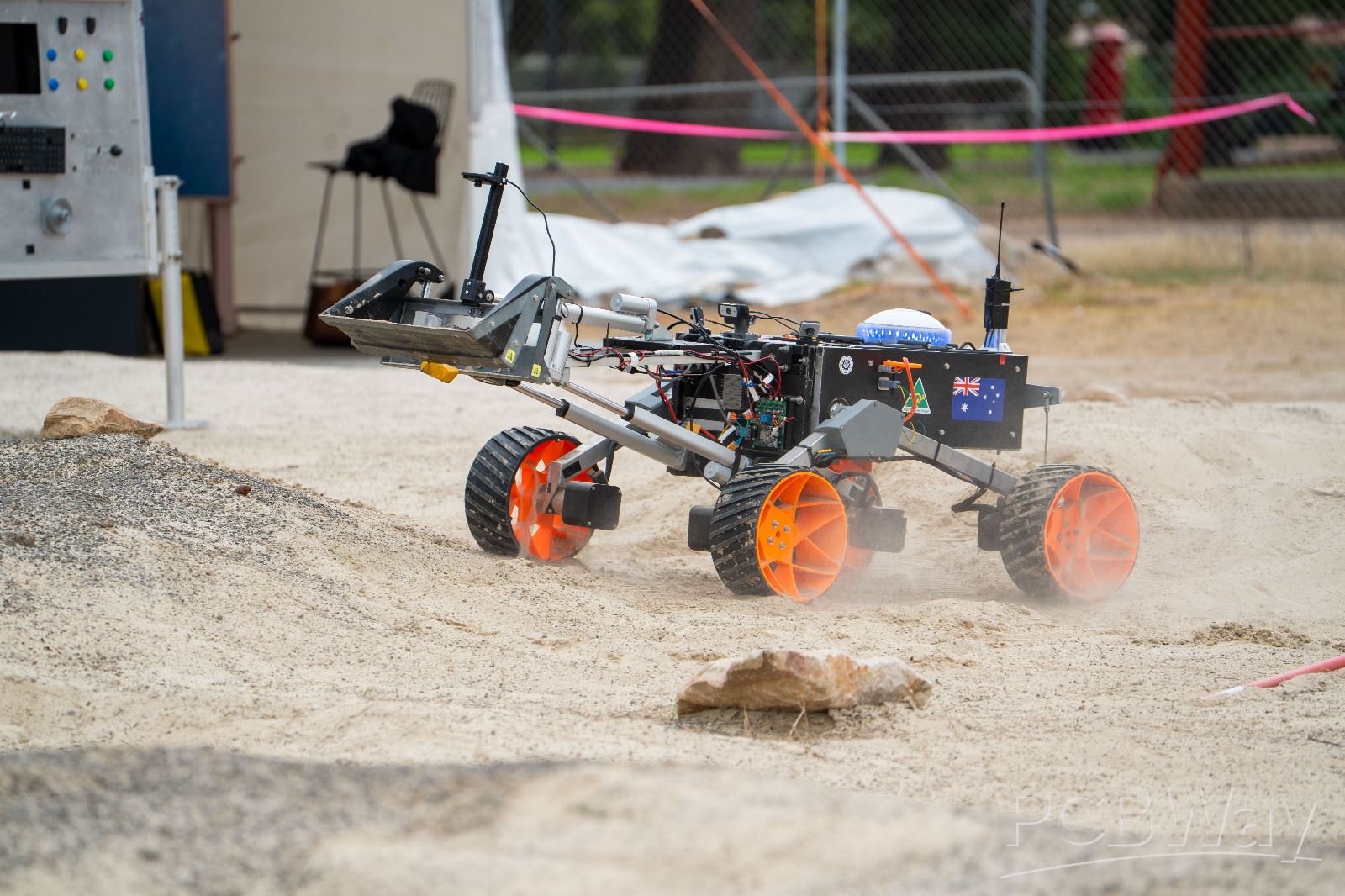
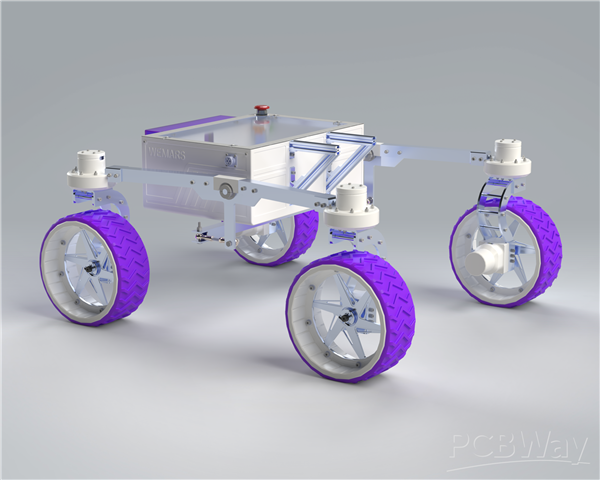
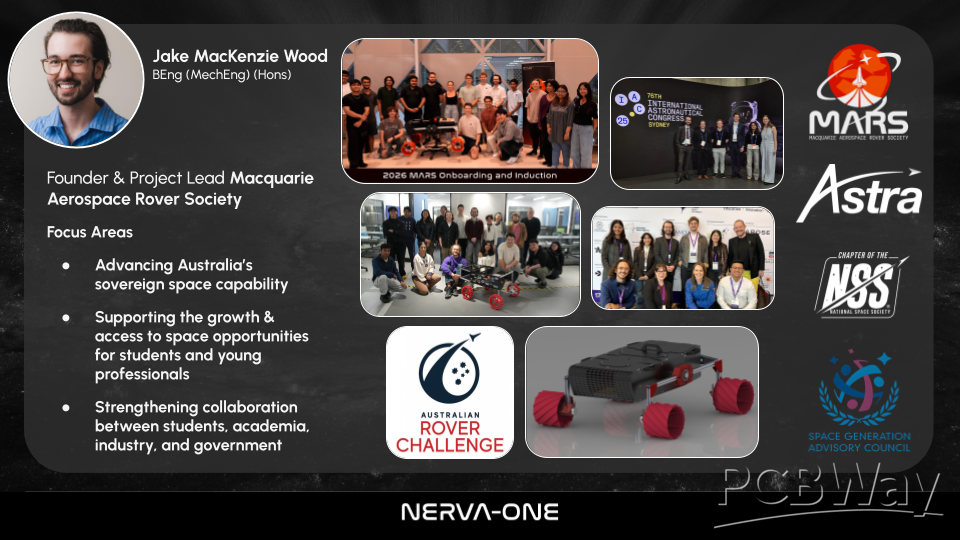
Jake is the Founder and Project Lead of the Macquarie Aerospace Rover Society (MARS). His work centres on developing practical aerospace systems, with a focus on propulsion, mechanical design, and advanced manufacturing, while contributing to the growth of Australia’s sovereign space capability. He is passionate about creating opportunities for students to gain hands on engineering experience and engage with the space industry, leading student led projects that bridge the gap between theory and real world application and foster collaboration between students, academia, and industry.
The project has also been heavily shaped by the support of our academic supervisor, whose guidance has been instrumental throughout the journey. From helping refine the project direction to backing an ambitious concept that many would consider unrealistic for students, her support has been one of the main reasons the project has progressed to this stage. She has consistently encouraged both technical depth and practical execution, allowing us to turn an idea into manufactured hardware.
Our motivation for undertaking NERVA-ONE comes from a shared desire to challenge ourselves with a genuine engineering project of significant technical depth. The broader significance behind the project is to help establish a stronger hands on propulsion pathway for students. Liquid rocket engines are often seen as too complex, too expensive, or too specialised for student development, but this project aims to challenge that. By documenting the process from early calculations through to manufactured parts and testing, NERVA-ONE is intended to act as both a research project and a stepping stone for future propulsion work.
Technical Overview
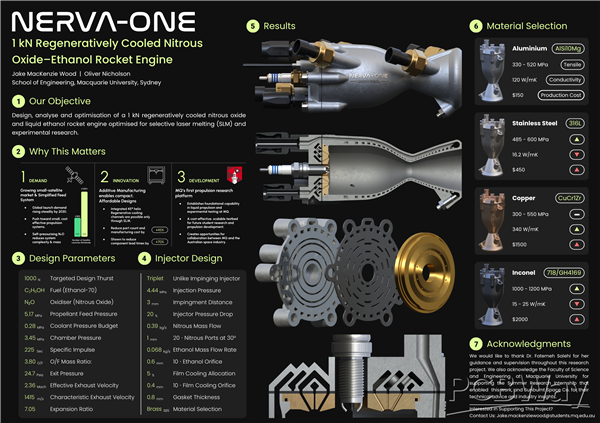
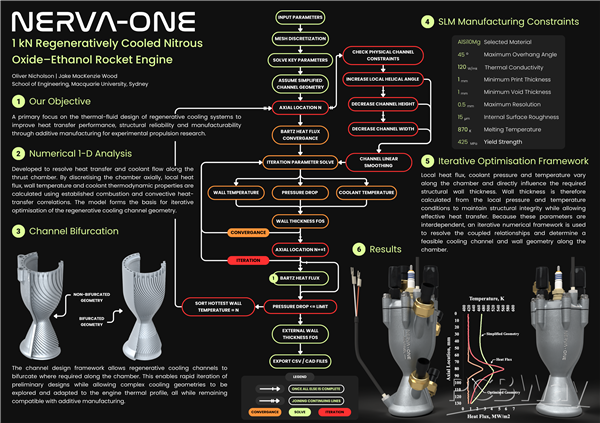
The name NERVA-ONE was given to us by Larry James, former Deputy Director of NASA Jet Propulsion Laboratory. It was inspired by Nerva, one of Rome’s Five Good Emperors, known for wisdom, stability, and laying the groundwork for future prosperity. The goal was to create an engine that could bridge theory and hardware by combining performance analysis, thermal modelling, structural design, additive manufacturing, machining, and practical testing into one system. Rather than relying on simplified assumptions alone, the engine was developed through an iterative process that allowed major design variables such as wall thickness, cooling channel geometry, and chamber shape to be refined together.
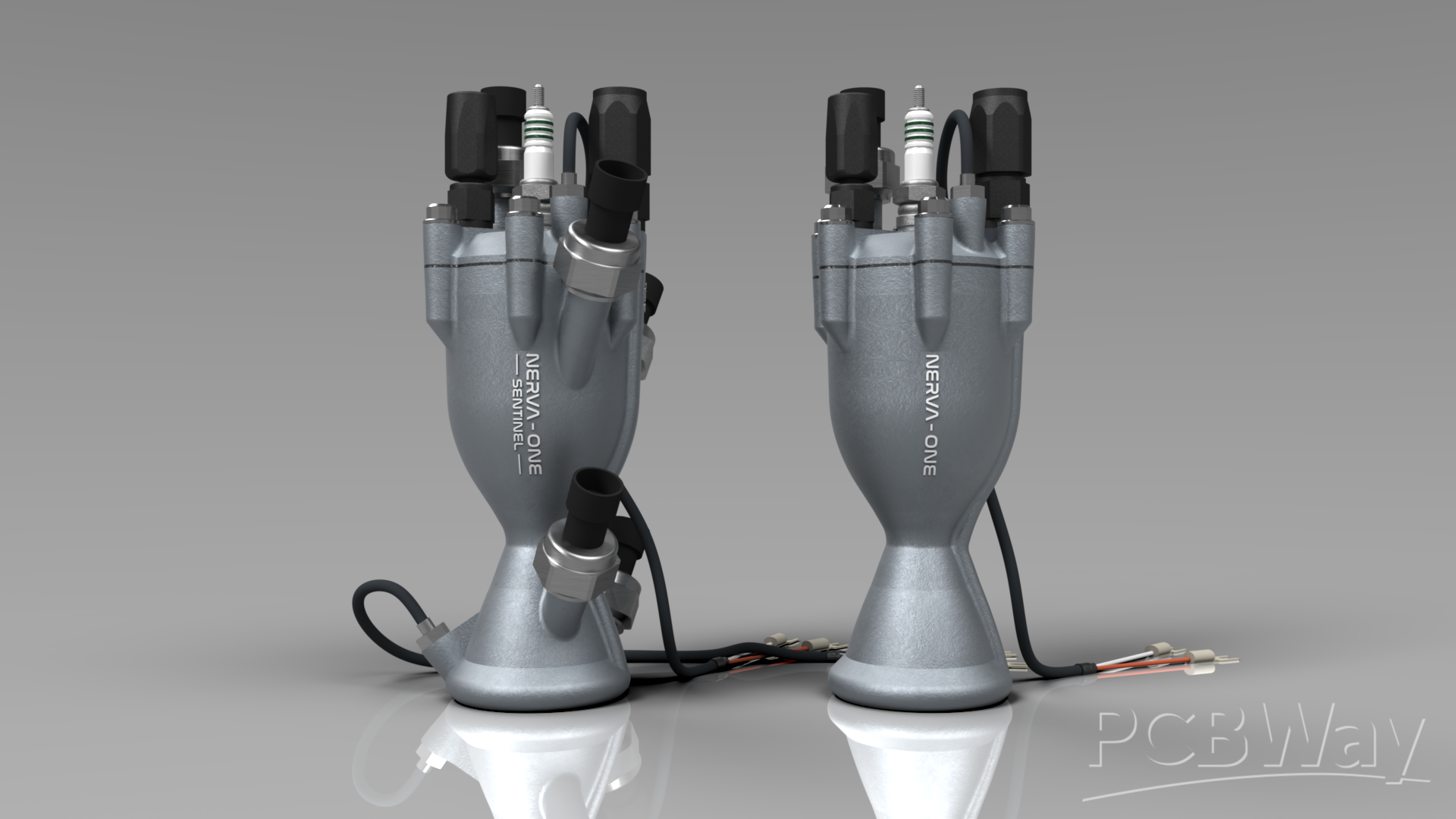
NERVA-ONE; a 1 kilonewton, ethanol-70/nitrous oxide liquid bipropellant rocket engine, designed around a regeneratively cooled thrust chamber to withstand high heat flux at chamber pressures of 3.45 MPa. The chamber and nozzle are additively manufactured from AlSi10Mg, with integrated cooling channels that follow the internal contour of the engine. A defining aspect of the design is the fully coupled optimisation approach, where parameters such as channel height, width, helix angle, and wall thickness are varied along the engine length to balance thermal performance, structural integrity, and pressure drop within a constrained geometry. This allows the engine to move beyond uniform, constant geometry designs, instead producing a highly tailored thrust chamber optimised for both performance and manufacturability.
Future Goals
The next stage of NERVA-ONE is focused on advancing both propulsion performance and practical accessibility. This includes investigating higher performance and greener propellant combinations, including self pressurising fuel systems that could simplify vehicle architecture while improving overall system efficiency. In parallel, a major objective is the expansion of the current internal design code into a user facing parametric optimisation platform, enabling rapid engine generation, cooling analysis, manufacturability studies, and performance trade off assessments without requiring direct interaction with the underlying codebase.
From a hardware perspective, the project aims to transition toward increasingly monolithic additively manufactured engine systems, where multiple components are integrated into single part architectures to reduce assembly complexity. Experimental hot fire testing remains a critical priority to validate injector atomisation, regenerative cooling effectiveness, thrust output, and the broader analytical models developed throughout the project. Beyond a single engine, NERVA-ONE is intended to become a scalable research platform supporting future honours, masters, and multidisciplinary engineering projects, helping establish a long term student propulsion capability at Macquarie University and contributing to Australia’s growing aerospace and sovereign space capabilities.
Partnership Opportunity
A partnership with PCBWay would remove a key production bottleneck and significantly accelerate the development of NERVA-ONE. Several critical components within the engine, particularly the injector and regeneratively cooled chamber, rely on complex internal geometries and tight tolerances that are difficult to achieve without access to high-quality manufacturing and advanced processes such as Selective Laser Melting (SLM).
Support in SLM manufacturing would enable us to realise fully integrated designs, including internal cooling channels and injector features, that are not feasible through conventional methods. This would allow us to move beyond simplified prototypes and into higher fidelity hardware, accelerating iterative testing, validation, and overall system performance. Beyond functional hardware, one of the first things we would love to produce through a partnership with PCBWay would be a high quality display model of the engine as a thank you for the support she has given us. It would be a small gesture of appreciation for someone who has played such a major role in helping bring this project to life.
As one of the first fully university student-led liquid bipropellant rocket engines in Australia, NERVA-ONE offers PCBWay a unique platform to showcase its support for emerging engineering talent and the application of high precision and additive manufacturing in modern propulsion systems. This support would be actively recognised through project documentation, technical content, and physical hardware, providing clear visibility of PCBWay’s contribution throughout the development and testing of the engine.
Beyond sponsorship, we see potential partners as part of the story of proving what young engineers can achieve when given the right support. NERVA-ONE represents curiosity, initiative, and practical innovation, and we hope to inspire more students to pursue advanced engineering projects that once felt out of reach.
- Comments(0)
- Likes(1)