

AI-Powered Robotic Car for Advanced Assistive Care
PROJECT PROPOSAL: SmartCare: AI-Powered Robotic Car for Advanced Assistive Care
Submitted by: O. Jyothish Yadav (14-Year-Old Independent Student Developer)
Sponsorship Request Type: 100% Free Motherboard Fabrication (PCB) & Assembly (PCBA) for specified modules + Hardware Components Sponsorship.
1. Project Overview & Objective
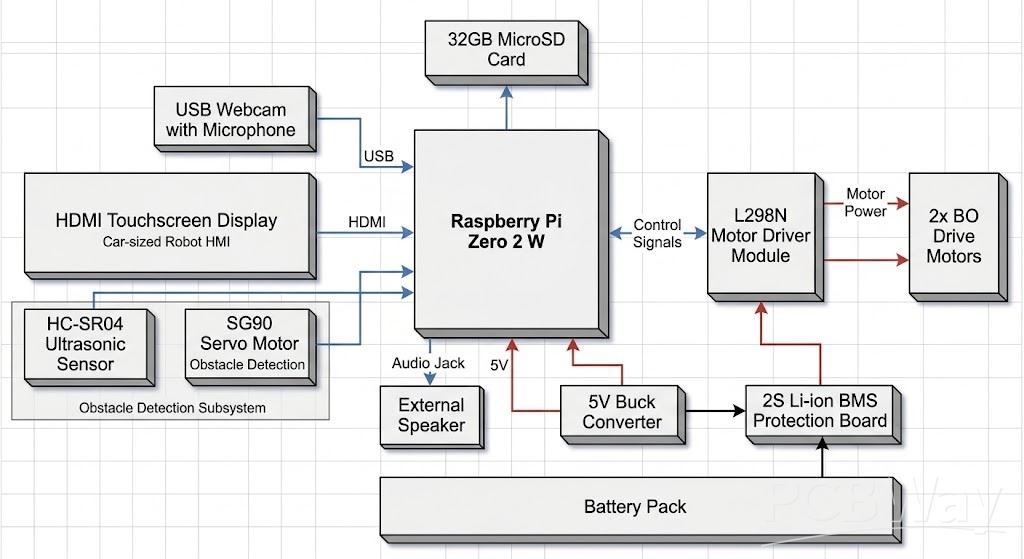
I am building the 'SmartCare' robotic companion car to provide affordable, intelligent support for elderly individuals and people with limited mobility. The system runs via local and cloud Python scripting on a dynamic 4WD chassis. This proposal requests sponsorship support purely for a custom-fabricated motherboard to ensure structural stability during my upcoming competition testing, alongside the necessary electronic components. I will handle all physical mounting and external assembly manually using loose components.
2. Comprehensive Analysis of the 7 Programmed Loops (Main Features)
Secure Face Profile Enrollment: During initial setup, live video frames are captured and processed by a custom Python script to extract and map the primary user's unique facial geometric vectors. These vectors are handled over the network to a cloud infrastructure to keep user profiles synced, securely authenticating the user during daily operations.
Network Status: 100% Online. 2. Continuous Speech Synthesis Framework: This layer manages multi-lingual verbal interaction. The system processes voice input waveforms captured by the microphone, analyzes the intent using cloud natural language APIs, and triggers instantaneous synthesized vocal responses in regional Indian dialects (including Telugu, Hindi, and Tamil) using live cloud-streaming text-to-speech engines.
Network Status: 100% Online.
Cross-Generational Household Support: The robot runs background logic loops that actively monitor environmental audio frequencies. The script screens for audio-visual anomalies, sending real-time audio streams to a cloud classification network to catch specific acoustic patterns for sudden crying, heavy gasping, or repetitive sighing sounds.
Network Status: 100% Online.
Rigid Pre-Food Compliance Alerts: Before a meal session is logged as cleared, cloud-connected computer vision object-classification models audit the user's meal tray. The Python script uploads the visual frame data to detect and confirm the mandatory presence of medical prescription tablets or pill strips next to the food tray, cross-referencing them against the scheduled medical database online.
Network Status: 100% Online.
Vision-Based Fall & Immobility Detection: Continuous frame inputs are fed into a high-fidelity skeletal coordinate cloud model that maps the user's posture in real-time. If the cloud infrastructure flags a sudden downward vertical drop in the user's center of gravity followed by zero movement, it instantly pushes a critical trigger command down to the robot.
Network Status: 100% Online.
Dynamic Screens & Emotional Responsiveness: Conversational data is sent to an online cloud sentiment analysis network. The digital facial expressions displayed on the screen shift instantly via local Python Tkinter loops (empathy, happiness, alertness, or focused listening) to precisely match the emotional token returned by the cloud API.
Network Status: 100% Online.
Locomotion & Indoor Radar Navigation (Fallback Emergency Safety Mode): During normal operation, navigation data maps sync over the active network connection to route the 4WD chassis smoothly.
🚨 CRITICAL WI-FI DISCONNECT EMERGENCY LOGIC 🚨: Because all primary tracking features rely completely on cloud networks, a background routine constantly checks the internet status. If the Wi-Fi connection drops suddenly, the robot instantly suspends all cloud features and enters a local emergency safemode. It polls the ultrasonic distance sensor and micro servo motor locally to scan the path directly ahead, forcing an immediate, total emergency safety stop if an obstacle is found, keeping the car safely frozen in place until the internet reconnects.
Network Status: 100% Online (With a local hardware fallback loop for emergency stops during disconnects).
3. Custom Motherboard PCBA Design & Assembly Specifications (Exact Hardware Routing)
I am requesting a Custom Motherboard Fabrication and Assembly (PCBA) package based on the following precise engineering specifications:
Pre-Soldered Core Modules (PCBA Request): I request precision pre-assembly and soldering directly onto the PCB surface for the core modules: the Raspberry Pi Zero 2W Single-Board Computer, the embedded 5V DC-to-DC Buck Converter circuit, the L298N Dual H-Bridge motor driver layout, and the PAM8403 Audio Amplifier Board. I will manually wire the motor driver terminals to my 4WD chassis motors at home later.
Power Supply, Inter-Charging Loop & Core Safety Paths:
The board power input begins at an onboard DC Female Barrel Jack designed to receive power directly from the battery pack's DC Male port.
To enable easy charging, a dedicated 2-Pin Battery Charging Interface Port must be placed on the motherboard. This port connects directly to an External Charging Module via a matching 2-Pin Male cable.
The copper power tracks on the board must connect the main DC Input Jack, the Charging Port, the input of the 5V Buck Converter, and the VCC/GND high-power terminals of the L298N Motor Driver Module in parallel. This ensures the raw battery voltage goes directly to the L298N (since the reduced 5V output of the buck converter is not enough to drive high-torque 4WD chassis motors) while keeping the charging path unified.
Buck Converter Output Power Distribution (Zero-GPIO Routing): The 5V Buck Converter outputs its reduced, stable 5V line in parallel to feed the system logic. It connects directly to the power pins of the PAM8403 Audio Amplifier Board and routes directly to the Raspberry Pi Zero 2W's Micro-USB Power Input Port. Absolutely zero GPIO pins must be used for system power delivery.
Zero-GPIO Pure Hardware Expansion Ports:
USB Hub, LAN, and Audio: The 5x extra standard USB Type-A ports, the Internet LAN (RJ45) port, and the analog audio output jack must connect entirely through hardware data lines directly to an integrated Micro-USB Male Data Cable on the PCB. This cable will plug directly into the Raspberry Pi Zero 2W's Micro-USB Data Port. Absolutely zero GPIO pins must be used for these communication lines.
Full-Size HDMI Port: The video tracking lines from the Raspberry Pi Zero 2W's Mini-HDMI port must run via copper traces straight to a standard Full-Sized HDMI Female Port fixed on the side of the PCB. This allows me to easily plug the robot into any standard TV or computer monitor at home using regular, standard HDMI cables.
GPIO Control Pins & Male Header Breakout Section: The Raspberry Pi's GPIO pins must only be used for control signals. The L298N Motor Driver layout and the PAM8403 Audio Amplifier module must be wired directly to their required Raspberry Pi GPIO control lines on the board. All remaining active GPIO pins from the Pi must be extended to a side row on the PCB as Male Pins only, with the exact pin names clearly printed in white silkscreen text next to them so I can easily connect my loose external servo motor and ultrasonic sensor using jumper wires.
Onboard 2-Pin Locking Speaker Port: The audio output lines from the pre-soldered PAM8403 amplifier must route directly to an onboard 2-Pin JST/XH locking female port. My external speaker must be supplied with a matching 2-Pin Male cable so it can simply snap firmly into this port, ensuring a reliable audio connection that will not slide out during movement.
4. Master Bill of Materials (Complete Component Request Check-List)
I respectfully request PCBWay to include every item listed below as part of the hardware sponsorship package. Please supply these components and accessories completely loose and separate from the custom motherboard, as I will be doing all manual external positioning, sensor mounting, and chassis assembly myself:
1x Single-Board Computer / Edge Processor (Raspberry Pi Zero 2W - pre-soldered).
1x 4-Wheel Drive (4WD) Robot Car Chassis Kit (Must include 4x High-Torque DC Motors, 4x Matching Wheels, and structural chassis layers).
1x 4-Cell Lithium Battery Pack with Integrated BMS (completely sealed factory brick with matched DC male barrel jack connector).
1x Lithium Battery Capacity Screen Voltmeter.
1x External Battery Charging Module (with a matching 2-Pin Male cable to lock into the PCB charging port).
1x Standard USB/CSI Webcam with Integrated Microphone.
1x External Speaker Module (fitted with a matching male 2-pin JST wire harness to slide into the PCB speaker port).
1x Ultrasonic Distance Sensor (Shipped completely loose for external manual wiring).
1x Micro Servo Motor (Shipped completely loose for external manual wiring).
1x Full Set of Jumper Wires (Female-to-Female & Female-to-Male, high-quality required).
1x HDMI Touchscreen Display (Shipped completely loose).
1x 32GB Class 10 MicroSD Card (Shipped completely blank and empty, no software pre-loaded).
1x Mini Wireless Keyboard with Touchpad and 2.4GHz USB dongle (Requested diagnostic debugging accessory).
5. Sincere Student Appeal & Conclusion
I am submitting this corrected proposal as an independent 14-year-old student developer, and I deeply appreciate your time and review. By keeping everything focused strictly on the custom motherboard fabrication, pre-soldered core modules, and raw electronic hardware parts, I hope your technical board can approve this straightforward sponsorship. This support will give my project the industrial grade of durability required to compete successfully on a global stage.
Thank you for your generous dedication to empowering young innovators worldwide
Apply for sponsorship >>- Comments(0)
- Likes(1)