





|
Altium DesignerAltium Designer
|
SensWear: An Open-Source, Modular, AI-Ready Wearable Platform
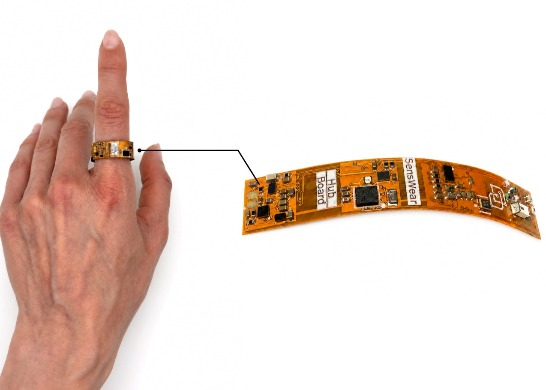
SensWear is an open-source, modular wearable development platform that gives researchers, engineers, and makers control over their hardware, firmware, and raw sensor data. It combines a flexible main board with interchangeable sensing and interaction modules, helping developers build and experiment with wearables in different shapes and for different applications. Explore SensWear.
We created SensWear to reduce the engineering work between a wearable idea and a working experiment. Developing a new device often involves designing processing, wireless communication, battery management, sensing, and software together. Changing the sensor or where the device is worn can then require substantial rework. Our approach separates these responsibilities: reuse the core electronics, select the sensing or interaction module, and adapt the enclosure to the application.
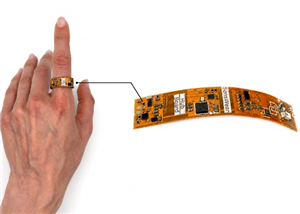
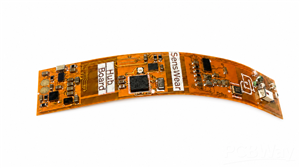
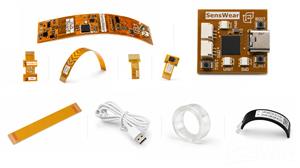
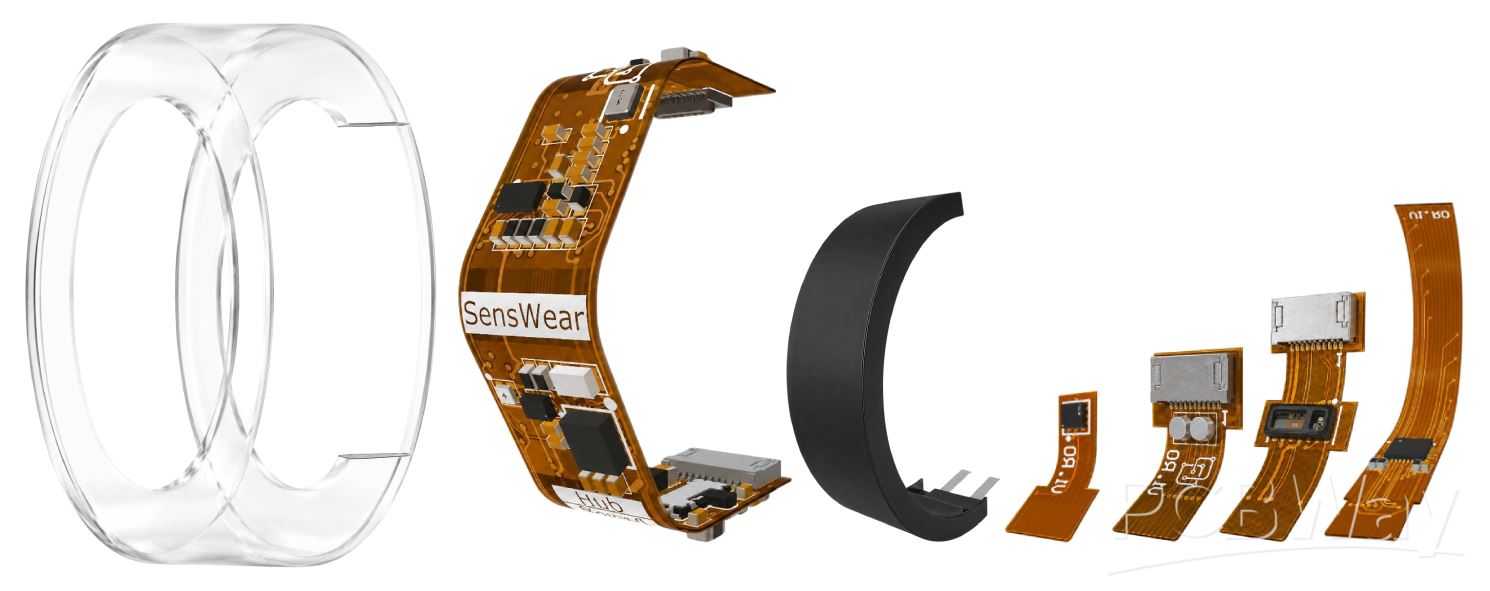
The main board provides the foundation. A Nordic Semiconductor nRF54L15 handles embedded processing and Bluetooth Low Energy connectivity, while a Bosch BHI360 smart six-axis IMU captures motion and supports sensor fusion. The board also integrates battery charging, fuel gauging, power regulation, and programmable LED feedback. Its I²C expansion interface supplies power and communication to compatible daughter boards, allowing new sensing functions to be developed around the same core. Main board details.
The current sensor and actuator designs include:
- Optical sensing: A MAX30101 PPG board with red, infrared, and green channels for collecting raw optical waveforms.
- Temperature sensing: A MAX30208 board for skin-surface and ambient temperature measurements.
- Touch interaction: An MTCH6102 capacitive touch board for touch-position and gesture experiments.
- Haptic feedback: A dedicated board for programmable vibration and tactile feedback.
Together with the onboard motion sensor and LEDs, these modules support experiments that connect sensing, interpretation, and user feedback. Developers can also design custom daughter boards for additional sensors or actuators. Sensor and actuator specifications.
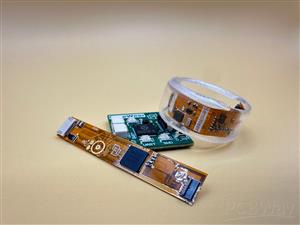
Physical flexibility is central to the design. The flexible PCB architecture supports integration into smart rings, wristbands, headbands, chest bands, patches, and custom enclosures. This lets developers investigate different sensor placements and wearable shapes while retaining a familiar electronics and software foundation. The Crowd Supply kit also includes a smart-ring enclosure as a starting point. Wearable configurations.
SensWear’s firmware is built on Zephyr, with drivers and configuration options for the onboard hardware and selected daughter-board setup. Bluetooth services expose sensor data and device controls to connected applications. Developers can inspect and modify how measurements are acquired, communicated, and used in their own experiments. Firmware and build documentation.
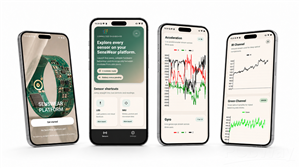
The companion applications provide tools for connecting to the device, configuring supported features, visualizing measurements, and collecting data. Python, TypeScript/React Native, and Web Bluetooth SDKs support integration into research tools, mobile applications, and browser interfaces. This gives users a practical path from their first sensor stream to a custom application. Software and SDKs.
For AI development, access to raw signals is particularly valuable. Researchers can examine measurements, develop preprocessing methods, construct datasets, and evaluate algorithms for tasks such as activity recognition, gesture interaction, and physiological sensing. The configurable firmware and embedded hardware provide a foundation for exploring lightweight processing and edge AI approaches suited to the device’s resources.
Openness extends to the design files. The public hardware repository includes Altium Designer projects, schematics, PCB layouts, component libraries, and manufacturing outputs. SensWear’s hardware, firmware, and software are released under the MIT license, allowing others to study, modify, and build upon the platform. SensWear is also OSHWA-certified under FI000005. Hardware files · Open-source hardware certification.
Our goal is to make wearable development more accessible and reusable. A student can learn embedded sensing, a researcher can investigate a new interaction technique, and a product team can prototype a custom wearable using the same platform. We welcome contributions ranging from new daughter boards and firmware drivers to enclosures, applications, and reproducible experiments.
SensWear: An Open-Source, Modular, AI-Ready Wearable Platform
Project images are for reference only. Actual production is based on the manufacturing files on the project page.
Please review the designer's notes (e.g., PCB thickness) and select the appropriate options.
PCBWay is not responsible
for issues caused by unsuitable parameter selections.
For more important ordering information, please refer to
Read More


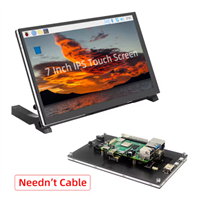
Raspberry Pi 5 7 Inch Touch Screen IPS 1024x600 HD LCD HDMI-compatible Display for RPI 4B 3B+ OPI 5 AIDA64 PC Secondary Screen(Without Speaker)
BUY NOW

- Comments(0)
- Likes(0)
- 1 USER VOTES
- YOUR VOTE 0.00 0.00
-
10design
-
10usability
-
10creativity
-
10content
More by Yusein Ali
-
Programmable Mist Maker - XIAO / QT PY Extension
2412 2 2 -
RadioHAT - Raspberry Pi radio development platform
2084 0 4 -
-
-
-
ARPS-2 – Arduino-Compatible Robot Project Shield for Arduino UNO
4228 0 6 -
A Compact Charging Breakout Board For Waveshare ESP32-C3
5011 3 8 -
AI-driven LoRa & LLM-enabled Kiosk & Food Delivery System
5778 2 2 -