Solving Wearable PCB Size Limits with Wafer-Level, Chip-Scale Integration
Wireless wearable applications require a degree of IC, package, and board size reductions that only wafer-level chip-scale integration can solve.
Step 1: Solving Wearable PCB Size Limits with Wafer-Level, Chip-Scale Integration
riven by the market, consumer electronics products become progressively more powerful, compact, and power efficient. Wearables in particular demand that a portable, battery-powered, integrated device provide everything from high-precision analog measurement to intuitive human interfaces. Wearable device developers must carefully partition the product's feature requirements among a cluster of integrated circuits (ICs), juggling sometimes conflicting priorities.
Let’s consider the requirements for a wearable design that pushes the boundaries of what is possible in terms of size, battery life, and functionality. Our example device falls into the “does one thing well” category — a screenless, coin cell-powered step counter that alerts users when they need to move around while also keeping track of the number of steps throughout the day. A simple capacitive touch interface enables user input, and a tri-colored LED provides just enough output to provide the user with useful and necessary information. This product's design shows how powerful ICs squeezed into small packages help to facilitate innovation and product differentiation.
Product requirements
Our product is a step counter designed to be as simple and small as possible, offering no screens, buzzers, or iPhone apps, with a similarly simple and small user interface. Basic design requirements include:
Smallest achievable size. The product with case should be as close in size as possible to a CR2032 battery so that a user can carry the device in a pocket or attach it to a keychain.
User input. On one side of the coin cell-shaped case, provide a capacitive touch interface that recognizes the following inputs:
- Swipe: Disable the alarm indicating that the user needs to stand
- Tap and hold: Start a new day (reset the step counter)
- Tap: Check the step count for the day
Simple output. An LED on the case provides the following output:
- Red: A periodic, short flash signals that the user has been stationary for too long
- Green double-flash: Occurs when a user starts a new day by tapping and holding the device
- 1 second red/orange/green output: Indicates 33 percent, 66 percent and 100 percent of steps counted for the day, persisting for a few seconds after a tap on the touch surface
The size of a CR2032 battery is 20 mm x 3 mm. How small can we make the device? Let’s assume that the product’s plastic case can be made thin enough so that it adds no more than about 5 mm in diameter while still supporting easy battery replacement. That leaves the depth.
In the product’s stack up, its depth is composed of four components: the battery, the printed circuit board (PCB), any components on the PCB, and the product's plastic case. PCB thickness could be as small as 0.5 mm for a four-layer PCB. Minimizing the depth of the components to be soldered to this PCB requires careful part selection. This is where finding high-performance chip-scale package devices becomes crucial to our design.
Wafer-level chip-scale package benefits
The wafer-level chip-scale package (WLCSP) is the culmination of years of incremental advances in manufacturing and chip assembly technology. In WLCSP packaging, the silicon is directly connected to solder balls on one side of the package, as opposed to older technologies that route silicon port pads to package pins through bond wires. This newer design enables the design of packages with a width and height that is nearly as small as the interior silicon itself.

Incorporating an 8–bit EFM8SB1 into a wafer-level chip-scale package (WLCSP) leaves room for other functions necessary in space constrained modules used in wearable applications.
For our step counter an eight-bit MCU is the best choice because while functionally extremely dense, it already fits into small packages such as a 3 mm x 3 mm QFN package or a WLCSP package measuring only 1.78 mm x 1.66 mm in size,
Next up is pedometer selection. To take full advantage of the thin profile of the WLCSP-packaged MCU, all integrated circuits on a board need to be WLCSP package devices as well. For this reason, our on-board accelerometer would ideally also be offered in a WLCSP package. The newly released Bosch BMA355 gives the design a highly integrated sensor that does much of the 3-axis event detection on chip, communicating qualified events through an SPI interface that can be interfaced by using the right eight-bit MCU.
Because both ICs, along with the few necessary discrete passive devices, can be low profile, the product’s plastic case can be made thin and close to the capacitive sensing surface, which optimizes touch sensitivity. The product case could even be tapered slightly in the area near the capacitive sensing pads to close the small air gap created between the board PCB and the board components.
Doing wearable board layout with WLCSP
Using WLCSP package devices maximizes the amount of board space that can be allocated to our PCB implemented capacitive sensing interface. Both the MCU and the accelerometer can be clumped along the edge of one side of the roughly circular PCB, along with an LED that can be exposed through a hole in the device’s packaging.

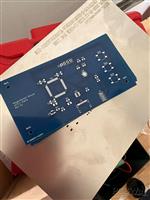
Wearables board layout with capacitive sensors and WLCSP MCUs.
To detect a finger swipe, the board must have two capacitive sensors, ideally of equal size, interdigitated slightly along their common edge. These two sensors should take up the bulk of the surface area on the MCU side of the board, although they should be surrounded by a third thin sensor that also surrounds the other two sensors. This third sensor provides crucial information during human interaction that our MCU will use during touch and slider qualification.
Touch qualification. The portability of wearables means that these devices usually will be found on the body or in-hand. For a device that measures proximity of conductive material such as hands and skin, the near-constant human contact could lead to touch qualification issues. Fortunately, features of the MCU and accelerometer chosen for this design help the developer overcome these challenges.
While the system has three capacitive sensors, it actually has four touch inputs. The accelerometer provides an interrupt-driven tap detector that can provide the interface with one more means by which firmware can qualify touch events. By taking advantage of the accelerometer’s tap detector, touch qualification by the MCU goes through the following stages:
- Detect positive delta on perimeter sensor along edges of device, enforcing an input use case where the user holds the device along the edges of it, or cups the device in the palm of one hand, followed shortly by:
- A tap detection event signaled by accelerometer, coinciding with
- A positive delta of sufficient magnitude detected on one or both of the center capacitive sensors.
Low power functionality. The accelerometer and the MCU both can be configured to operate in low power modes of operation. A capacitive sensing firmware library enables the MCU to enter a ~300 nA sleep mode, waking periodically to check for activity on the capacitive sensors. The MCU will also use a port match wake event to asynchronously wake if the accelerometer signals that an event has been detected and data is ready for retrieval.
What comes next?
This example shows a product at the “do one thing well” end of the spectrum of wearable devices. The functional density, precision, and energy efficiency with which WLCSP-sized integrated circuits operate in this example also illustrates how useful and empowering such IC devices can be. For instance, the product described could be viewed as a subsystem of a larger product in which the chip-scale MCU operates as a low-power sensor hub managing both a touch interface and an accelerometer. As silicon vendors manage to pack more features into smaller packages, system developers can take advantage of these innovations and use them to enable creative product design.

Sep 21,2015
1,290 viewsReport item
- Comments(0)
- Likes(0)
Upload photo
You can only upload 5 files in total. Each file cannot exceed 2MB. Supports JPG, JPEG, GIF, PNG, BMP
0 / 10000